





July 2026 SQE2 results are scheduled for release after 11am UK time on 17 November. If you took that sitting, use its existing results guidance—even though the results arrive after September’s changes. A possible January resit is a separate, later sitting with its own applicable specification.
The official notice published on 11 November also sets a short January seat-reservation timetable. This guide was checked on 16 November, before results release. No July pass rate or candidate outcome is available here. The aim is to separate cohort rules, administration and preparation readiness.
July 2026 SQE2 results: keep three dates separate
Write down the sitting you took, the date its results arrive and the sitting you might take next. Those dates answer different questions. The assessment date identifies the applicable marking framework. Results day tells you when to check the official account. A future sitting has its own booking and preparation requirements.
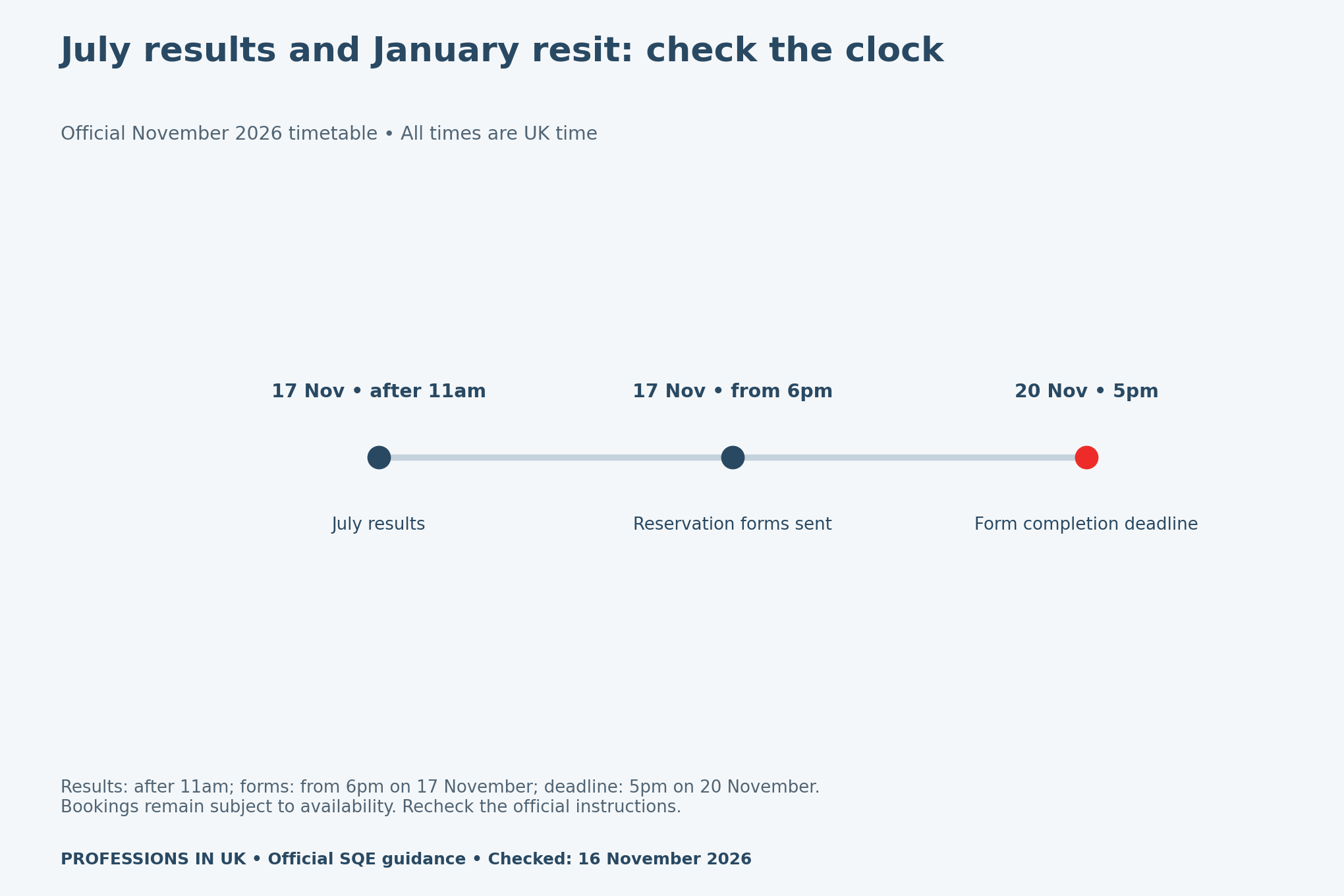
| Event | Official timing | What to verify |
|---|---|---|
| Results release | 17 November, after 11am UK time | Use the official notification and candidate account |
| Reservation forms | 17 November, from 6pm UK time | Check the registered email and current instructions |
| Form deadline | 20 November, 5pm UK time | Complete the required steps; availability still applies |
For the current process, follow the dedicated July-results-to-January-resit instructions. They cover pre-booking steps, reservation and later payment. The notice warns that failing to complete pre-booking steps by 6pm on results day risks delay. Keep your actual candidate information private; do not enter it into our planning files.
The July cohort does not receive the new breakdown
The SRA’s 22 October reminder explicitly says July candidates retain the existing results format and guidance. The separate ethics criterion applies to sittings after 1 September 2026. Receiving results in November does not move July into that later cohort.
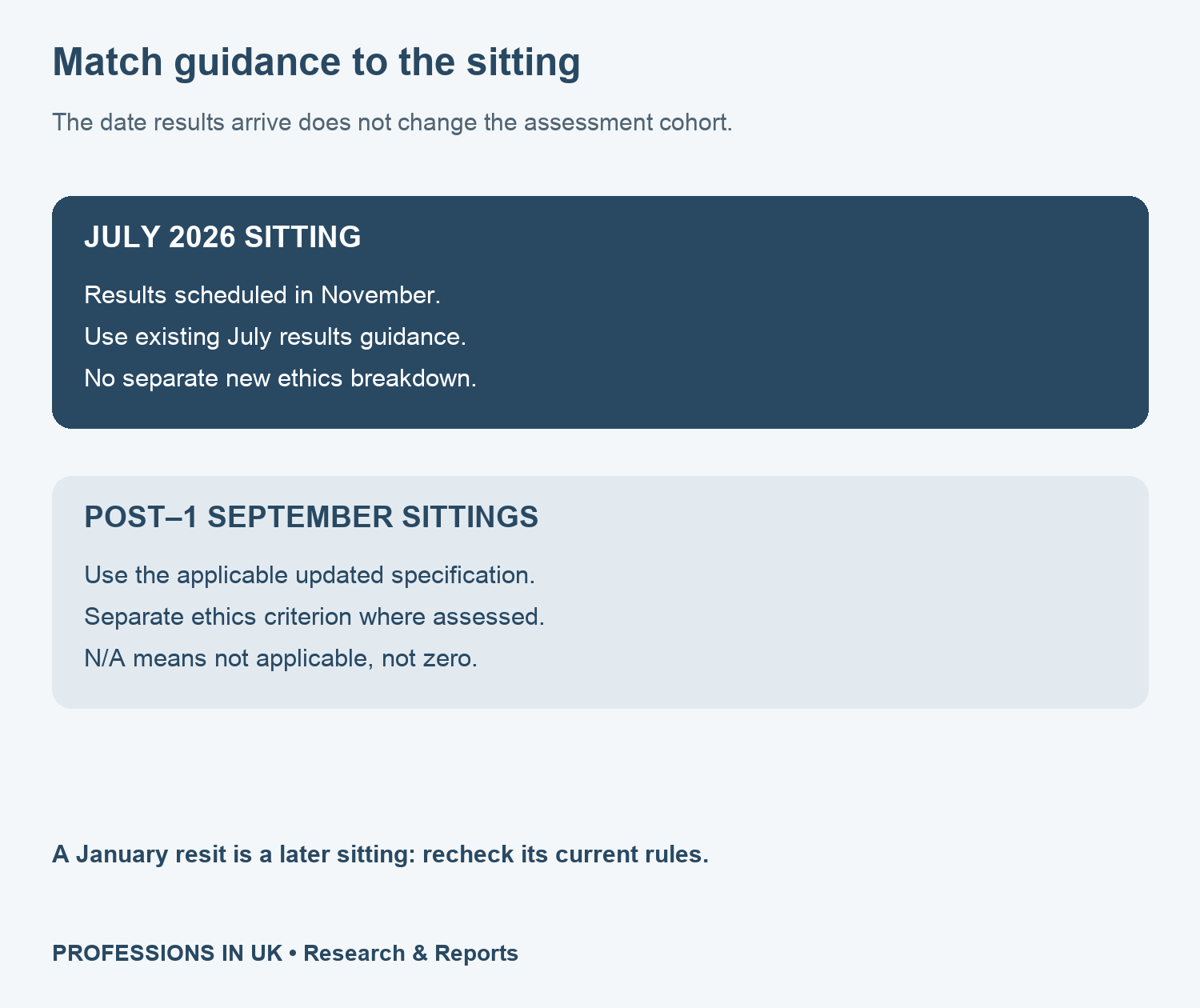
This distinction does not mean ethics was absent from July’s assessment. The change concerns the separate criterion and feedback presentation. Avoid treating a missing new line in July results as missing assessment, or comparing two different displays as if their labels had always been identical.
Why equal Skills and Law groups matter
The official post-September explanation keeps Skills and Law equally weighted for a station. Criteria share the weight inside their own group. Where ethics is specifically assessed, the Law group has three criteria; otherwise it has two. “N/A” indicates that the separate ethics point is not applicable, not a zero mark.
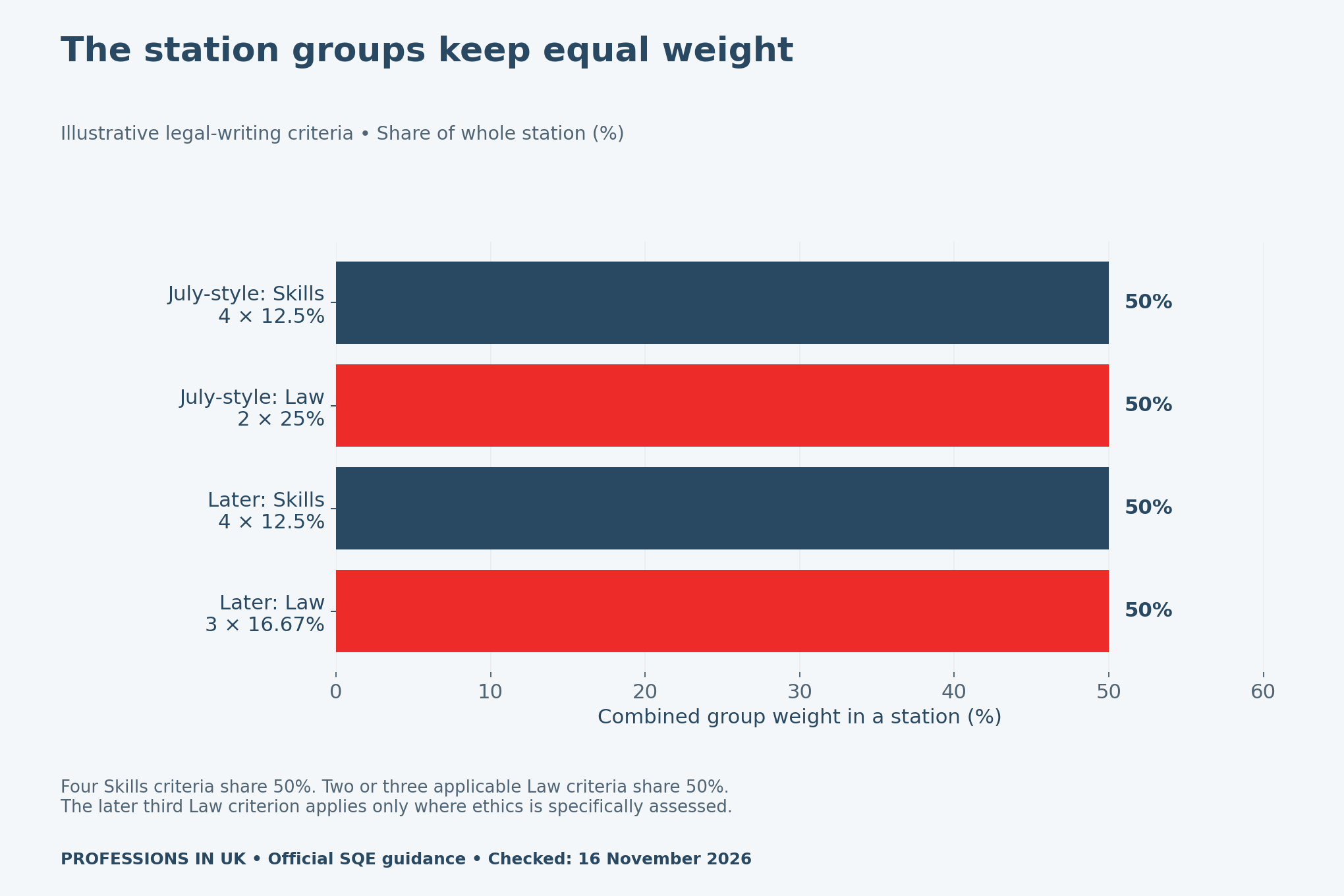
Imagine putting four items in one basket and three in another. Counting all seven items equally would give the first basket more influence. The assessment method instead gives the two groups equal influence. The scores must therefore be combined through their groups, using the guidance for the relevant sitting and station.
A fictional score example, not a result reconstruction
Take a wholly fictional later station with four Skills marks of 4 out of 5 and three Law marks of 2 out of 5. Skills reaches 16 out of 20, or 80%. Law reaches 6 out of 15, or 40%. Giving the groups equal weight produces (80 + 40) ÷ 2 = 60%.
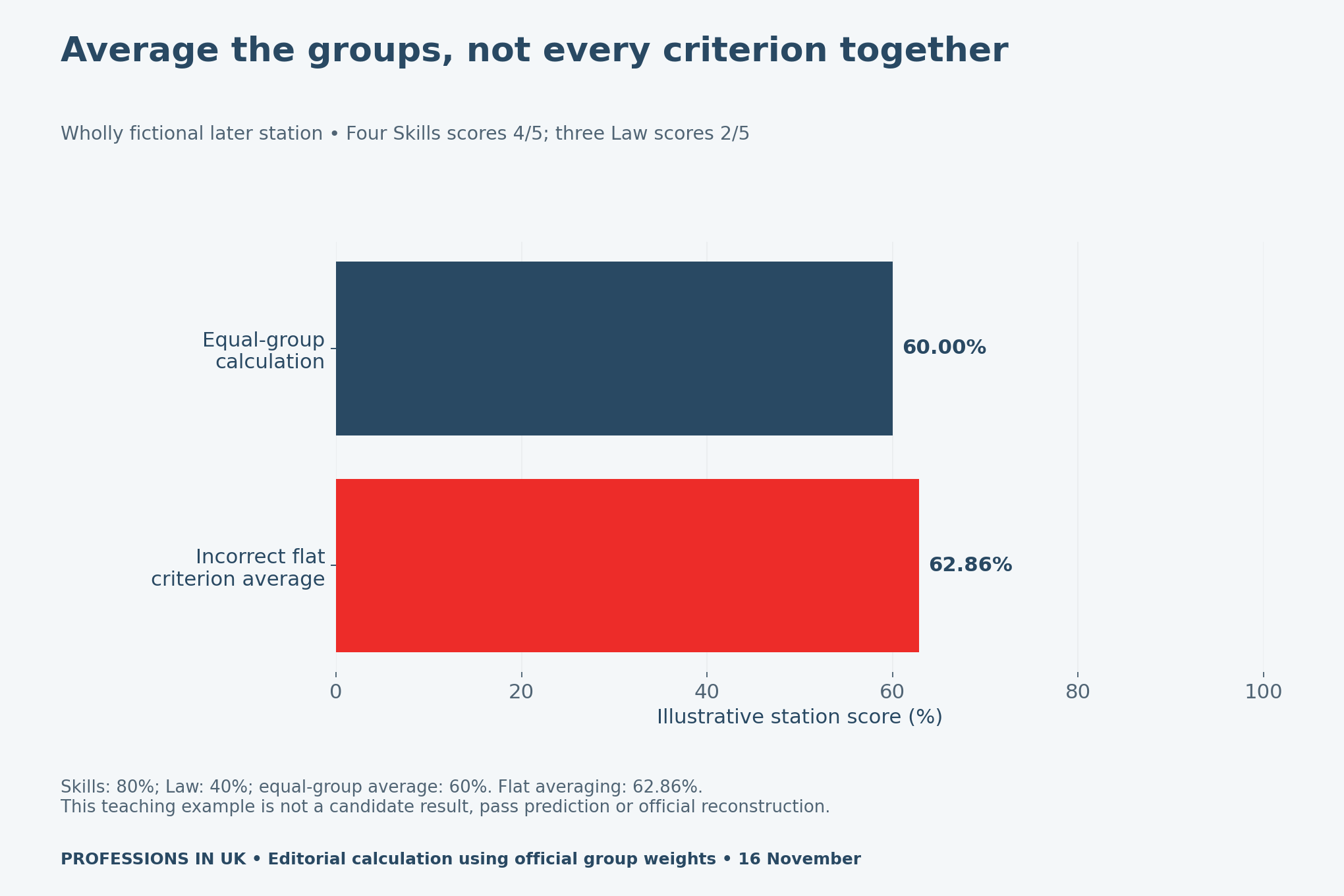
The incorrect shortcut adds all 22 marks and divides by the combined maximum of 35, producing about 62.86%. It gives the four-criterion Skills group more weight than the three-criterion Law group. The exercise explains a calculation error; it does not supply a universal calculator for every station or recreate the full official 16-station result process.
Do not insert zero for an N/A ethics entry. That would change the applicable denominator and invent a scored failure. Equally, do not use this example to change an official result yourself. Read the official explanation and use the appropriate query or review route if a result needs clarification.
An administrative deadline is not a study-readiness verdict
If a resit becomes relevant, first separate the booking question from the preparation question. A deadline may require a timely administrative decision, but it does not establish that the earliest available sitting is the best fit. Review your own circumstances and the current official process before committing.
Use the private planning sheet to identify a specific task that needs work. “Improve legal writing structure under timed conditions” is more actionable than “work harder”. Record what feedback or practice supports the conclusion, the next action and a review date. Do not turn a single disappointing exercise into a diagnosis of every skill.
| Planning question | Evidence to consider |
|---|---|
| Which sitting’s rules apply? | Actual assessment cohort and official guidance |
| Which task needs practice? | Specific feedback and repeated practice examples |
| Can I prepare realistically? | Available study time, work and caring commitments |
| Which administrative steps apply? | Current booking and adjustments instructions |
| What remains uncertain? | Questions for the official assessment support route |
Keep genuine candidate identifiers, results emails, access details and adjustment evidence in approved private channels. The downloadable files are blank or fictional. No upload to this website is needed, and we have not evaluated anyone’s result or readiness.
Scope, official sources and limitations
SQE2 concerns the solicitor qualification route in England and Wales. It is not a guide to legal admission across every UK jurisdiction. Passing SQE2 alone does not establish admission; check the SRA’s full requirements. Our wider legal-services coverage provides context, while this article focuses on the correct cohort and next administrative questions.
Personalized UK Career Consulting
Receive tailored career guidance designed just for you. Get actionable steps and expert support to boost your career in 1-3 days. Take control of your career now.
Get StartedThe dated timetable comes from the 11 November notice and the dedicated booking page. The cohort distinction comes from the October reminder and current official guidance. The numerical example is an editorial calculation with invented marks. We do not report July results before release, predict a pass mark or claim that the display change proves a harder examination.
Recheck deadlines immediately before using them. The official website can update booking instructions and assessment guidance. Keep the date and source beside any saved checklist, and distinguish a reservation request from a confirmed booking. The worksheet cannot replace the official account or current assessment regulations.
Download the dated tools and fictional example
- November timetable and official sources (CSV)
- Sitting-to-guidance comparison (CSV)
- Fictional weighting calculation values (CSV)
- Blank private results and readiness plan (CSV)
Suggested citation: Professions In UK, “July 2026 SQE2 Results: Check Your Sitting and Resit Dates”, checked 16 November 2026. Official SQE/SRA guidance is linked beside each claim; calculation examples are fictional teaching aids.


