





School employer engagement capacity planning starts with the staff time around an activity, not just the hour when an employer meets learners. Before adding a presentation, visit or project, agree its learning purpose, the work it creates and who can realistically do that work.
Cambridge OCR’s 12 November 2026 recommendation calls for vocational experiences across ages 14–16, supported by sustained employer contact and careers guidance. It is a policy proposal, not a newly enacted requirement or proof that a particular event improves employment outcomes. This report focuses on programme planning in the relevant English school context.
School employer engagement capacity planning: start with purpose
An event count tells you how many activities happened. It does not tell you whether learners understood an occupational task, connected it to classroom learning or could ask useful follow-up questions. Write a specific learning purpose before negotiating dates. For example: learners should be able to explain how a technician checks a fault, rather than simply hear a job title.
Then define the activity. A workplace visit, classroom talk and sustained employer project have different preparation and supervision demands. Keep those types separate in your plan. Six activities are not automatically six equivalent experiences, and a full attendance sheet does not demonstrate a career outcome.
What the older teacher survey can—and cannot—show
The quantitative background comes from an older OCR summary published on 22 September. It describes a survey of more than 700 respondents alongside qualitative work. Among surveyed teachers, 33% cited staff capacity and 27% resources as barriers to wider vocational provision. Those figures are not fresh November fieldwork or percentages of all UK schools.
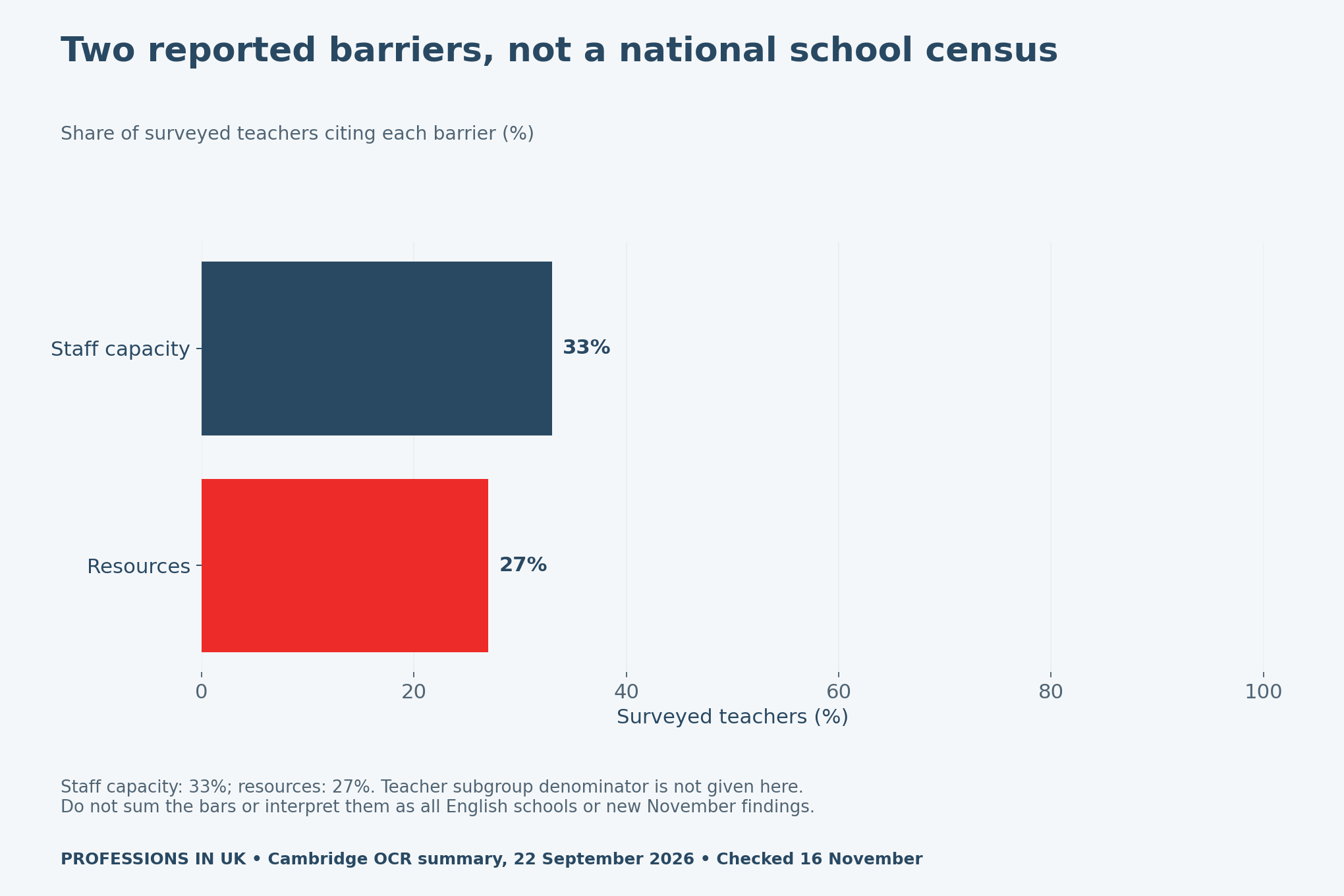
Do not multiply either percentage by the total survey response count to estimate a number of teachers. The overall sample includes different groups. Nor should you add the two percentages to claim that 60% faced either barrier: the same teacher could potentially appear in both responses. Detailed fieldwork dates and a national probability sampling design are not established here.
The useful planning question is therefore local: what work would this activity create in our programme, and what capacity has actually been agreed? A survey can suggest a question worth asking. It cannot fill the school’s timetable or identify the staff available next Tuesday.
A fictional six-activity example: count all three stages
Suppose a fictional school plans six employer activities. For each one, it allocates two staff-hours to preparation, one to delivery and one to follow-up. The base calculation is 6 × (2 + 1 + 1) = 24 staff-hours. This is an editable teaching example, not an observed school, a staffing standard or a recommended allocation.
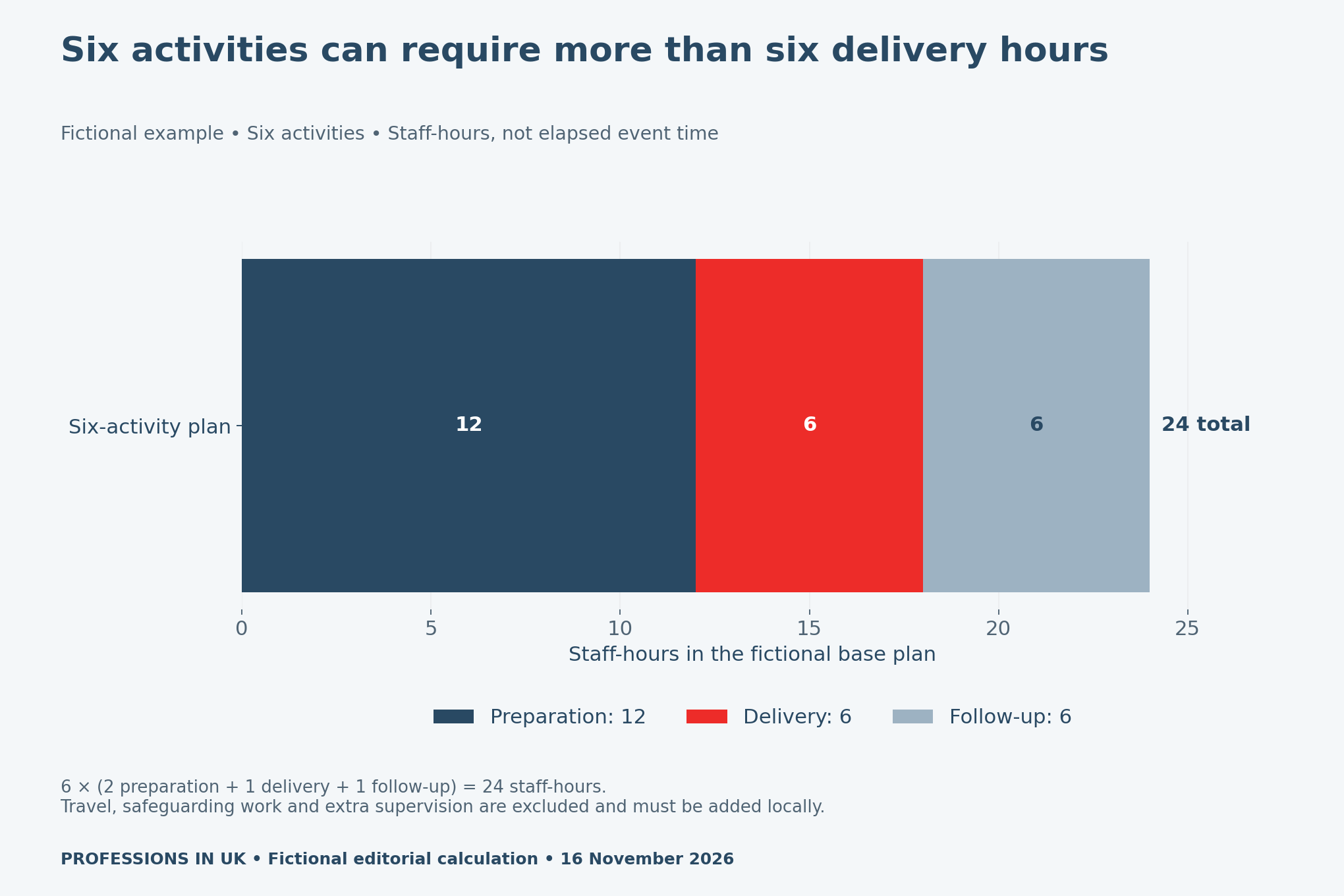
The delivery slot alone accounts for six hours in this example. The other eighteen hours arise before and after contact. That arithmetic explains why another event cannot be treated as costless simply because it fits into a lesson. It does not establish how much preparation any real activity needs.
| Stage | Fictional input per activity | Six-activity staff-hours |
|---|---|---|
| Preparation | 2 hours | 12 |
| Delivery | 1 hour | 6 |
| Follow-up | 1 hour | 6 |
| Base total | 4 hours | 24 |
Staff-hours also differ from elapsed time. Two adults working for one hour use two staff-hours, even if the session lasts only one hour. In the blank worksheet, multiply people by hours for each stage, then multiply repeated activity work by the number of activities. Add other tasks separately and document any work shared across the whole programme.
Use the workload file without double counting
The blank CSV has separate columns for preparation people and time, delivery people and time, and follow-up people and time. For one row, calculate: activity count × [(preparation people × hours each) + (delivery people × hours each) + (follow-up people × hours each)] + other task hours. The final column is deliberately blank; a CSV stores values and does not supply a working spreadsheet formula.
If one employer briefing serves several activities, record that shared task once under other hours or in a clearly separate programme row. Do not add it in every activity and again in a programme total. Conversely, if separate groups each require supervision, include the people and time for each group. Keep the assumptions beside the total so a colleague can reproduce it.
Add the locally relevant travel, access arrangements, safeguarding work, employer liaison and additional supervision. Follow the school’s approved procedures when deciding what those tasks require. This worksheet neither determines the required supervision ratio nor certifies that an activity is safe or compliant.
Agree responsibility before filling the calendar
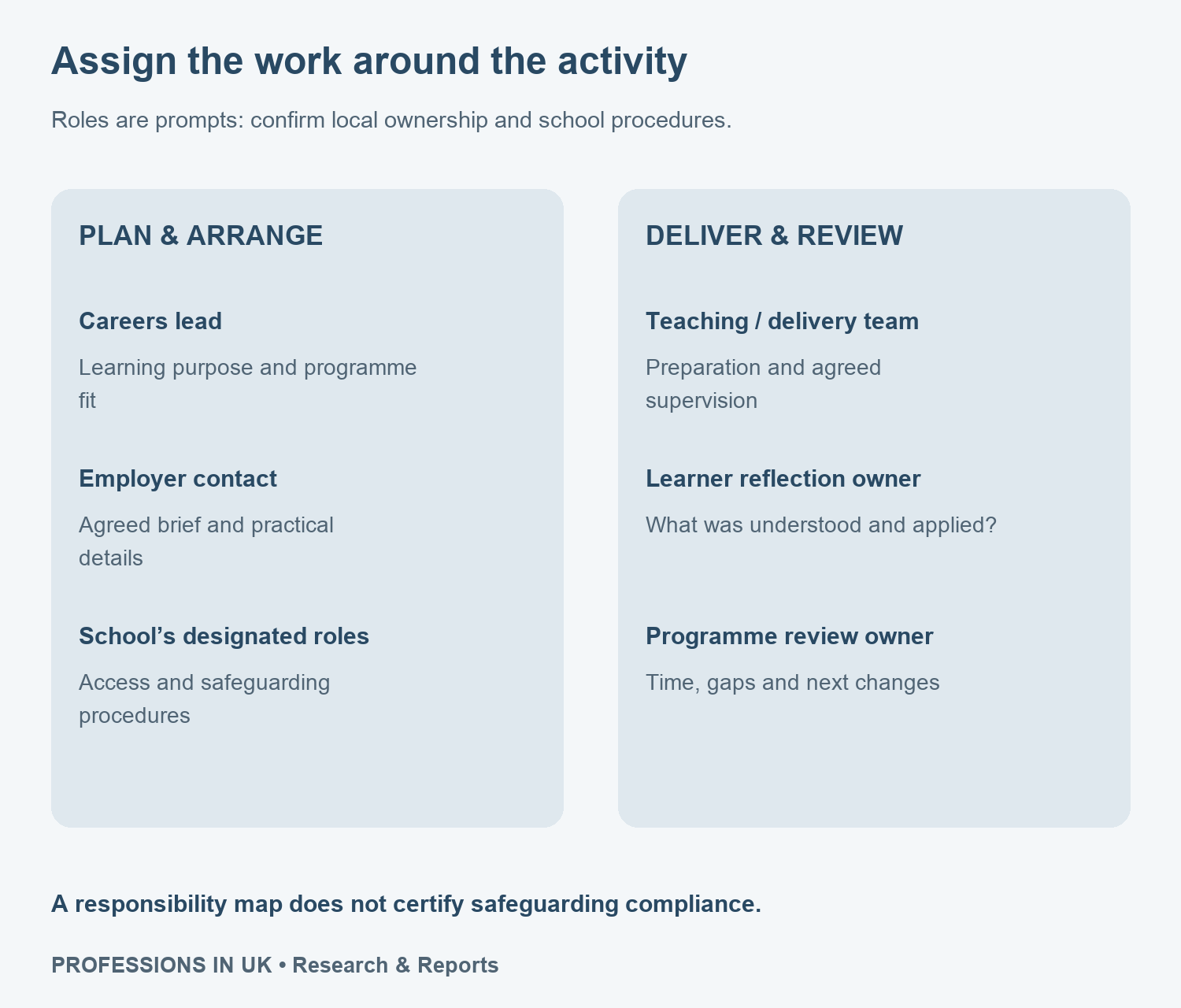
Assign an owner role and an agreed review date to each part of the plan. “The team will handle it” hides a capacity gap. A clearer record identifies who confirms the employer brief, who prepares learners and who checks that reflection happens. Obtain agreement from the people involved rather than treating a name in a worksheet as consent to extra work.
Next, compare the required hours with genuinely allocated time. If no owner or capacity is agreed, keep the activity provisional. Options may include changing its scope, sharing a preparation task, moving the date or reducing the number of activities. The worksheet does not choose among those options; it makes the trade-off visible.
Personalized UK Career Consulting
Receive tailored career guidance designed just for you. Get actionable steps and expert support to boost your career in 1-3 days. Take control of your career now.
Get StartedReview learning quality as well as attendance
Choose a small review question linked to the original purpose. After a technical demonstration, can learners explain the task and one relevant skill? After an employer project, can they identify a decision they changed after feedback? These are suggested learning prompts, not validated assessment scales or proof of later employment success.
Record a concise, aggregated summary through approved school systems. Note missing follow-up rather than assuming a learner learned nothing. Do not place pupil names, health details, employer contact information or safeguarding records in a public template. Our downloads require no upload to this website.
For professionals comparing this programme work with their own development, our education and training coverage provides wider context. This report addresses school delivery capacity, rather than individual teaching offers or university placement selection.
Sources, method and limits
The fresh news hook is the November OCR announcement. The September survey summary supplies the two barrier percentages. The linked Untapped Potential landing page was checked, but its retrieved text did not expose the full report. We therefore do not infer a teacher subgroup denominator or additional methodological details from that page.
The two charts serve different purposes: one preserves reported survey measures; the other explains an original fictional workload calculation. The responsibility matrix is an editorial planning aid. No school audit, programme trial or measured improvement has been conducted. The examples do not transfer qualification rules across all four UK nations.
For a future local review, define the activity types and time-recording period in advance. Keep estimates separate from actual hours, record shared tasks once and report incomplete records. That could support a more useful discussion next term. It would still describe the participating programme, not every English school.
Download the workload plan and review tools
- Reported barrier measures and source notes (CSV)
- Fictional six-activity calculation values (CSV)
- Blank activity-to-staff-hours plan (CSV)
- Quality and responsibility review prompts (CSV)
Suggested citation: Professions In UK, “School Employer Engagement Capacity Planning: Staff Time Before Events”, 16 November 2026. Source measures are attributed; all example hours are fictional and editable.


