





UKRI policy fellowships 2027 require a time plan before a polished application. Our calculation combines the expected outer phases with the minimum placement commitment: 9.6 full-time-equivalent months across an 18-month calendar. That baseline helps you discuss workload cover; it does not cap the effort or promise an award.
UKRI policy fellowships 2027: the dated call
The official UKRI opportunity, published 17 November 2026, lists 56 positions for early- and mid-career researchers. Applications close on 16 February 2027 at 4pm UK time, with an expected start on 1 October 2027. The count describes opportunities, not guaranteed awards. Read the current call before relying on any planning worksheet.
The call requires support from an eligible UK research organisation. Its detailed eligibility, residence, clearance and position specifications matter more than a generic career-stage label. If your circumstances are unclear, make that an explicit question for your research office rather than assuming the worksheet decides eligibility.
Separate elapsed time from workload
A calendar month tells you when a commitment occurs. An FTE-month expresses its workload equivalent. Three months at 0.4 FTE therefore represent 1.2 FTE-months. They still occupy three months of the calendar, with meetings and deadlines that may not fall neatly into equal weekly blocks.
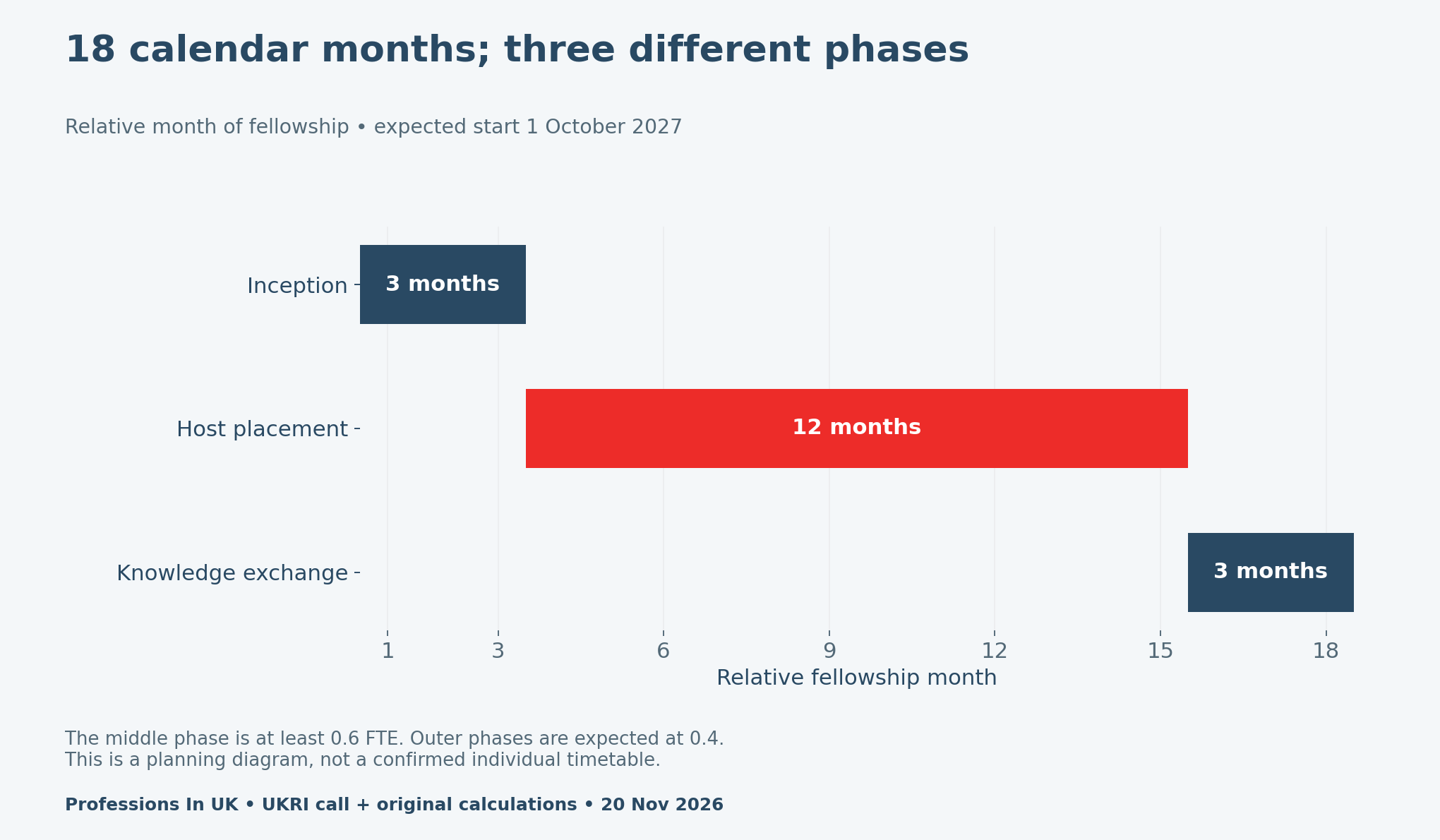
To make a workable plan, put existing teaching, supervision and research deadlines alongside the phases. Then mark which commitments need cover, rescheduling or explicit agreement. A total workload figure cannot tell you whether two immovable deadlines clash in the same week.
How we calculate the 9.6 FTE-month baseline
UKRI sets three months of inception at expected 0.4 FTE, twelve months of placement at a minimum 0.6 FTE, and three months of knowledge exchange at expected 0.4 FTE. We multiply months by the stated fraction for each phase, then add the results. The word minimum is essential: a higher agreed placement commitment produces a larger total.
| Phase | Months | FTE used | Calculated FTE-months |
|---|---|---|---|
| Inception | 3 | 0.4 (expected) | 1.2 |
| Host placement | 12 | 0.6 (minimum) | 7.2 |
| Knowledge exchange | 3 | 0.4 (expected) | 1.2 |
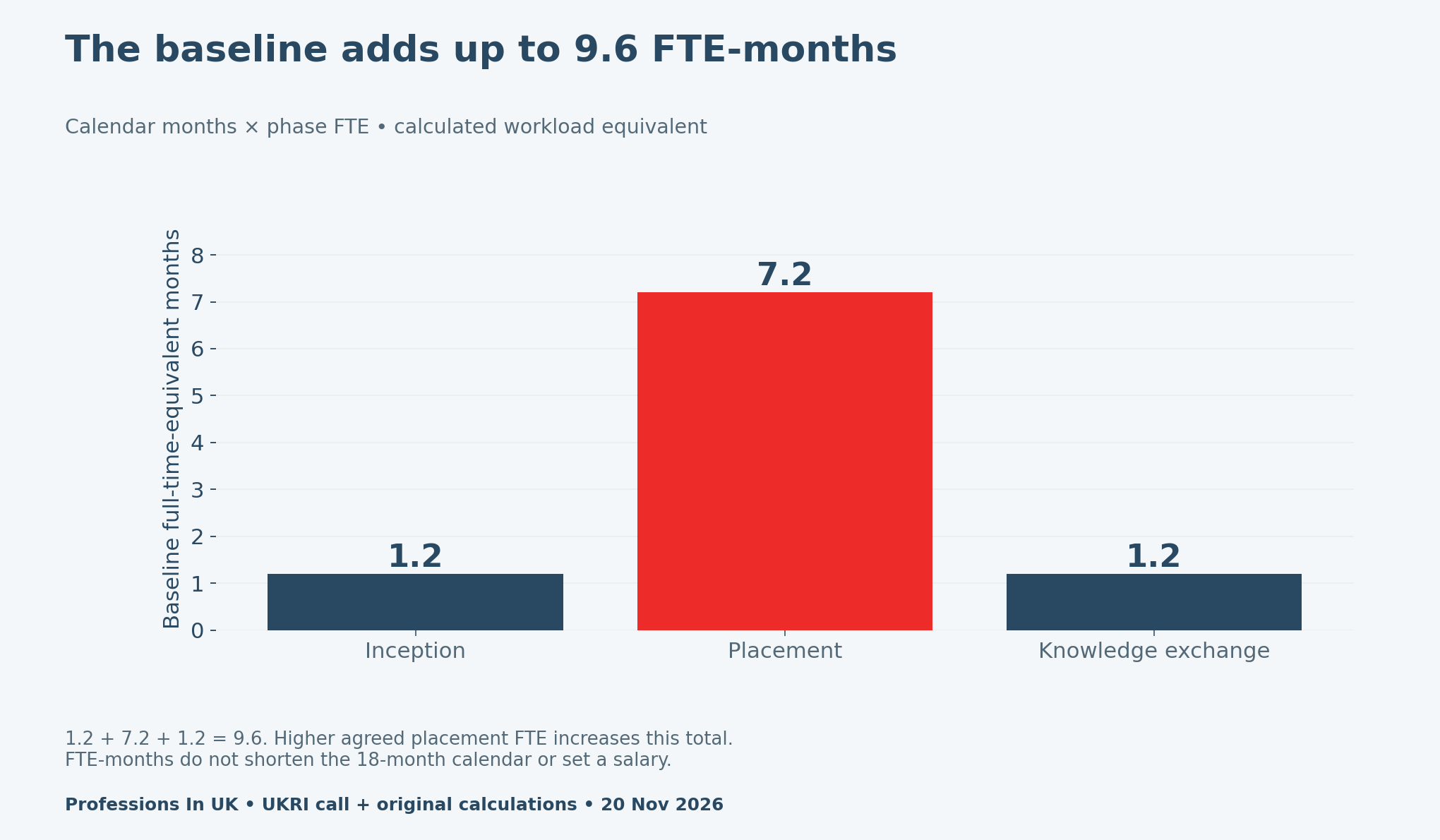
For comparison, holding the two outer phases constant and using a fictional 0.8 FTE placement gives 12.0 FTE-months. A full-time placement gives 14.4. These sensitivity examples expose the effect of an assumption; neither is a new condition imposed by this article.
Use the workload plan to ask specific questions
Start with an ordinary working week and identify responsibilities that cannot simply disappear. Who will supervise a student? Which teaching block overlaps the placement? Who can authorise a change? Record a proposed solution and an approver role for each issue, leaving unresolved items visible.
Next, consider location and travel against caring responsibilities and accessibility needs. A nominal fraction of working time does not describe a commute or an inflexible meeting pattern. Use the published position information and your institution’s support route to identify questions before committing to a plan.
Finally, include the return phase. Knowledge exchange needs time to turn experience into useful outputs and share learning with colleagues. Treating the return as an immediate resumption of every earlier duty can make the last part of a carefully costed plan unrealistic.
Funding arithmetic is not a salary offer
The maximum full economic cost is £180,000 for core policy fellowships and £220,000 for the specified What Works Innovation and Natural Hazards and Resilience types. UKRI funds 80% of FEC. At those ceilings, our arithmetic gives £144,000 and £176,000 respectively.
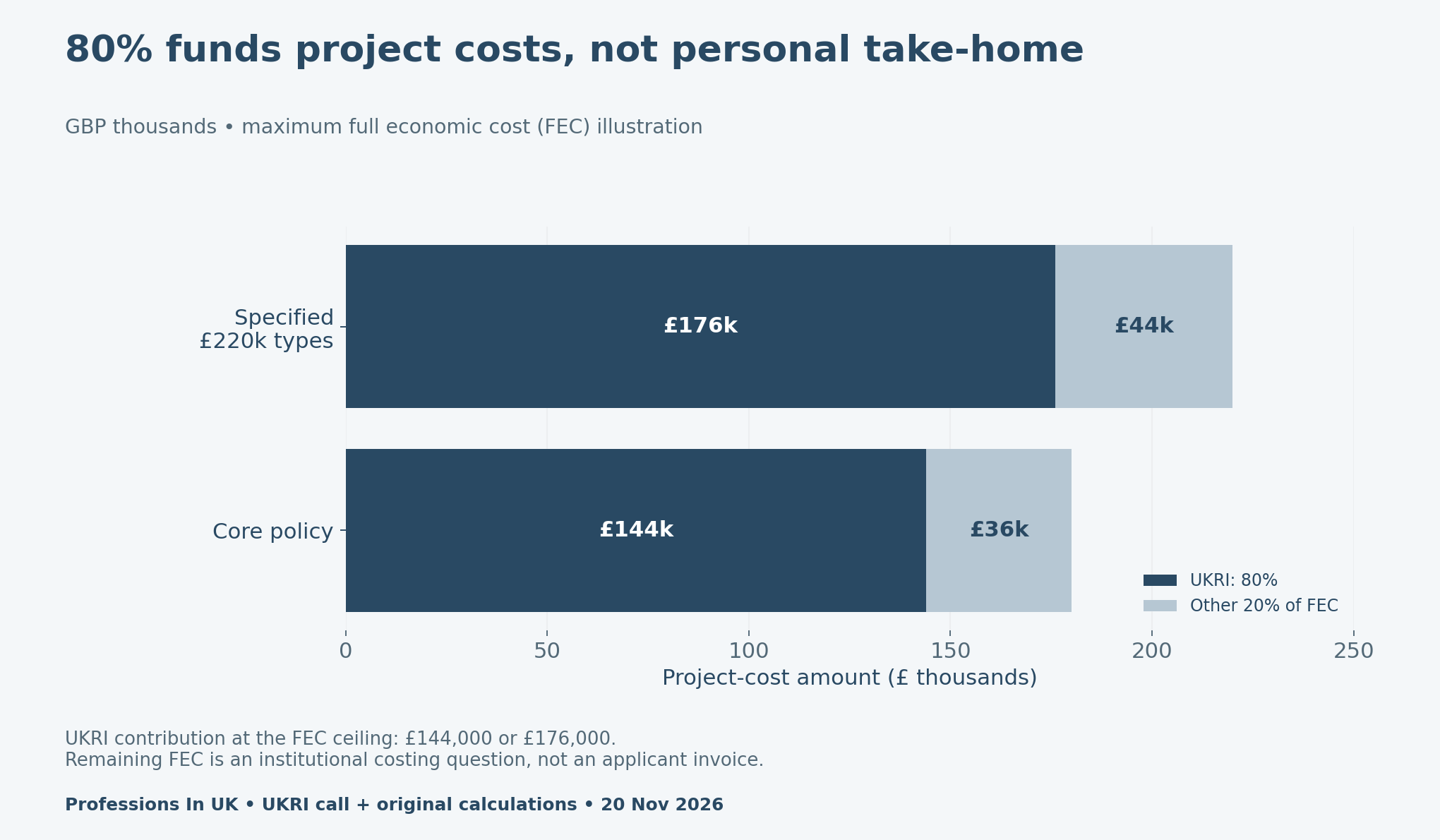
For a budget discussion, keep three fields separate: eligible project cost, funder contribution and your employment terms. Ask the research finance team to explain each. A subtraction is useful for reconciliation, but it cannot determine how an institution meets its costs or what an individual receives after payroll deductions.
Build a readiness map before approaching the application
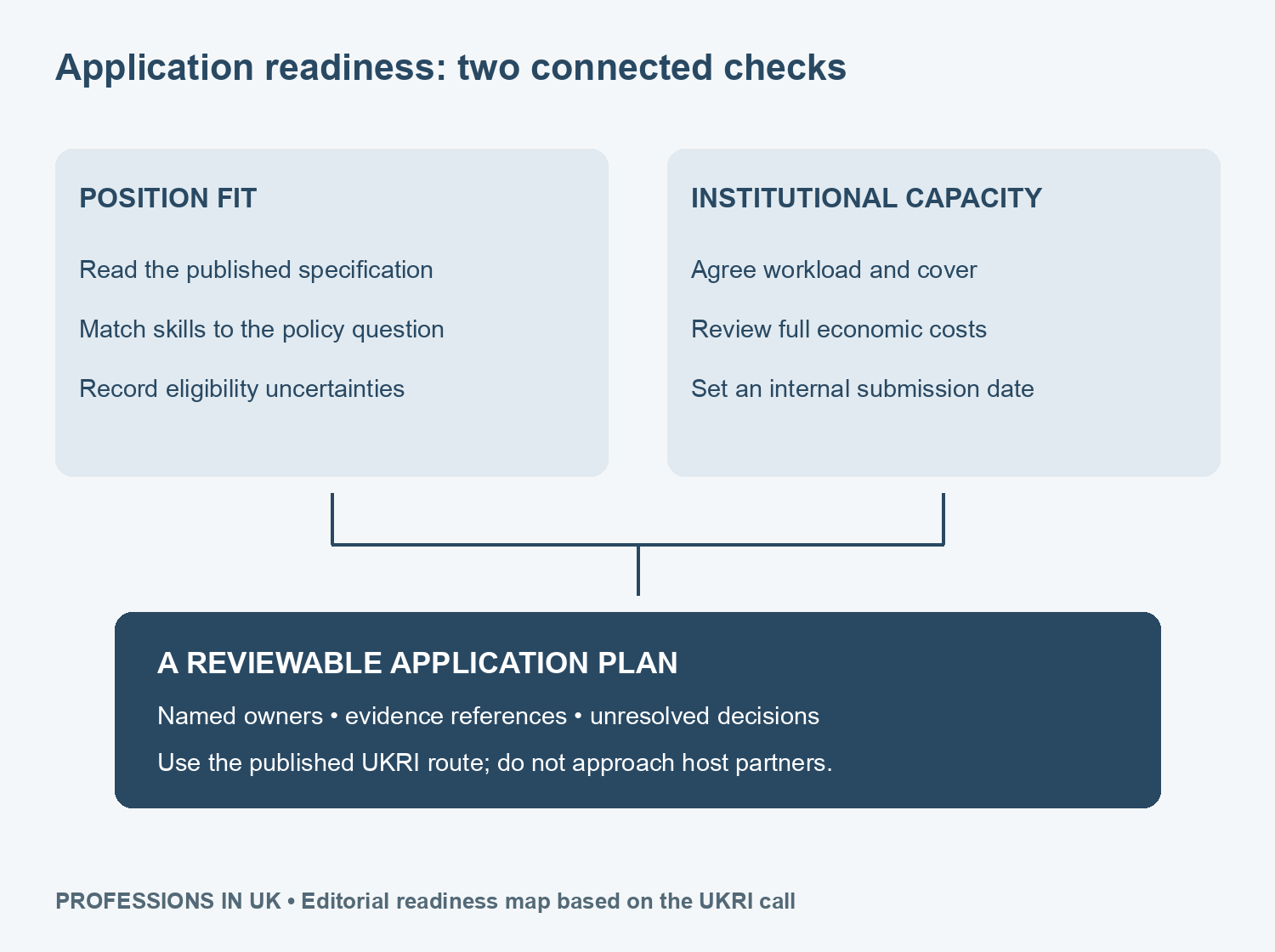
Create a short evidence note for the position: the policy problem, the skills you can demonstrate and the example that supports each claim. A publication title alone may not show how you explain uncertainty to a decision-maker. Describe what you did, what evidence you used and where your conclusion stopped.
In parallel, create an institutional decision log. Each row needs a responsible role, evidence reference, due date and current status. That prevents a promising application from depending on several unwritten assumptions about cover, costing or sign-off.
Our capacity-planning guide for school-employer engagement uses a related principle: match an activity to the capacity and owner needed to deliver it. Here, apply that principle to an academic-policy transition rather than assuming the two settings share the same procedures.
Personalized UK Career Consulting
Receive tailored career guidance designed just for you. Get actionable steps and expert support to boost your career in 1-3 days. Take control of your career now.
Get StartedDownload the planning files
Use the dated calculations to reproduce the charts and the blank institutional planner to record your own decisions. The blank file collects planning notes, not sensitive personnel or health records. Store any necessary personal information only through your institution’s appropriate process.
- Phase inputs and baseline workload (CSV)
- Maximum-FEC funding arithmetic (CSV)
- Illustrative placement-FTE sensitivity calculations (CSV)
- Blank institutional workload and sign-off planner (CSV)
Methodology and limits
We checked the official call on 20 November 2026 and calculated the charts from its stated phase lengths, workload fractions and funding percentages. Our planner and sensitivity examples are editorial tools, not official UKRI forms. The research date, assumptions and status labels remain in the downloadable files.
UKRI policy fellowships 2027 may suit researchers who can connect relevant expertise with a host’s policy question. However, neither this analysis nor its 9.6 FTE-month baseline settles eligibility, position fit, actual workload, institutional funding treatment or selection. Use the live call and your organisation’s submission process for the final application.


