







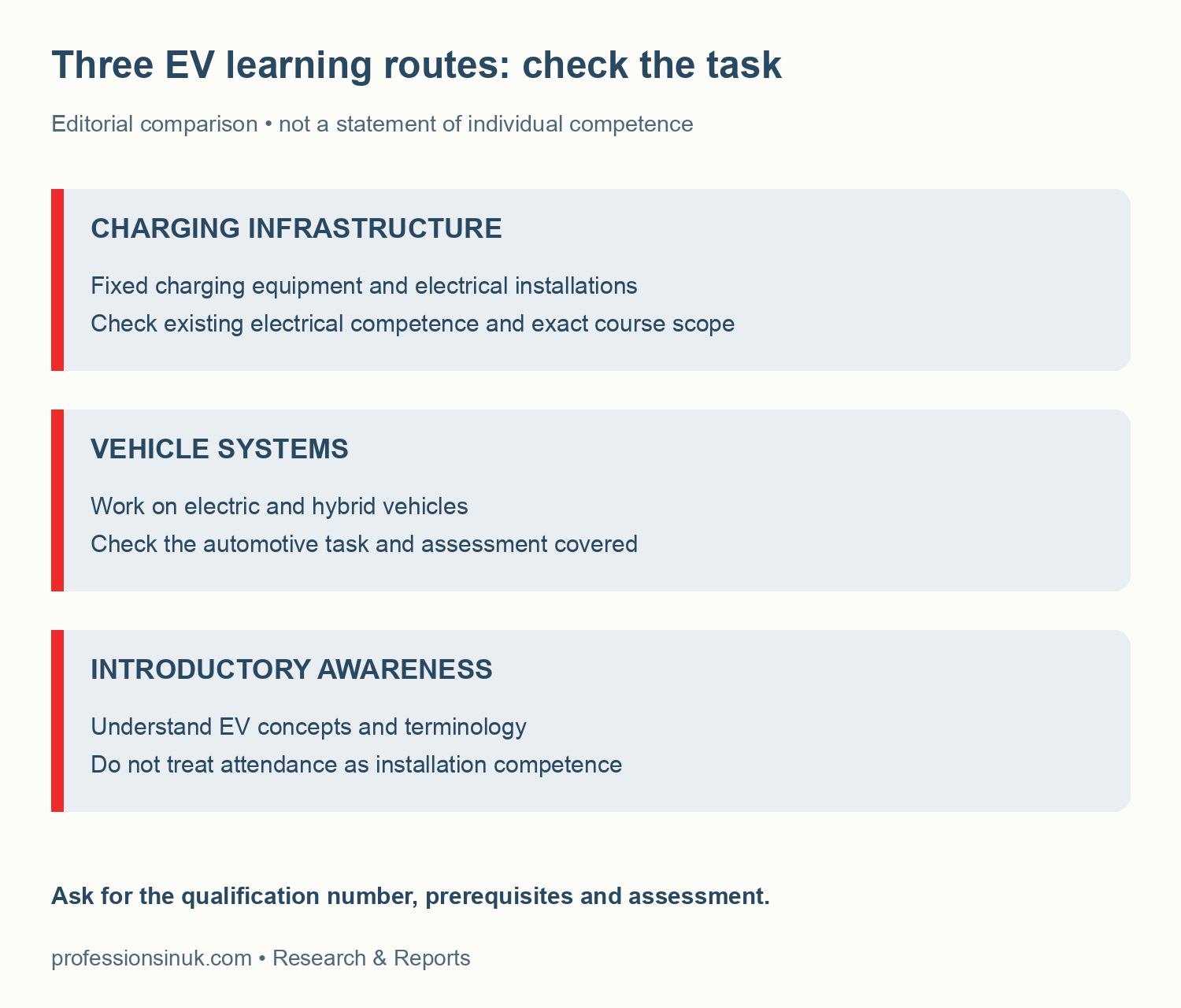
EV charge point installer training in England needs a task check before a course comparison. Ask what the qualification covers, which skills it assumes and how it assesses learning. A course about electric vehicles may concern vehicle repair, charging infrastructure or introductory awareness. Those are different routes.
New research gives that distinction a timely context. England awarded 2,520 charging-installation qualifications in 2024/25, compared with 6,410 in 2021/22. Our calculation shows a 60.7% fall between those endpoints. However, these are qualification awards. They are neither a count of unique people nor a measure of today’s vacancies.
This report combines the historical award figures with current awarding-body information and a practical verification pack. It does not rank providers or recommend electrical work. Research checked on 8 November 2026.
What the new EV training research measures
Learning and Work Institute released The road to net zero on 3 November 2026. Its transport chapter analyses Ofqual data for England. The figures describe academic years, so a November publication does not turn them into November enrolments.
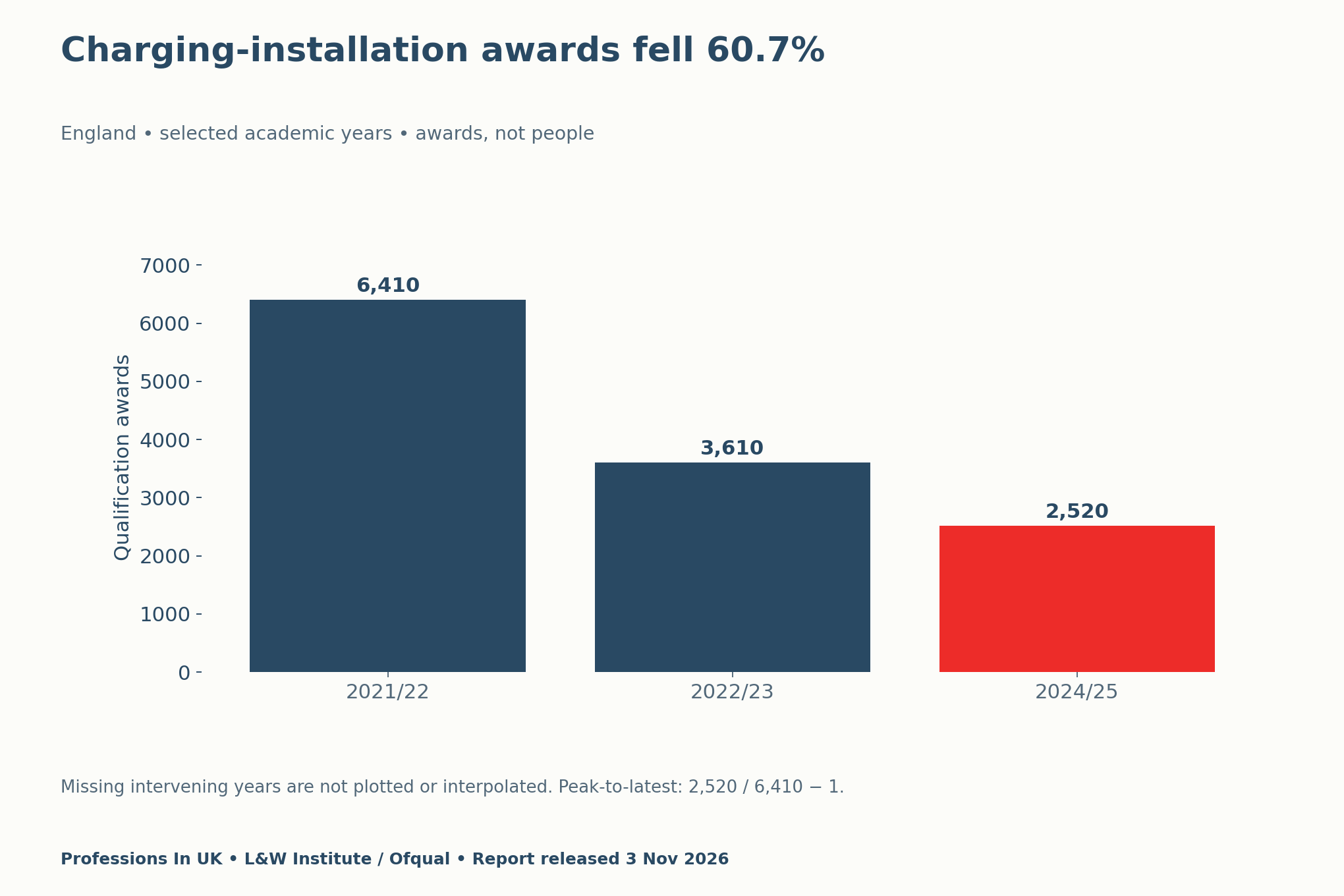
| Academic year | Charging-installation awards | Interpretation |
|---|---|---|
| 2021/22 | 6,410 | Reported peak |
| 2022/23 | 3,610 | Following academic year |
| 2024/25 | 2,520 | Latest observation used here |
The peak-to-latest difference is 3,890 awards. We calculate the percentage change as (2,520 ÷ 6,410 − 1) × 100. Rounded to one decimal place, the result is −60.7%. This agrees with the report’s rounded 61% decline.
A decline in awards does not explain its own cause
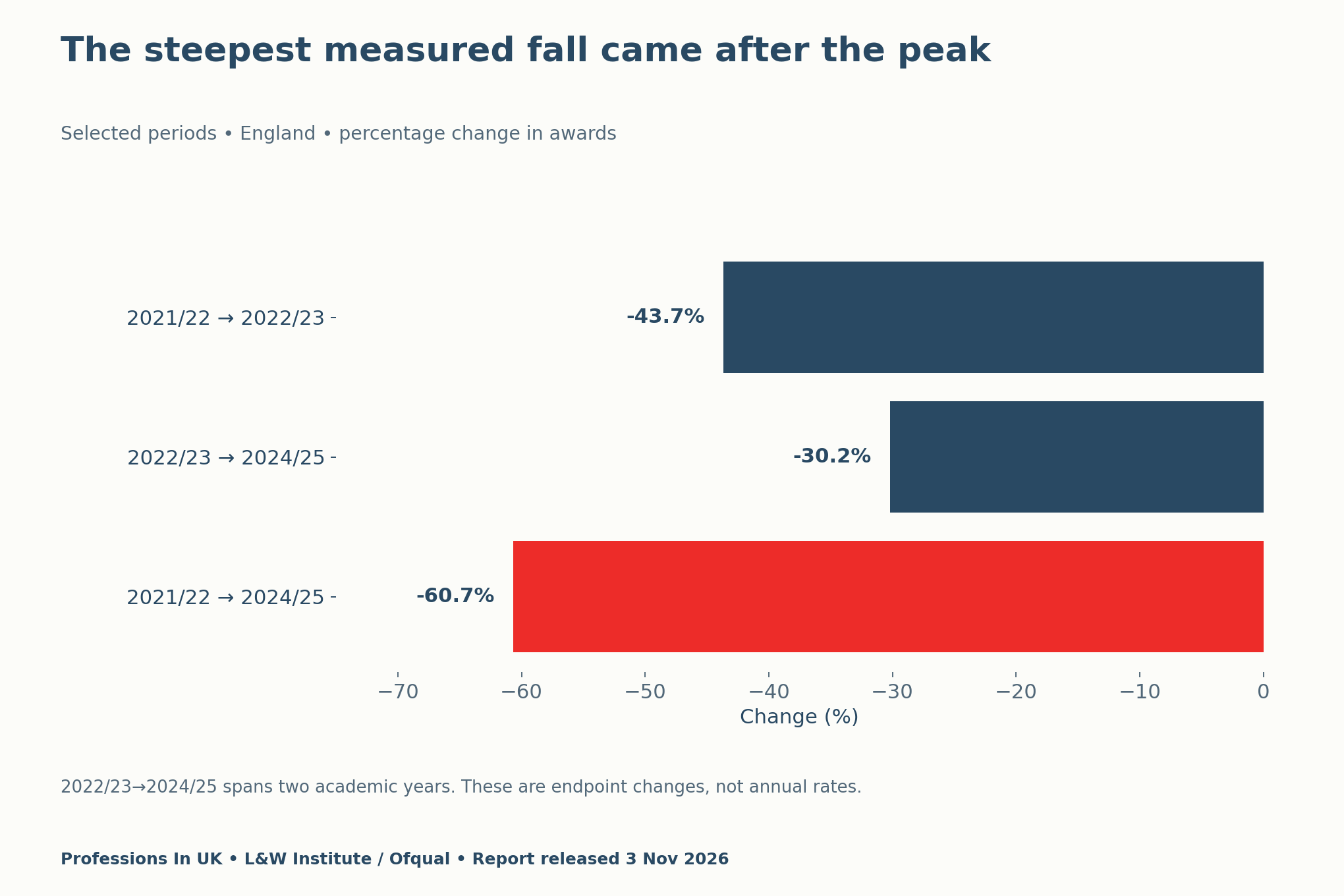
The first interval fell by 2,800 awards. The later two-year interval fell by another 1,090. These calculations describe the scale and timing of the change. They cannot isolate a reason, measure local employer demand or establish how many qualified workers remain in the workforce.
Consequently, a provider should not use these figures as proof of guaranteed work. Equally, a reader should not assume the fall means recruitment has stopped. A local job search, provider verification and an assessment of existing competence answer separate questions.
Separate three learning routes before comparing courses
The report records 16,630 EV and hybrid qualification awards in 2024/25. Within that broad total, it identifies around 2,500 charging-installation awards and 1,950 introductory-awareness awards. Its more precise charging time-series figure is 2,520. We retain that precision difference rather than silently treating the two presentations as identical.
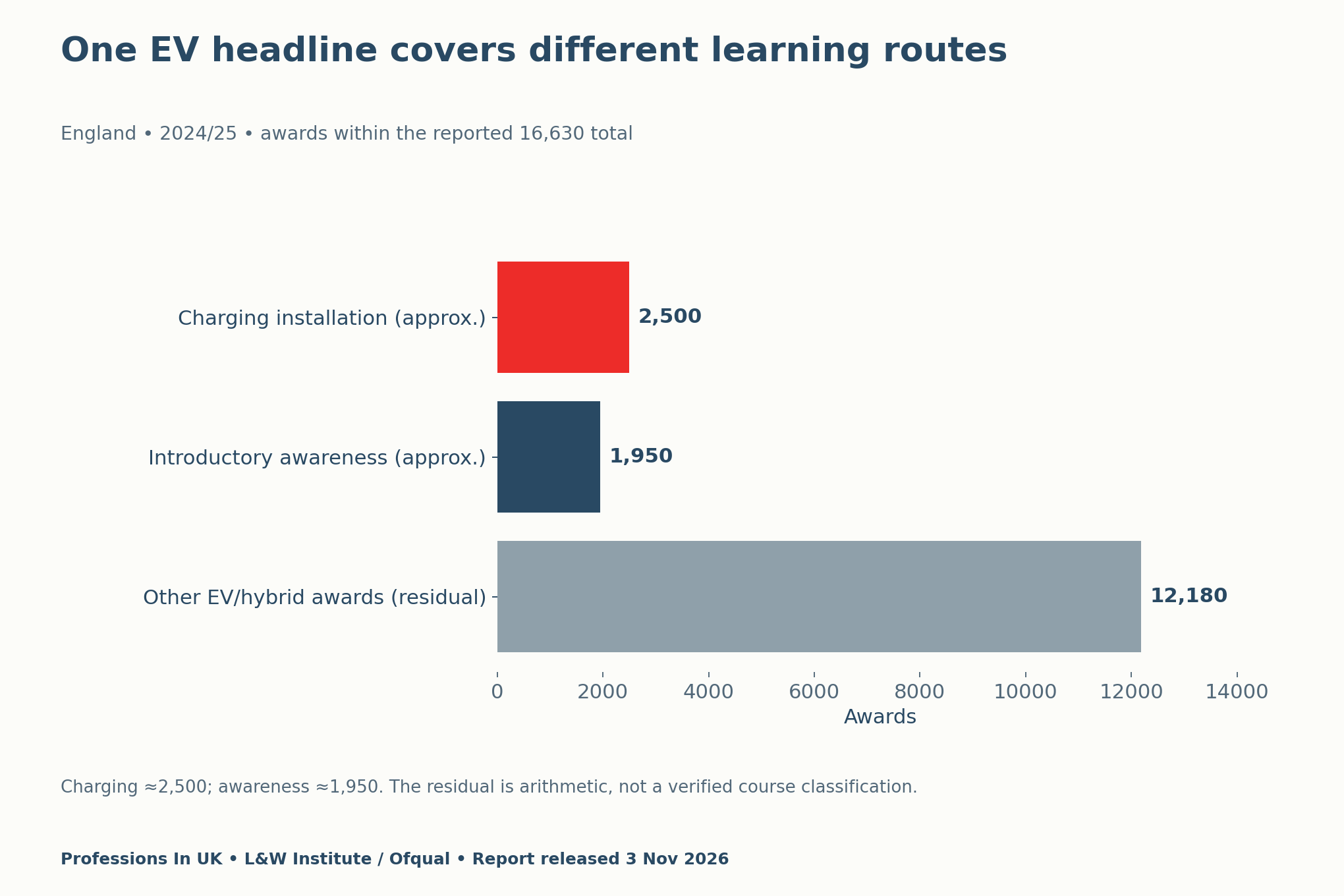
The broad total therefore cannot be read as the number of newly trained charging installers. It mixes learning with different purposes. Before comparing price or duration, write the task you want to perform in one sentence. Then compare that task with the exact qualification scope.
Check the current qualification, not an old course label
The City & Guilds 2921 qualification page distinguishes domestic and small-commercial charging from larger-scale design and installation routes. It lists 2921-34 for the requirements of domestic and small-commercial charging installations. Its page also dates the end of availability of the older 2921-31 route to 31 October 2024.
That makes the precise number useful when checking a current advert. Ask a provider to identify the qualification it will register you for now. A familiar family name or an old web page is insufficient. Check the awarding body’s current handbook and approved-centre information, then retain the dated evidence.
Assessment also needs careful wording. The awarding-body page describes an online multiple-choice test for 2921-34. Do not infer that every advertised course includes a separately assessed practical installation. Ask what practical facilities and learning activities the provider supplies, and distinguish those activities from the formal assessment.
Safety remains a separate gate. Electrical Safety First’s EV guidance says home charging needs a registered, competent electrician trained and qualified for charge points. This article is a training-selection resource; it provides no wiring or installation instructions.
EV charge point installer training England: course checks
When comparing EV charge point installer training in England, start with your existing qualifications and experience. Send the provider your actual background and request written entry advice. A career changer without underlying electrical training should not treat a specialist add-on as a complete route into electrical competence.
Next, record the exact title, number, awarding body and registration status. Add the entry requirements, assessment method and practical facilities. Finally, note the full price, any separate assessment costs and every progression claim that still needs evidence. Keep “not stated” separate from “not offered”.
Personalized UK Career Consulting
Receive tailored career guidance designed just for you. Get actionable steps and expert support to boost your career in 1-3 days. Take control of your career now.
Get Started| Question | Evidence to retain |
|---|---|
| What task does it cover? | Exact title, number and current handbook |
| Can I enter with my background? | Written requirements and provider response |
| What is assessed? | Assessment specification, not attendance claims |
| What practice is available? | Facilities and supervised activity details |
| What remains uncertain? | Dated questions and unresolved evidence |
Our related guides to electrician career paths and retraining costs at 40 can help you frame the wider decision. Check the provider’s current terms before budgeting; this report has not collected live course prices.
Download the data and verification tools
The source table preserves the three published observations. The chart-input file also identifies approximate contextual figures and their denominators. Use the blank provider sheet for your own checks; its empty rows are not completed research. The task grid is an editorial starting point, with space to record evidence and limitations.
- Selected-year charging-installation awards (CSV)
- Chart inputs and scope notes (CSV)
- Blank course-verification sheet (CSV)
- Task-to-evidence comparison grid (CSV)
Methodology, limitations and citation
We transcribed the reported figures from the original report, pages 27–29. We calculated endpoint differences without estimating missing annual observations. The context chart uses the report’s rounded subcategories and labels its residual as arithmetic. No provider sample, learner survey or employer audit was carried out for this article.
Coverage is England’s historical awards within a UK-wide report. Awards can include repeat learners and do not establish current competence, completion of a wider training route, earnings or vacancies. Current rules and course terms may change. Neither the worksheets nor the charts certify suitability to perform electrical work.
Suggested citation: Professions In UK (8 November 2026), “EV Charge-Point Installer Training in England: Check the Qualification”, calculations using Learning and Work Institute’s November 2026 Ofqual analysis. Cite the original report alongside any reused figures.


