




If you’re comparing job offers, start with a simple question. Who decides when you start and finish? These flexible working job offer questions for UK applicants help you check how a role would fit your week before you accept it.
In the 2025 British Social Attitudes survey, 61% of workers said being able to decide their working hours mattered to them. Only 31% said their current job allowed it. Ask about location, start times, paid hours and notice separately. A hybrid role can still have fixed hours.
What workers said about controlling their hours
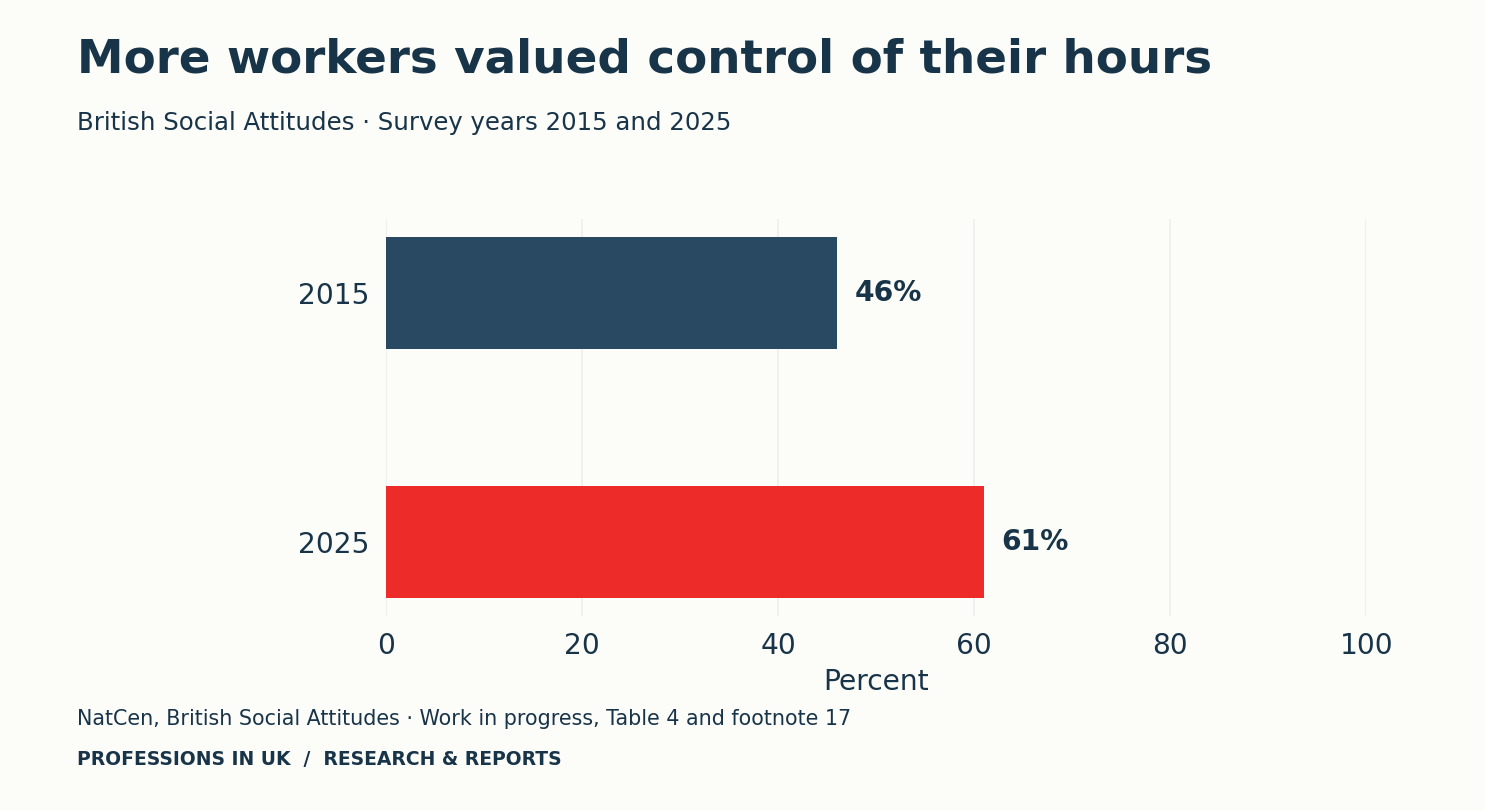
In a chapter published by NatCen on 3 November 2026, Resolution Foundation economist Hannah Slaughter compared the 2015 and 2025 British Social Attitudes survey waves. The share of workers who valued control over their working hours rose from 46% to 61%, a difference of 15 percentage points.
The 31% figure answers a different question. It describes workers who said their current job let them decide their times or days of work. The survey first asked that question in 2025. Therefore, there is no 2015 current-job control result to compare with it.
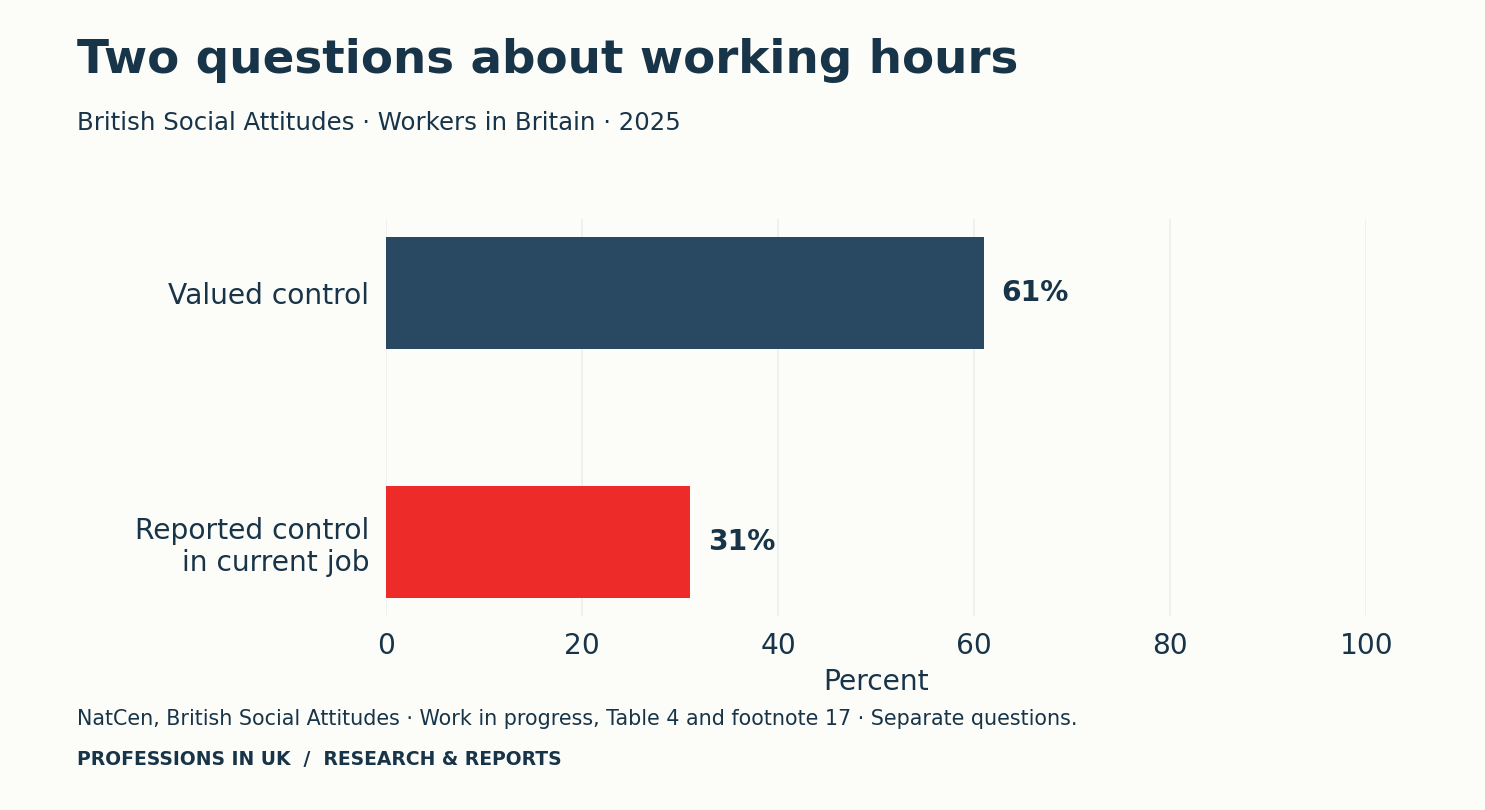
Subtracting 31 from 61 gives a 30-point difference between the published shares. To count people who valued control and lacked it, you would need to link answers for the same people and check the question bases. The figures also cannot tell you what any one employer will agree to.
Four things to check in a flexible working job offer
Location. Ask how many days you need to attend the office, which days they are and who sets them. Also check whether the rules change during induction or busy periods. If a manager says there are two office days, ask whether your team picks them or follows set days.
Start and finish times. Ask whether you can choose both times and what core hours apply. For example, a team may let you start early but still expect you to attend a late meeting. Check how often that happens and what the team does when it conflicts with an agreed schedule.
Total paid hours. Ask for the hours per week and the length of breaks. A shorter day, a compressed week and a later start can have very different effects. For instance, working the same weekly hours across four days means longer days even if it creates a day off.
Predictability. Ask who can change the schedule, how much notice you receive and what counts as an exception. A rule can be flexible on paper yet hard to plan around if office days change frequently.

Two fictional offers with the same pay and hours
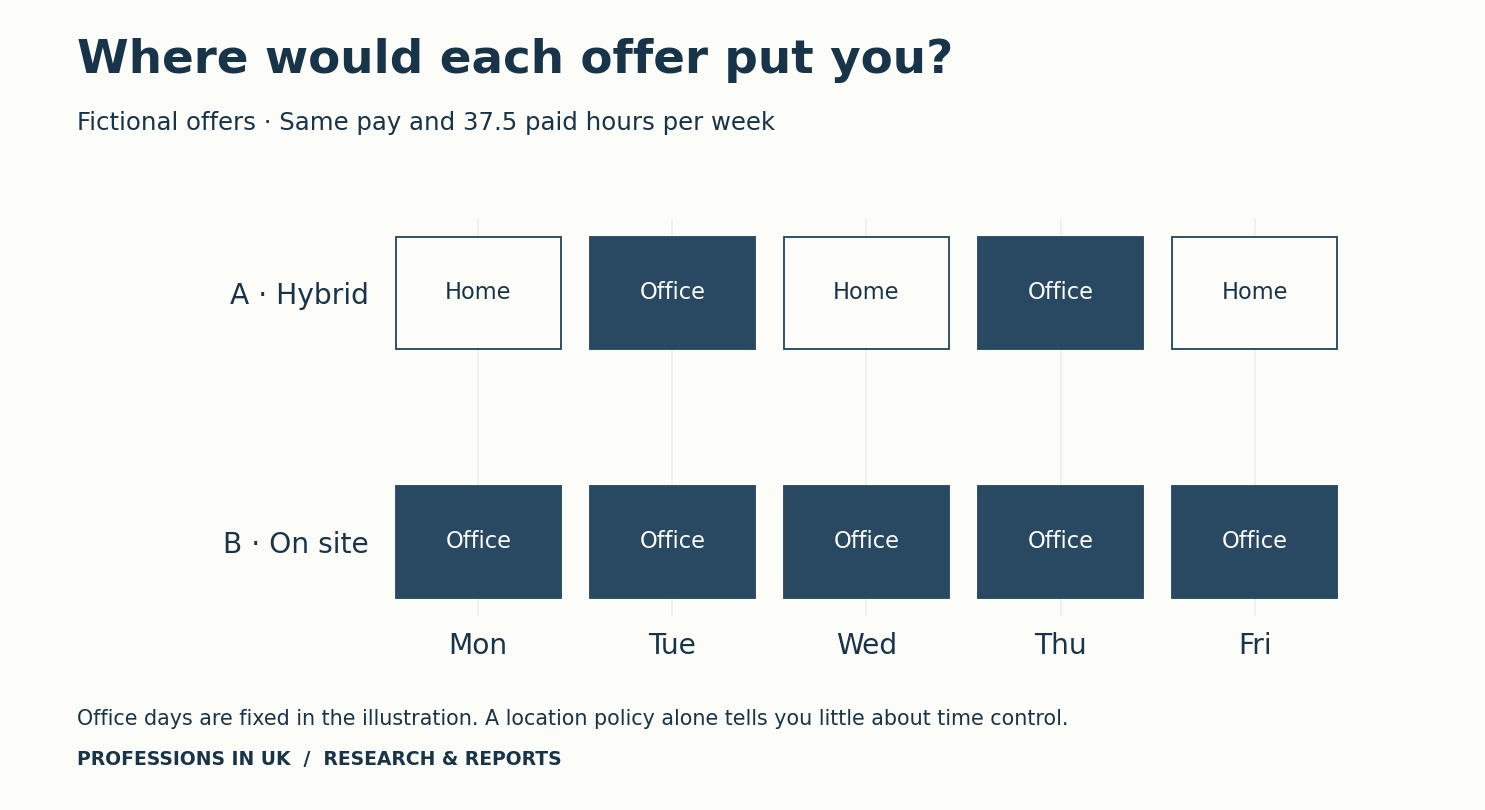
Both example jobs pay the same salary and require 37.5 paid hours over five days. Both include a half-hour unpaid break each day. Offer A is hybrid, with office days on Tuesdays and Thursdays and fixed 09:00 to 17:00 hours. Offer B is entirely on site but lets you choose when to start within a defined window.
| Question | Offer A | Offer B |
|---|---|---|
| Where do I work? | Home three days, office two days | Office five days |
| Who sets my start? | Team sets a 09:00 start | I choose between 07:30 and 10:00 |
| How much time do I work? | 37.5 paid hours weekly | 37.5 paid hours weekly |
| What if the plan changes? | Team gives two working days’ notice in the example | Location changes by agreement in the example |
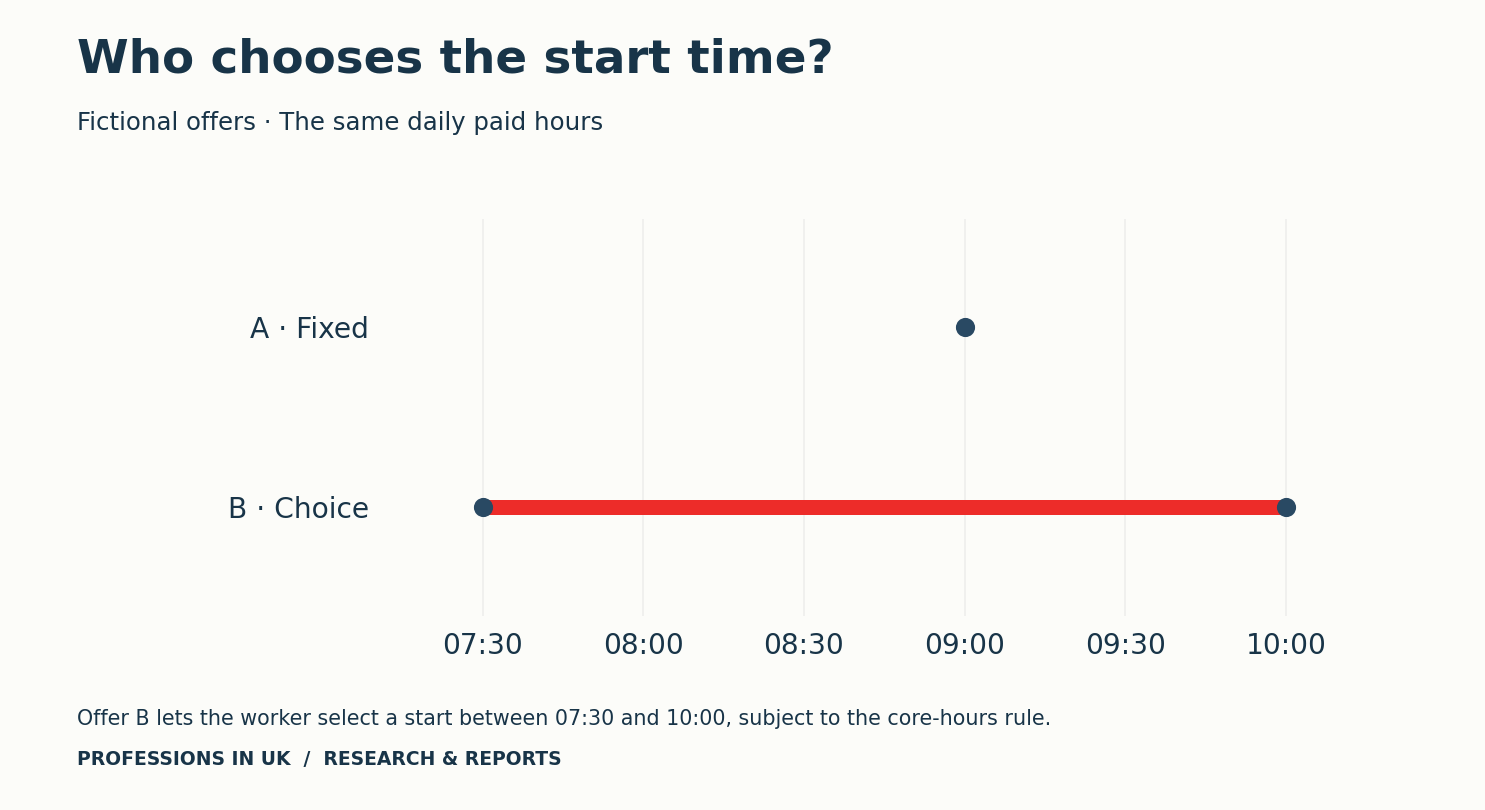
In Offer B, a 07:30 start means finishing at 15:30. A 10:00 start means finishing at 18:00. The day spans eight clock hours in either case, including the unpaid break. The example sets core hours from 10:00 to 15:30, with the usual break allowed.
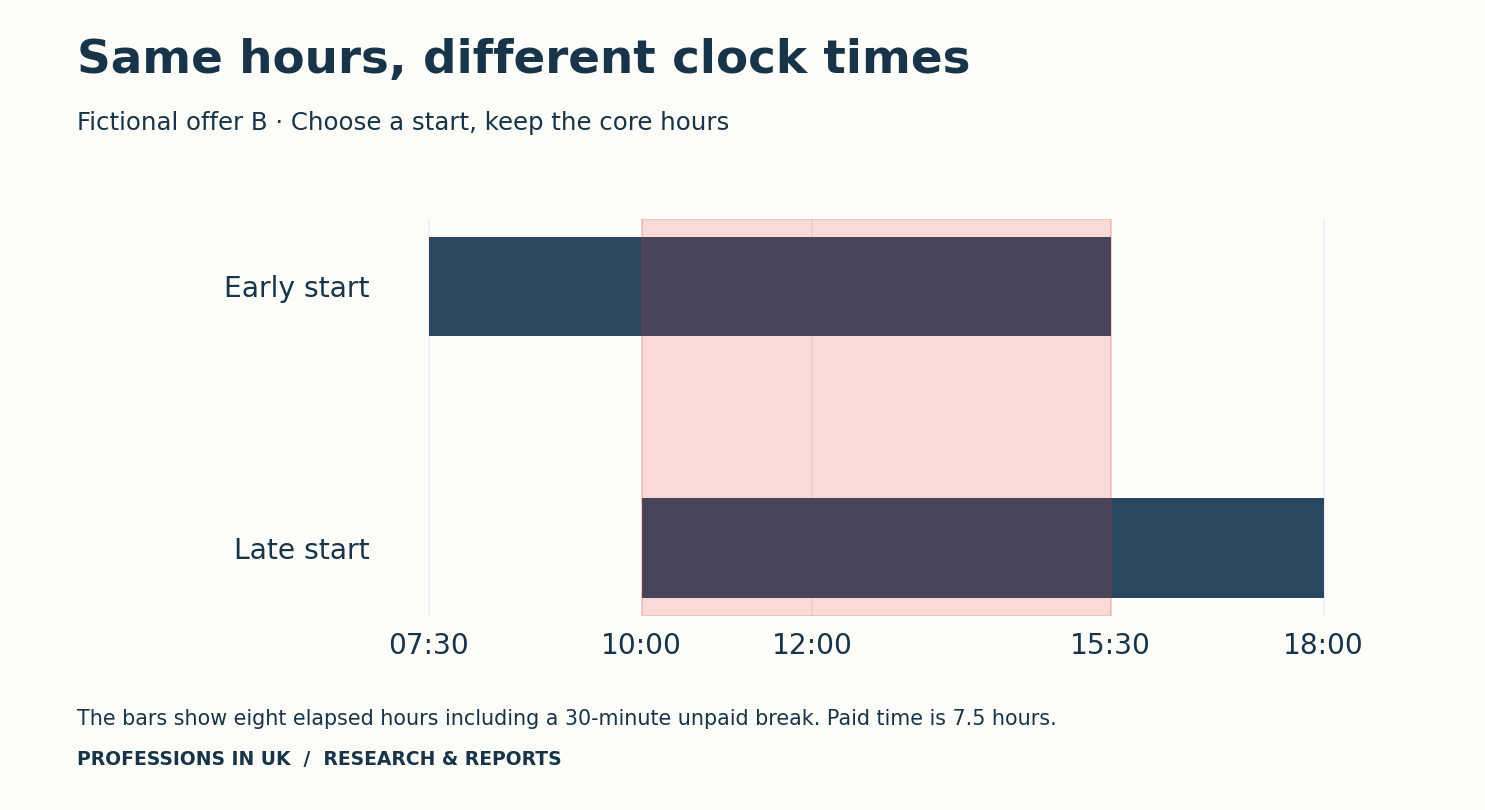
Which offer fits depends on what you need. If you must leave early on Thursdays, ask whether Offer B’s early finish works on that day. If travel is your biggest constraint, the three home days in Offer A might matter more. Our guide to the costs of moving for work covers a separate comparison when location changes the budget.
Get a clear answer before you sign
Start with a specific week. For instance, ask whether you could begin at 07:30 on a Thursday and leave at 15:30, and what happens if a client meeting falls later. Then ask who approves the arrangement and where you can find it in writing.
Use the offer grid to record the arrangement, who decides, notice, exceptions and where the answer appears. A written term is stronger evidence of what the offer says than a general job-ad phrase. If you only have a manager’s explanation or an unconfirmed policy, record that and leave the question open.
Finally, check any obligations outside a typical week. Ask about quarter-end cover, travel to other sites and whether the arrangement applies during probation. The FE teaching workload study offers another example of separating a formal schedule from tasks that sit outside it.
Personalized UK Career Consulting
Receive tailored career guidance designed just for you. Get actionable steps and expert support to boost your career in 1-3 days. Take control of your career now.
Get StartedMethod and downloads
The survey data come from NatCen’s Work in Progress chapter, Table 4 and footnote 17. The chapter discusses differences in survey methods over time and limits on subgroup comparisons. The results are British worker responses. They do not measure compliance, establish rights or estimate how common an arrangement is in a particular industry.
The offer examples hold pay and weekly hours constant. We use invented schedules to make the location and time choices visible. The worksheet records evidence for an individual offer and does not assign a flexibility score.


