





Jobs Guarantee eligibility in November 2026 needs a date check. The announced expansion across Great Britain starts from the end of November. The shorter qualifying period starts in April 2027. Treating those changes as one event could give a young jobseeker the wrong expectation.
The DWP announcement of 14 November describes the current referral period as 18 months on Universal Credit and out of work. It announces a reduction to 12 months from April 2027 for eligible young people. Its detailed Additional Information section makes the timing explicit. This report was checked on 16 November, before the announced nationwide rollout window.
Jobs Guarantee eligibility: November versus April
| Check | November position | Announced April 2027 position |
|---|---|---|
| Age | 18–24 | 18–24 |
| UC/out-of-work period | 18 months | 12 months |
| Geography | Expansion across Great Britain from end November 2026 | Great Britain |
| Eligible UC health-element recipients | April change not yet implemented | Voluntary participation from April 2027 |
| Government-funded weekly hours | Up to 25 | Up to 25 |
| Funded placement duration | 6 months | 6 months |
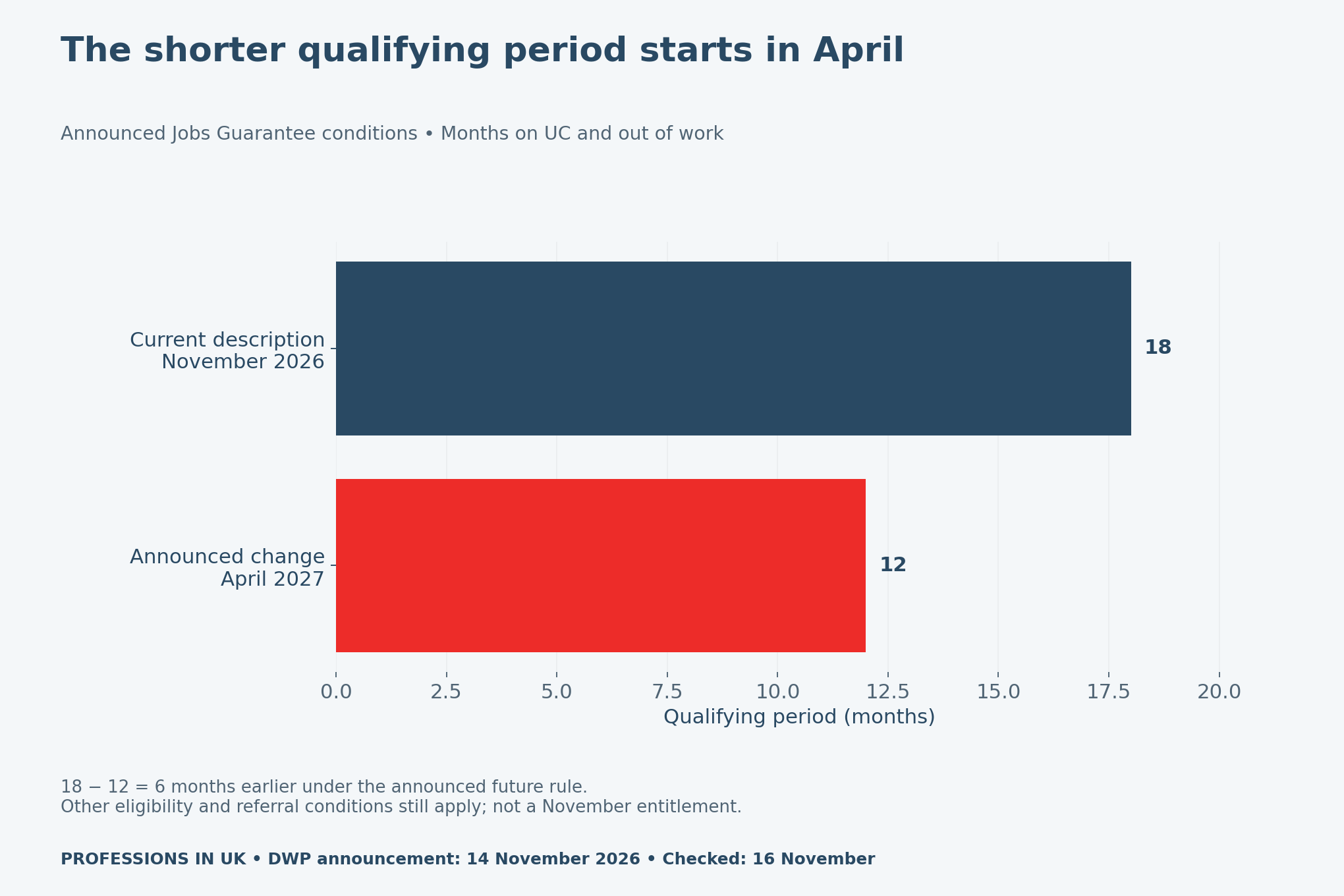
Read “eligible” as a condition that still needs checking. A number in a chart cannot account for every circumstance in a Universal Credit claim. Nor does reaching a duration threshold tell you which local partner has a suitable role ready. Those are questions for the official referral conversation.
Put the enquiry date beside the rule
For an adviser, the simplest safeguard is to write the date of the conversation before discussing the qualifying period. Then open the current official notice and identify whether the wording describes a present rule or a future change. Keep the publication date separate from the implementation date in your notes.
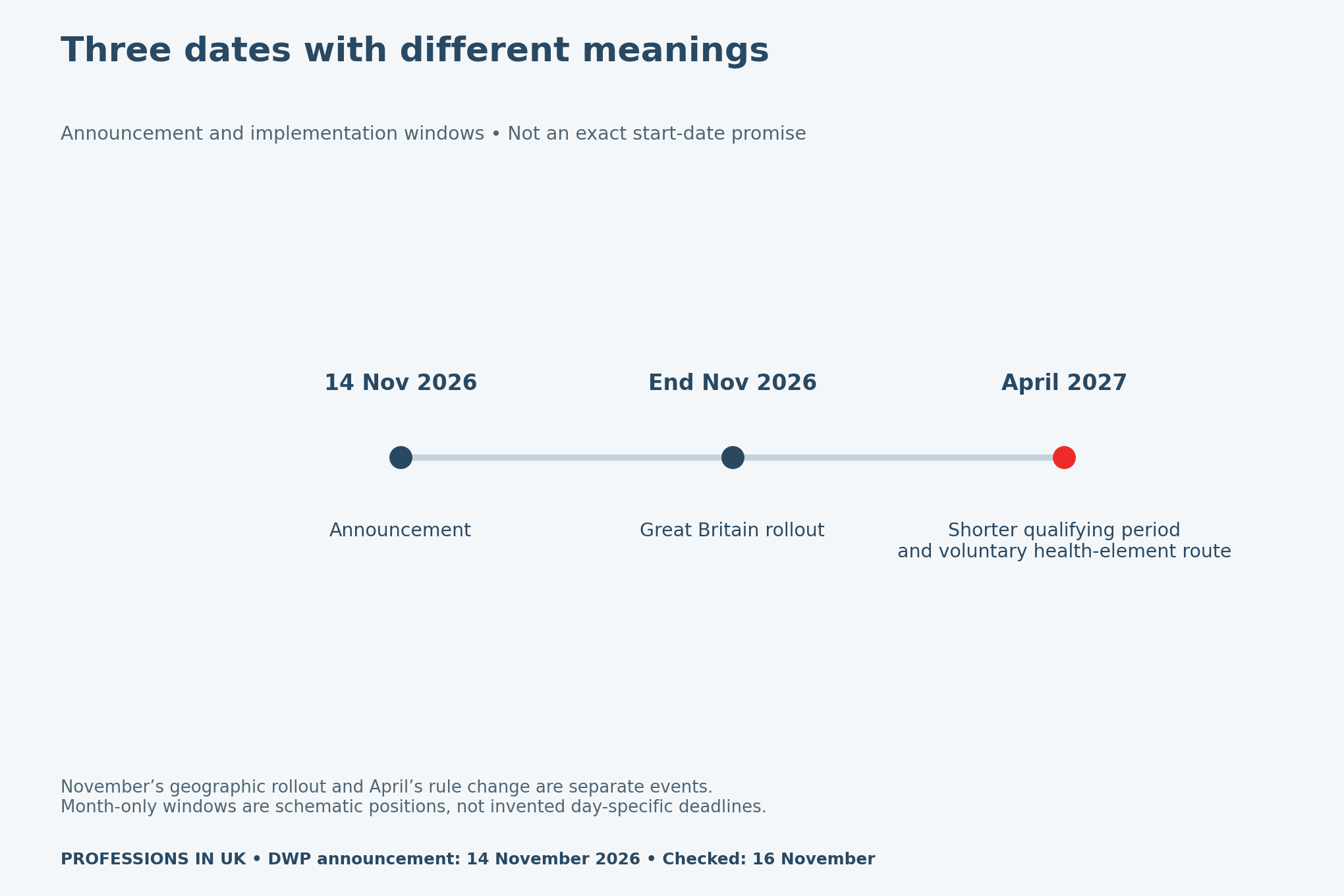
For example, imagine a fictional November enquiry from someone who has been on Universal Credit and out of work for 13 months. The announcement alone would not justify telling them that the future 12-month rule already applies. Record the question for their work coach and check which support is available now. Do not simply tell them to wait without exploring the official current options.
Now imagine a conversation taking place after the April change. The older 18-month wording would need rechecking against the guidance then in force. A saved screenshot of today’s announcement helps document your research, but it cannot prove the rules have remained unchanged. Put a recheck date into the planning sheet.
Great Britain does not mean every UK jurisdiction
The announced geographic scope is England, Scotland and Wales. Do not automatically extend it to Northern Ireland. If the reader lives elsewhere, start with the appropriate local official employment-support service rather than transferring this timetable across jurisdictions.
Even within Great Britain, a national rollout announcement is not verification that every local referral route is operational on 16 November. Ask who serves the area and what the next step is. Keep a confirmed local answer separate from the government’s intended rollout window.
Separate scope, timing and referral
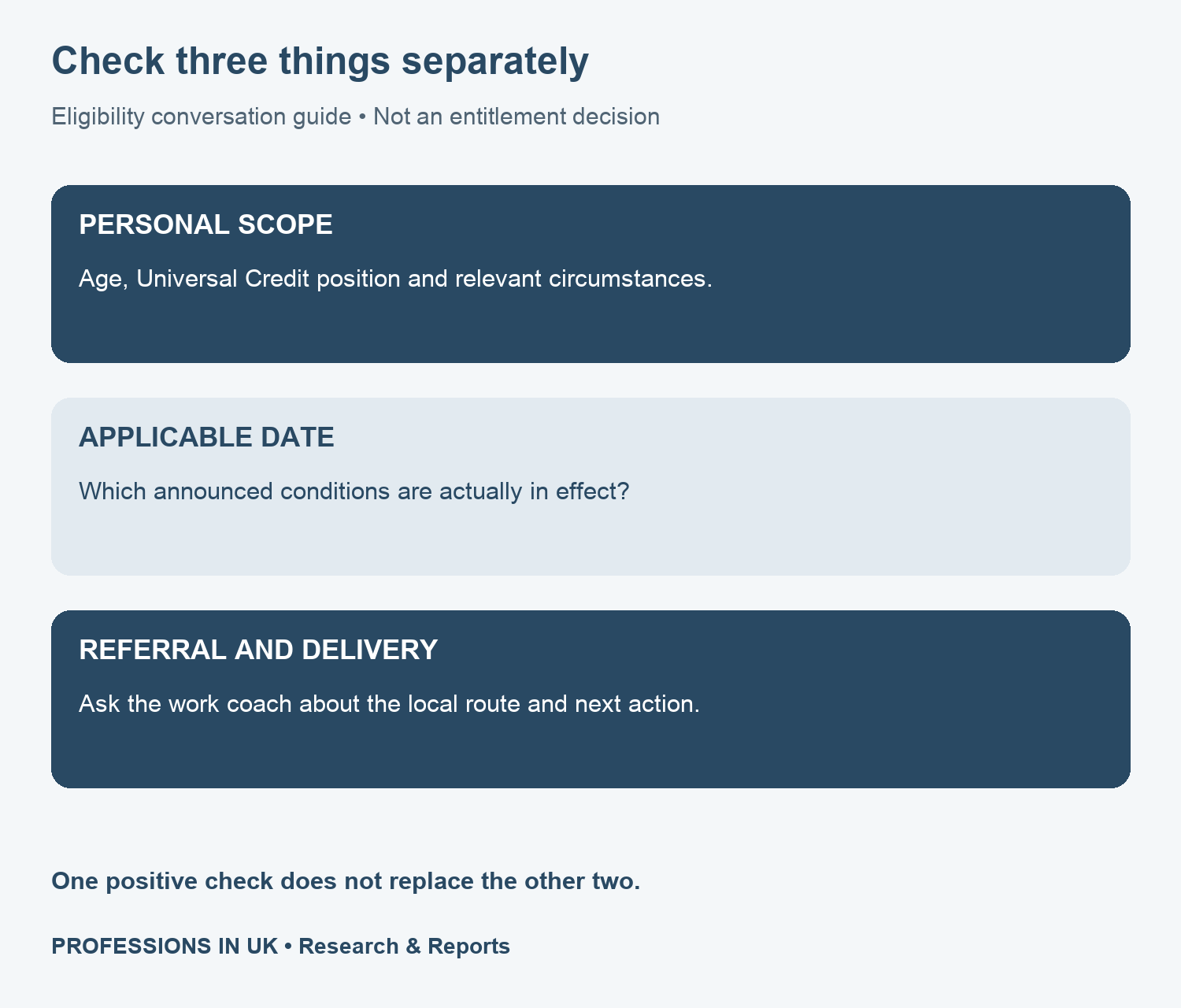
The first check concerns the person’s position. The second concerns when the relevant policy applies. The third concerns the work-coach and delivery-partner route. A positive answer to one does not settle the other two. This is why an adviser should avoid creating a single “yes/no” result from a few public facts.
You do not need to send us benefit records, health details or identity documents to use this guide. The blank discussion sheet works as a private list of questions. Leave sensitive details out of it and use approved official channels for information the work coach needs.
Ask about the matched job, not just the programme name
Before making plans around a role, ask about its duties, location, hours, contract dates and support. A placement description should be concrete enough to consider travel and practical commitments. If an answer is not yet available, mark it as unconfirmed instead of filling the gap with an assumption.
The announcement describes government funding for up to 25 hours a week over six months at the relevant minimum wage. “Up to” is a ceiling, not proof of a specific schedule. Six months describes the funded placement; it does not by itself promise a permanent role afterwards. Ask what progression discussions will take place and who will support them.
| Discussion area | A useful question | Keep the answer distinct from |
|---|---|---|
| Schedule | What hours and shifts are proposed for this role? | The programme-wide funding ceiling |
| Support | Who is the contact before and during the placement? | A general promise of support |
| Access | What arrangements can be discussed for my circumstances? | An assumed one-size-fits-all role |
| Progression | What happens as the funded period ends? | An assumed permanent offer |
| Income | Who can explain the individual pay and benefit position? | A calculation from weekly hours alone |
Keep the health-element change date explicit
DWP says eligible recipients of the UC health element can take part voluntarily from April 2027. Preserve both the eligibility qualification and the implementation month when discussing that change. Do not use this sentence to decide a person’s current requirements or benefit entitlement.
If someone needs advice about how employment affects their claim, direct that question to the appropriate official adviser. An hourly funding limit is not enough to calculate take-home pay, deductions, benefit interactions or the value of taking a particular role. Our templates deliberately do not produce those outputs.
Programme ambition is not today’s vacancy count
The announcement’s ambition is to support more than 90,000 participants by March 2029. That is a future programme measure. It is not a list of current openings, a local allocation or evidence that a specific occupation has places available. We therefore do not divide that figure into speculative monthly vacancies or individual chances of referral.
Personalized UK Career Consulting
Receive tailored career guidance designed just for you. Get actionable steps and expert support to boost your career in 1-3 days. Take control of your career now.
Get StartedOur separate apprenticeship brokerage analysis for England concerns a different initiative. Keep programme names, funding measures and application routes separate when comparing public employment and training support.
Method, limits and downloadable conversation tools
This is an analysis of a dated DWP policy announcement, especially its explicit Additional Information dates. The chart subtraction is 18 minus 12, giving six months. The timeline is schematic, with no invented day for the rollout or April change. No claim, referral or local delivery test was performed.
The announcement compresses some of the timetable in its introductory narrative. We use the detailed dates rather than interpreting the future 12-month condition as already current. Recheck official implementation information when you use this guide. These tools are not an official application form, a benefits calculator or proof of eligibility.
- Dated rule comparison (CSV)
- Dates, measures and source register (CSV)
- Blank work-coach discussion sheet (CSV)
- Blank official-guidance recheck log (CSV)
Suggested citation: Professions In UK, “Jobs Guarantee Eligibility: November 2026 vs April 2027”, checked 16 November 2026. Source: Department for Work and Pensions, announcement published 14 November 2026. Templates are independent editorial aids.


