





A freelance vs employed comparison in the UK’s creative industries means looking beyond the freedom to choose your hours. You also need to know when income arrives, what work fits into the week and whether there is space to keep learning. Those questions matter before you change arrangements, rather than after the calendar is full.
New research provides a useful starting point, but it cannot choose for you. This report separates group-level findings from a private planning exercise. It includes five charts, a terms-comparison infographic and four free CSV tools. Every worked weekly schedule is fictional. Research checked on 12 November 2026.
Freelance vs employed: read the creative-work comparison carefully
Creative PEC published its new job-quality study on 11 November. The report uses self-employment as an imperfect proxy for freelancing. Its employment-status categories do not cover every way a creative freelancer can work, and they do not determine anyone’s legal or tax position.
The original report, pages 48–49, compares historical observations. Figure 5.1 draws on APS/LFS 2023–2025 and Understanding Society Wave 14, 2022–2024. A new publication date therefore does not make these a November 2026 workforce poll. We retain that combined source note rather than imply a single survey period or common respondent base.
Keep household-income satisfaction separate from earnings
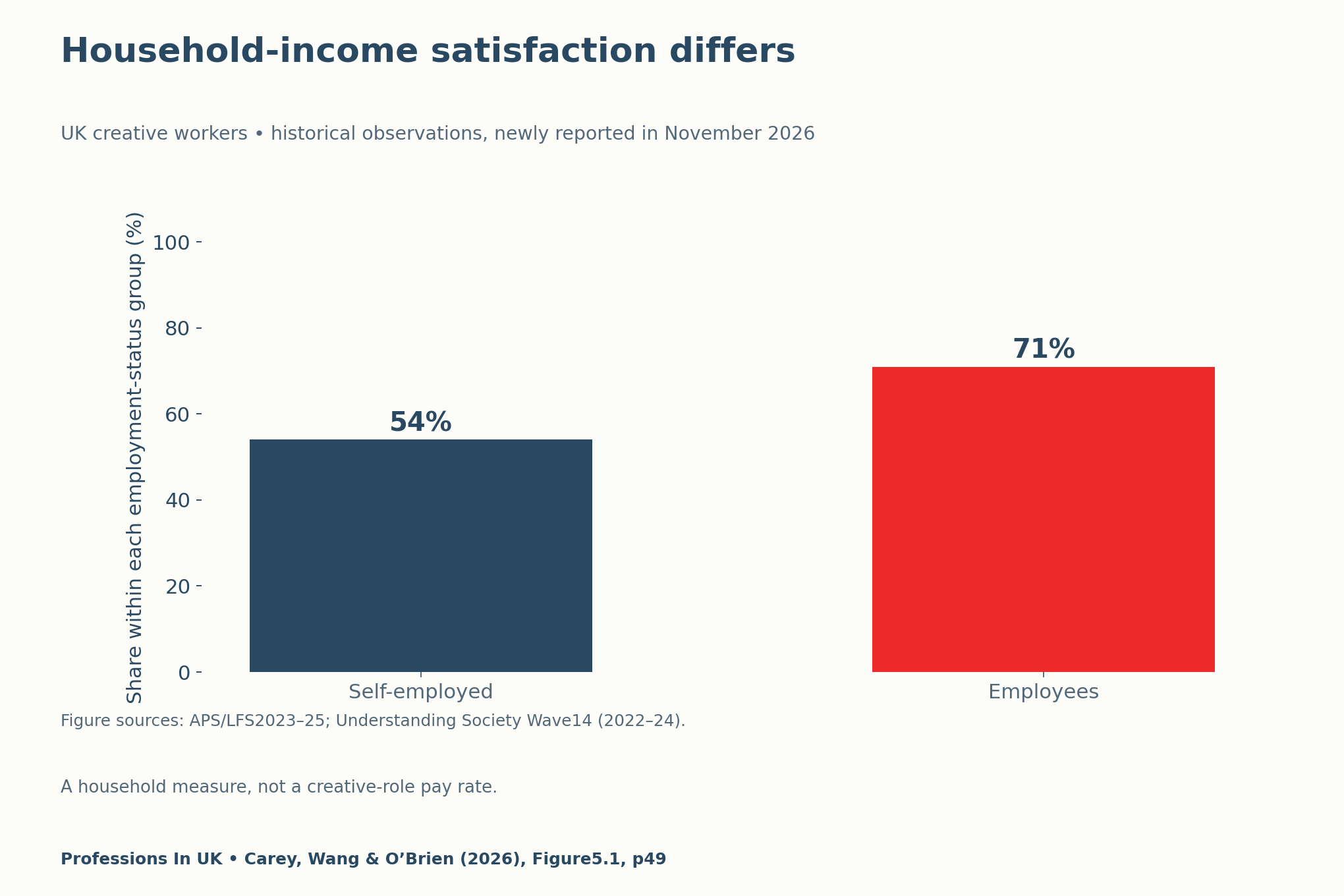
The difference is 17 percentage points: 71 minus 54. It does not mean employees earn 17% more, nor does it estimate the change in your income if you switch. Household income can include other earners and sources. Compare your own confirmed receipts and commitments privately instead of treating a satisfaction measure as a salary benchmark.
Payment terms deserve their own line. A quoted fee, an approved invoice and money received are different events. Record the agreed payment date, acceptance process and any conditions that affect when payment becomes due. Keep a potential project separate from confirmed work.
Autonomy over hours does not remove other time demands
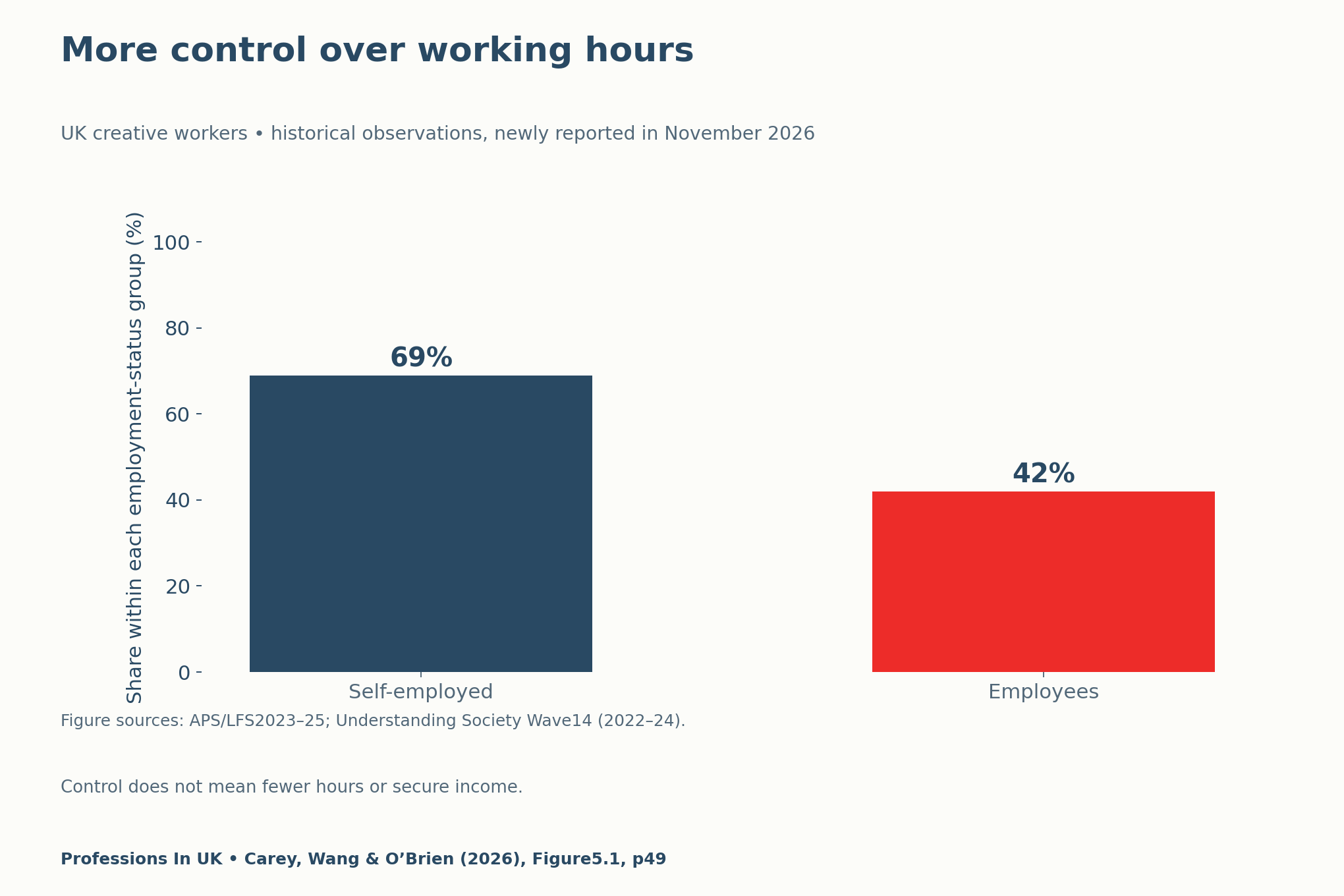
For a particular arrangement, ask what control means in practice. A client can leave you free to choose a start time while expecting a fixed delivery date. An employer may offer flexibility within team commitments. The written terms and working expectations matter more than the label alone.
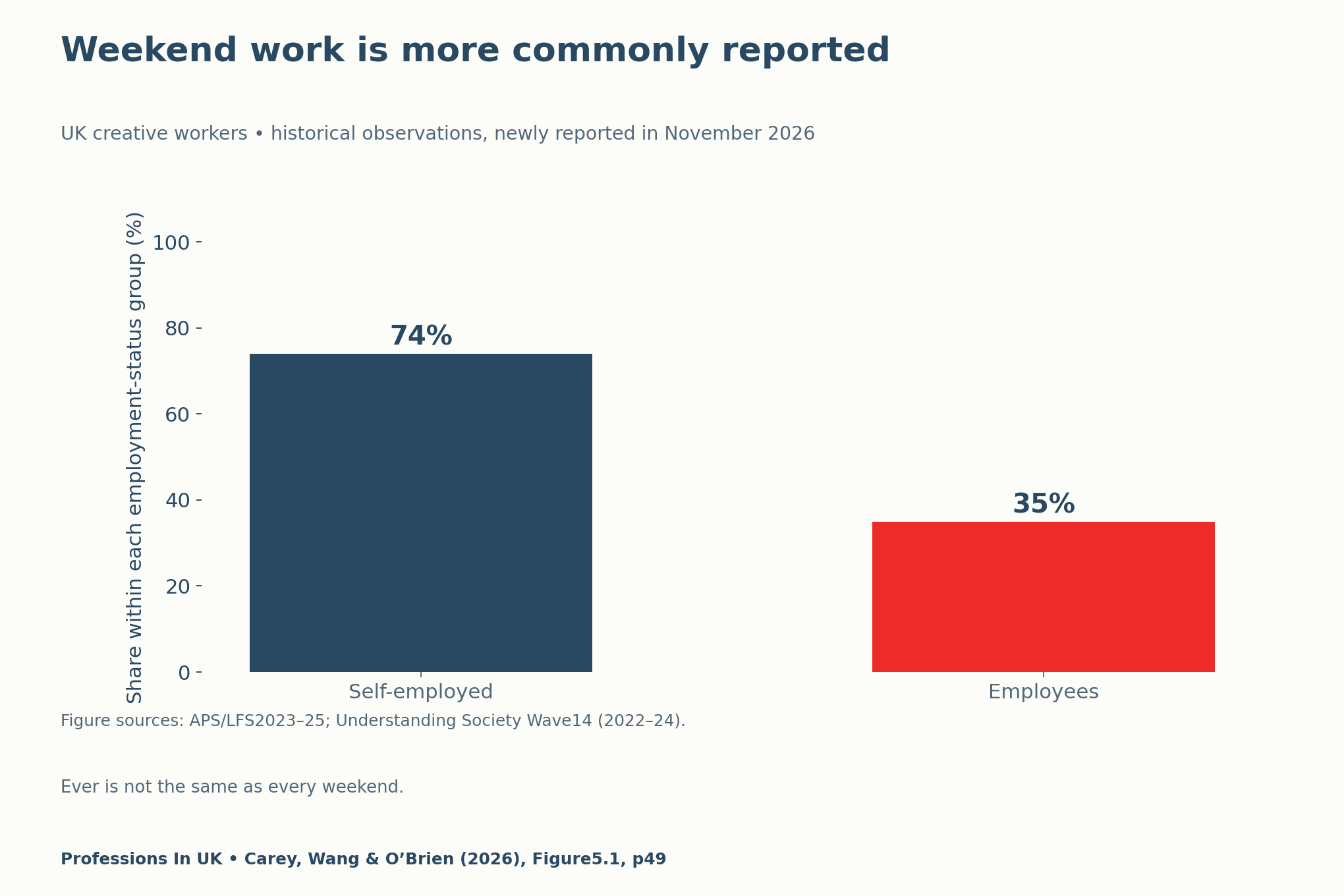
The 39-point gap is a descriptive subtraction, not a prediction about your future weekends. If evenings or weekends are important to you, make that constraint explicit in your plan. Do not hide it by assuming all work can be moved to another day without consequences.
Protect development time before filling the diary
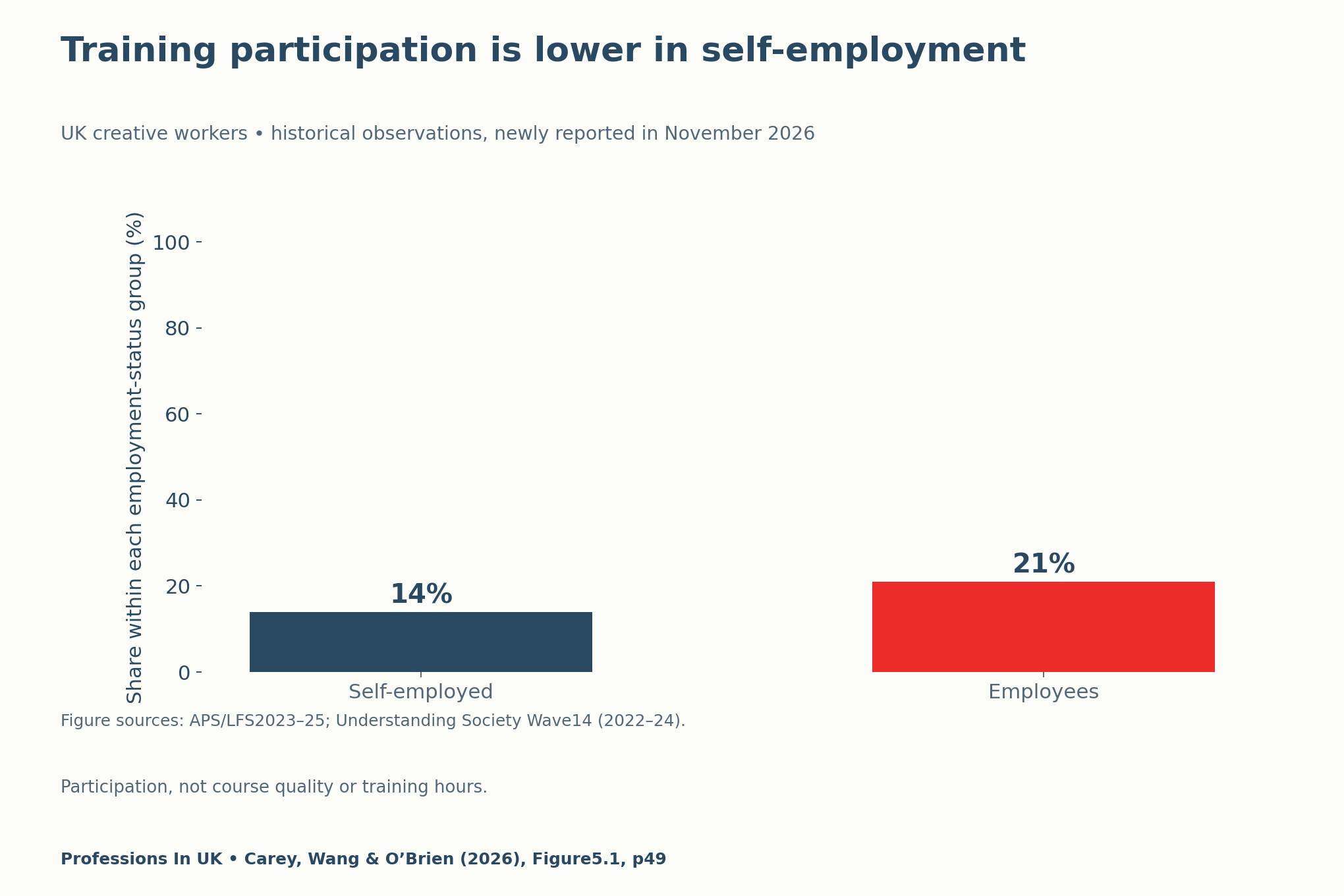
Learning needs an allocation as well as an intention. For an employed role, ask what time, budget, access and approval are actually available. For freelance work, consider the time needed to practise and update your tools alongside client delivery. Do not assume that either arrangement automatically supplies the right support.
A useful learning goal names an output you can inspect. For example, you might plan a small portfolio exercise using a new technique, with a defined scope and review point. Keep any employer or client material confidential and use authorised or invented inputs. Completion is evidence of that exercise, not proof of wider competence.
Budget the whole working week
Our fictional example starts with a 40-hour work budget that the individual has already decided is available. It allocates 24 hours to client delivery, five to business development, four to administration, three to learning and four to contingency. The total is 40; delivery occupies 60% of this invented work budget.
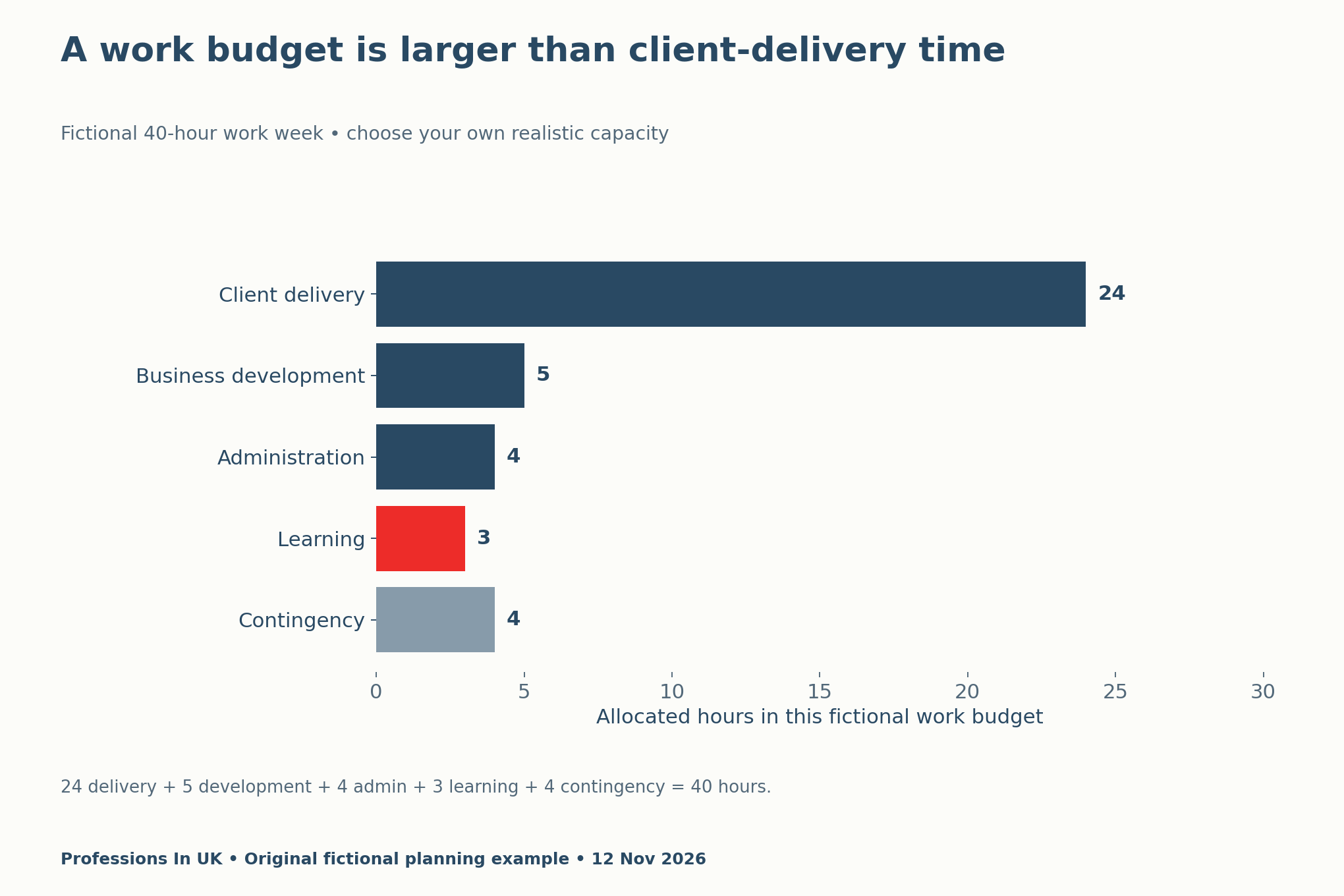
Choose your own capacity after considering caring commitments, rest, leave and other obligations. Those commitments are not assumed to fit inside or outside our invented example. If your available work budget is smaller, change it before allocating tasks. Do not begin with a desired revenue figure and quietly add unlimited hours.
The worksheet uses planned total = delivery + business development + administration + training + contingency + other work. Remaining budget = available work hours minus planned total. A negative result flags a conflict in the assumptions; it is not a command to work longer.
Compare confirmed terms with unanswered questions
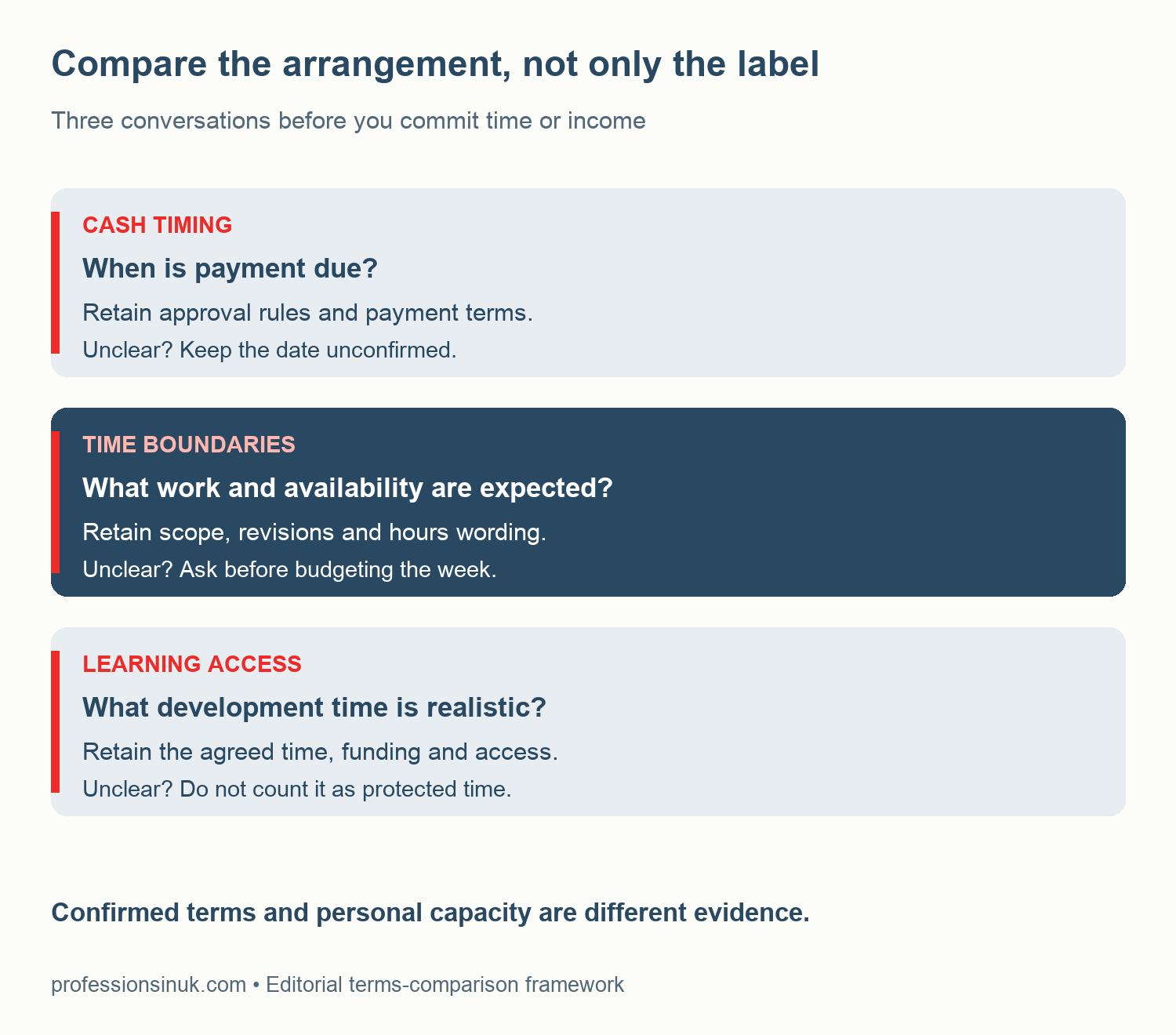
Use the comparison template for a real offer or engagement without uploading private contract details to us. Copy only what you need for your own record, identify the source and mark unconfirmed terms. This template does not draft a contract, decide employment status or assess enforceability.
| Topic | Evidence to retain | Planning implication |
|---|---|---|
| Payment | Agreed date and acceptance conditions | Keep timing uncertainty visible |
| Scope | Deliverables and revision boundaries | Leave time for the work actually included |
| Availability | Expected hours, meetings and response windows | Check compatibility with personal constraints |
| Learning | Confirmed time, funding and access | Do not budget support that is only assumed |
For related preparation, see our guides to interpreting salary ranges and showing self-taught skills on a CV. Use current evidence and the actual terms, rather than a generic claim that one work arrangement is always better.
Personalized UK Career Consulting
Receive tailored career guidance designed just for you. Get actionable steps and expert support to boost your career in 1-3 days. Take control of your career now.
Get StartedDownload the source comparisons and planning tools
The first CSV records the four reported comparisons and percentage-point arithmetic. The remaining files contain the fictional week, a blank weekly planner and a blank terms ledger. They are planning resources, not collected household budgets or a representative survey of schedules.
- Selected historical group comparisons (CSV)
- Fictional weekly-capacity calculation (CSV)
- Blank weekly-capacity planner (CSV)
- Blank offer and engagement comparison (CSV)
Methodology, limitations and citation
We checked the original figure and its employment-status definitions. The observations compare groups; they do not follow one person through a change of arrangement. Subsector, hours and circumstances can differ. The figure does not give a single common respondent count for these measures, so we do not invent one or combine the percentages into a score.
Our planning arithmetic is independent of the survey estimates. The fictional allocations sum to 40 hours, and 24 divided by 40 gives 60%. Personal scenarios remain on the reader’s own device. No contract, household finances, tax position or employment-status case was assessed.
Source citation: Carey, H., Wang, R. and O’Brien, D. (2026), Job quality in the creative industries, 2026, Creative PEC State of the Nations series, DOI 10.5281/zenodo.23763526. Original planning tools: Professions In UK, 12 November 2026. Cite the original report alongside any reused findings.


