





Prison employment support job offers are an important milestone, but they do not establish that someone started work. The new Future Skills Programme evaluation records 862 offers. Its practical lesson for employability teams is to make the handoff visible: who will confirm contact, timing, travel and the next action?
Prison employment support job offers: what was measured
The Ministry of Justice release of 19 November 2026 describes a process evaluation across 23 prisons in England and Wales. Monitoring covers November 2023 to March 2026. The evaluation report records 2,103 allocations, 1,589 completions, 999 successful interviews and 862 job offers. Those are programme milestones, not a measured sustained-employment rate.
The report also makes a crucial evidence boundary clear: the researchers did not interview participants after release. Therefore, accounts of through-the-gate support cannot stand in for direct follow-up with everyone who received an offer. This article uses that limitation to design a modest operational exercise, not to claim a proven solution.
Read the milestones separately
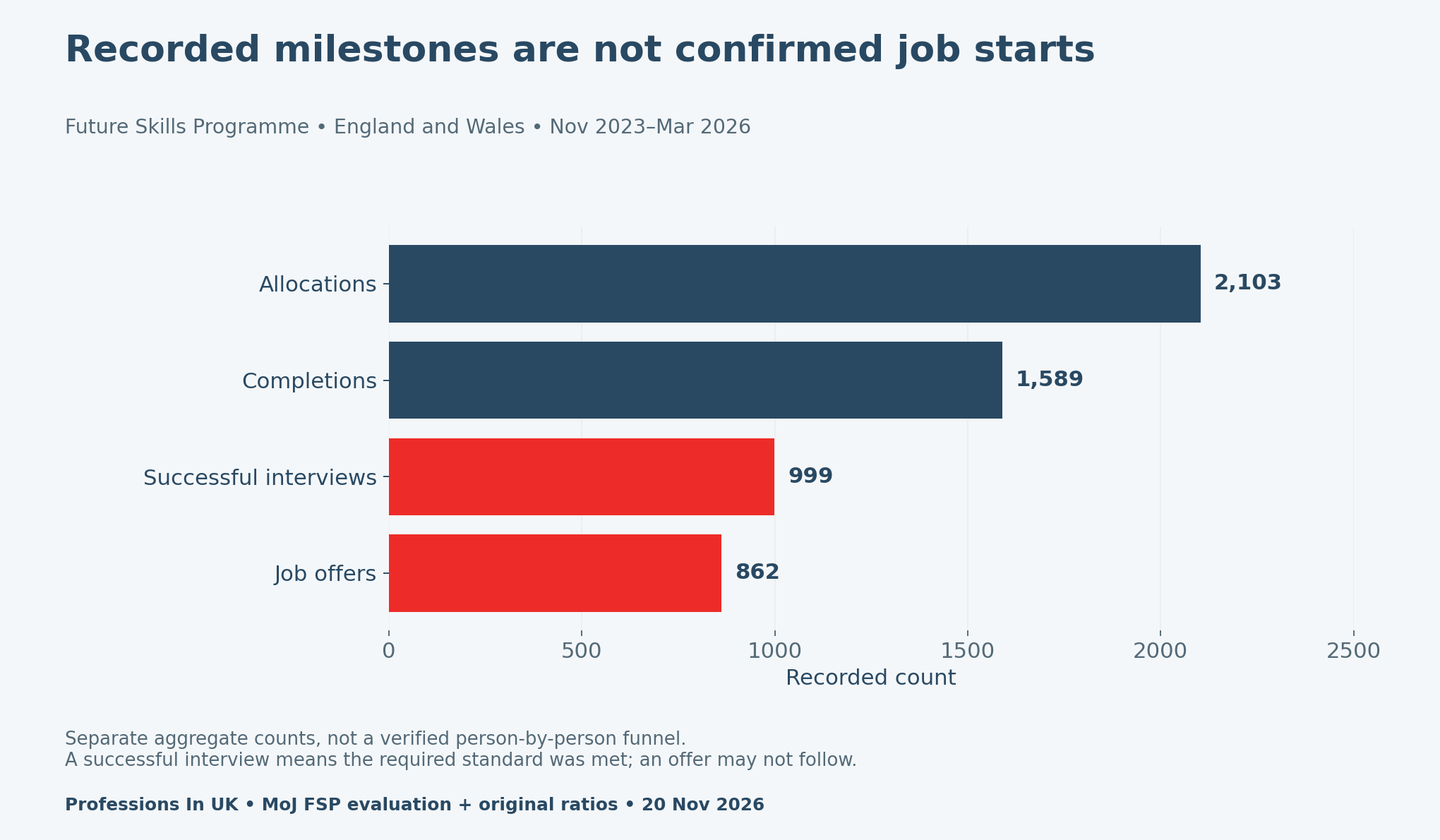
An allocation answers who was assigned to a course. Completion answers whether the programme milestone was recorded. A successful interview means the employer’s required standard was met, even if no offer followed. An offer is still different from an acceptance, an actual start and continued employment.
For a team dashboard, give each measure its own definition and reporting period. Do not draw connecting arrows simply because counts get smaller. Before treating rows as a funnel, you would need appropriate linked records, clear timing rules and a method for handling repeat events and missing follow-up.
Keep the denominator attached to the percentage
Dividing 1,589 completions by 2,103 allocations gives 75.6%, using the displayed figures. Dividing 862 offers by 999 successful interviews gives 86.3%. The second calculation compares aggregate counts; it does not verify that a particular successful interview converted into an offer.
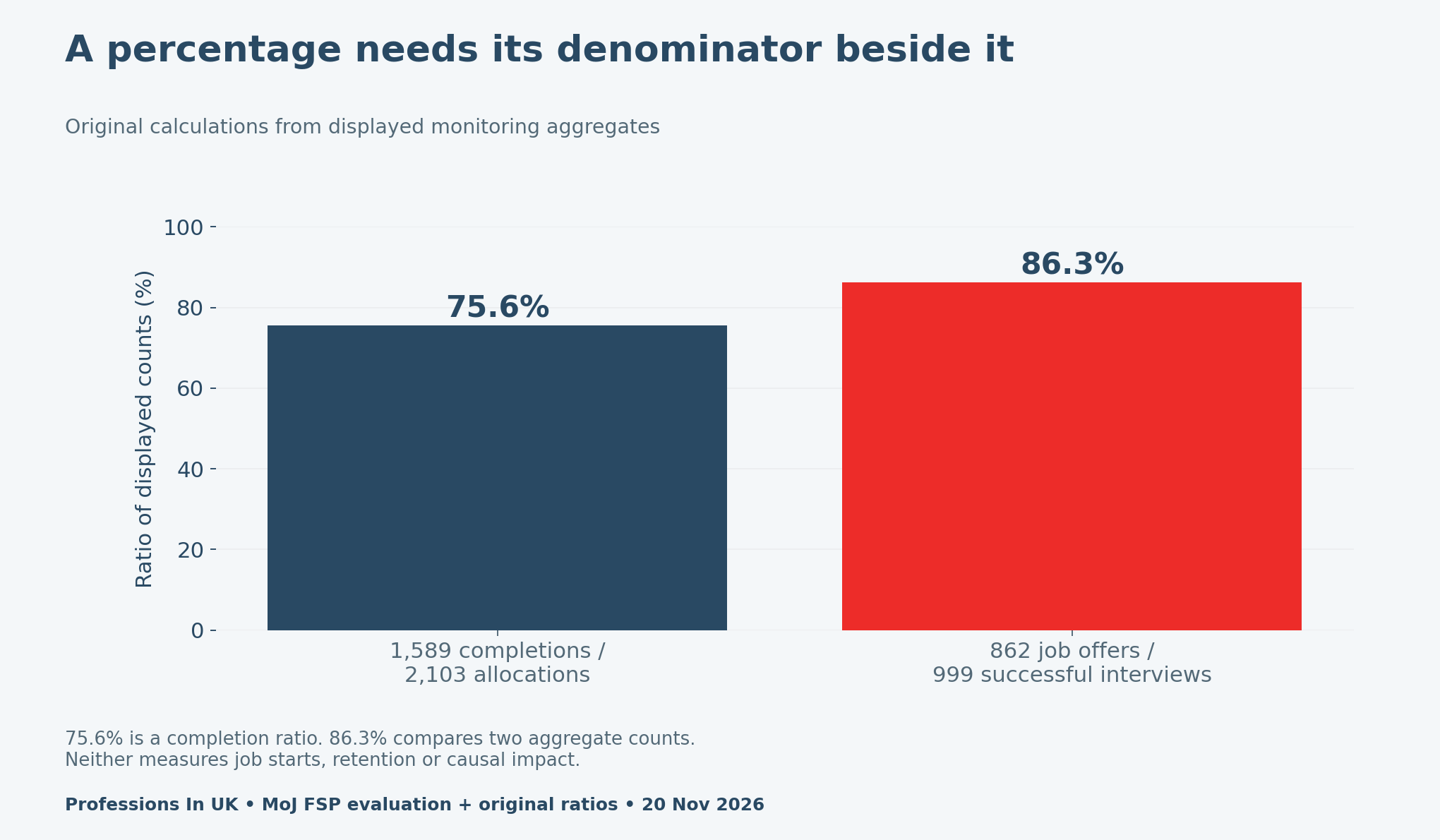
A useful label says what is divided by what. An unhelpful label says only “success rate”. The latter lets readers substitute their own meaning, which might be a start, a sustained job or reduced reoffending. None follows from these two calculations.
What should an employment handoff record contain?
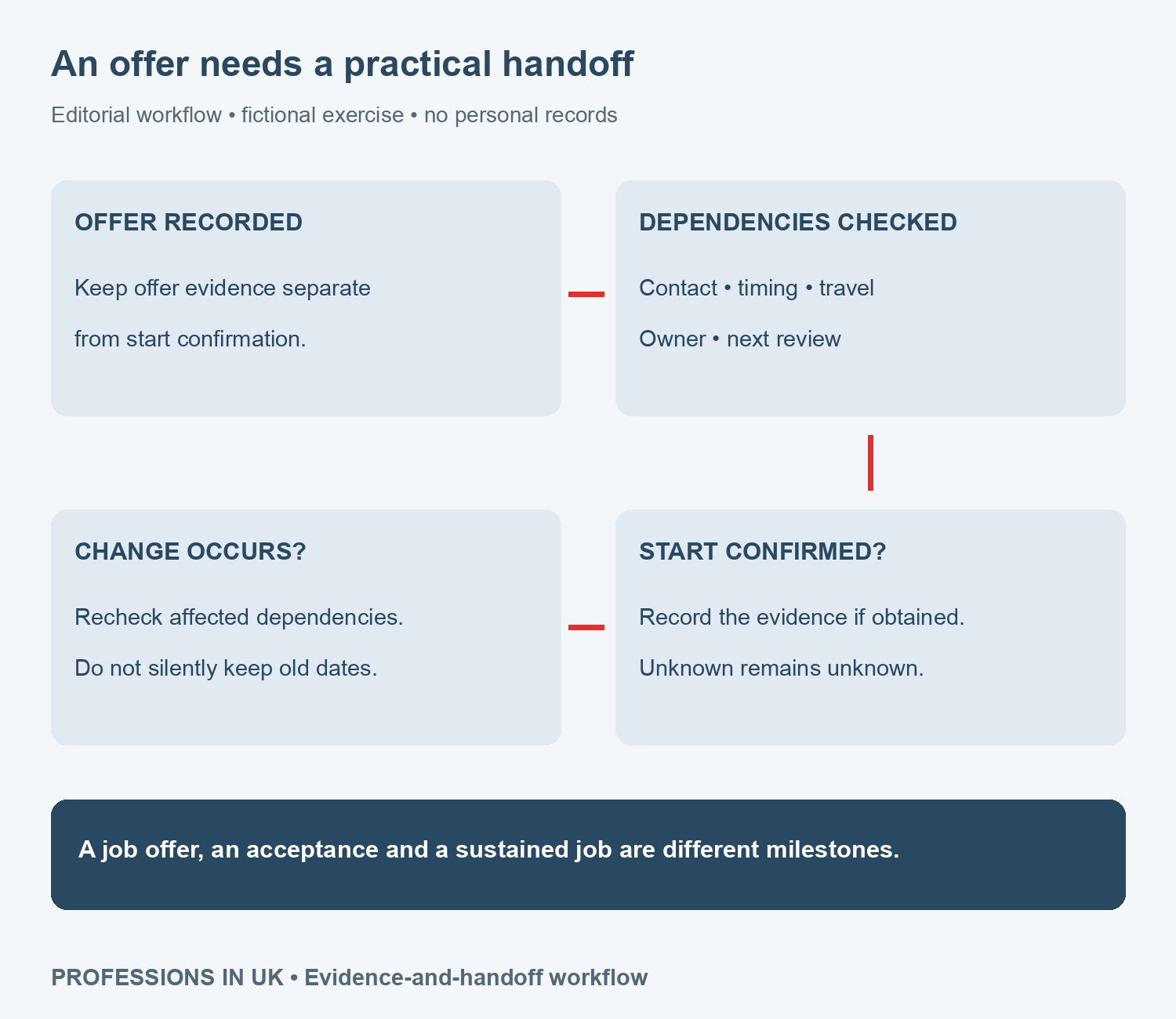
Begin with a case alias for the training exercise and the milestone you can actually evidence. Next, record the status of the contact route, start arrangement and travel check. Keep each unresolved dependency in a separate field with an owner role and a next review date.
A field should lead to a useful action. “Travel uncertain” needs a specific follow-up, such as checking the route at the proposed start time through the relevant support process. “Contact agreed” needs confirmation that the route remains usable after release. Avoid converting a missing answer into a negative judgment about the individual.
| Field | Practical purpose |
|---|---|
| Contact route | An agreed way to reach the person and employer |
| Start arrangement | Proposed day, time, place and confirmation status |
| Travel | Route, practical access and unresolved dependency |
| Dependency | What must be settled before the start |
| Handoff owner | Role responsible for confirming the next action |
| Follow-up | Next check date and evidence of the result |
Work through a changed-release-date example
Imagine a fictional participant with a provisional Monday start and a travel plan based on a Friday release. A revised release date arrives. The offer has not automatically disappeared, but the old contact and travel assumptions may no longer hold. Mark the affected fields for review rather than replacing the entire history.
Assign a role to confirm the employer’s position through the authorised contact route. Recheck practical timing and any necessary coordination. Then record the response, evidence reference and next action. Do not label the case “started” because an employer is expecting someone, or “failed” merely because confirmation has not arrived.
This exercise tests record quality rather than the person. A colleague should be able to identify what changed, which dependency is unresolved and who acts next. If the worksheet cannot answer those questions, simplify the handoff or clarify responsibilities before adding more fields.
Separate an operational tool from an impact claim
A clearer log can make uncertainty easier to see. It cannot by itself show that more people entered work because of the programme or the log. An impact claim needs an appropriate evaluation design, outcome definitions and comparison strategy. The current process report should not be relabelled as that evidence.
Likewise, a start confirmation would still not establish retention. Define the follow-up period and outcome separately if a service legitimately collects them. Keep “unknown” distinct from “not employed”, and do not count an unanswered contact attempt as evidence of either result.
Our capacity-planning guide offers a related way to attach activities to owner roles and time commitments. Here, the emphasis is continuity between an offer and the next confirmed milestone, with careful limits on what the data can establish.
Personalized UK Career Consulting
Receive tailored career guidance designed just for you. Get actionable steps and expert support to boost your career in 1-3 days. Take control of your career now.
Get StartedDownload the data and handoff exercise
- Dated FSP milestone-count register (CSV)
- Aggregate-ratio calculations and interpretation limits (CSV)
- Operational handoff field dictionary (CSV)
- Fictional example and blank handoff row (CSV)
Methodology, privacy and limits
We checked the publication and report on 20 November 2026. Charts reproduce four reported counts and calculate two transparent ratios. They do not add linked participant data, job-start estimates, confidence intervals or causal conclusions. The exercise is our own editorial tool, not an official MoJ form.
Use fictional or appropriately de-identified information when practising. Do not place names, convictions, health details, private contact information or release arrangements into a publicly shared worksheet. For real cases, follow the service’s authorised systems and procedures. Prison employment support job offers deserve accurate follow-up, without turning limited evidence into claims about people’s outcomes.


