




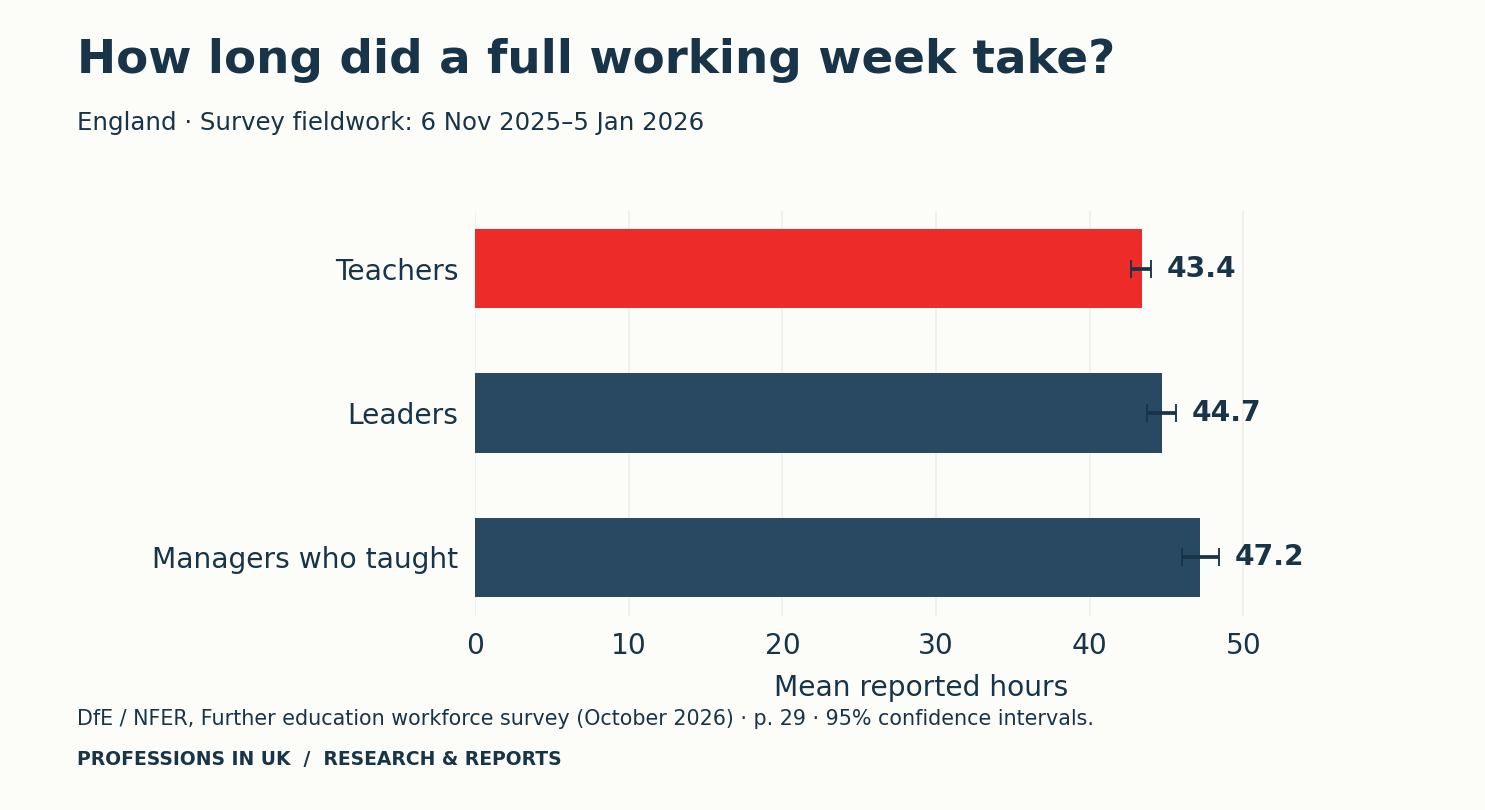
When you assess further education teaching workload in England, start with the timetable and ask what happens outside it. In a new Department for Education survey, full-time FE teachers reported an average of 43.4 hours in their most recent full working week. That figure covers more than classroom time, and your offer may look quite different.
Before you accept, ask the college to show you where preparation, marking, learner support and training fit. Then compare a lighter week with an assessment-heavy one. The worksheet below helps you separate what the employer confirms from what you estimate.
What the England workforce survey found
The Department for Education published its further education workforce survey on 29 October 2026. The National Foundation for Educational Research (NFER) collected responses from 4,440 teachers, managers and leaders between 6 November 2025 and 5 January 2026. The hours below describe each respondent’s most recent full working week during fieldwork, excluding their commute.
| Full-time role | Mean hours | 95% confidence interval |
|---|---|---|
| Teachers | 43.4 | 42.7–44.0 |
| Leaders | 44.7 | 43.7–45.6 |
| Managers who taught | 47.2 | 46.0–48.4 |
The report gives another useful benchmark. Full-time teachers averaged 21.9 hours of teaching, including online classes. In other words, the teaching timetable accounted for about half their reported working time at group level. Ask for a sample timetable, then ask what work the college expects you to do in the remaining time.
How staff viewed their workload
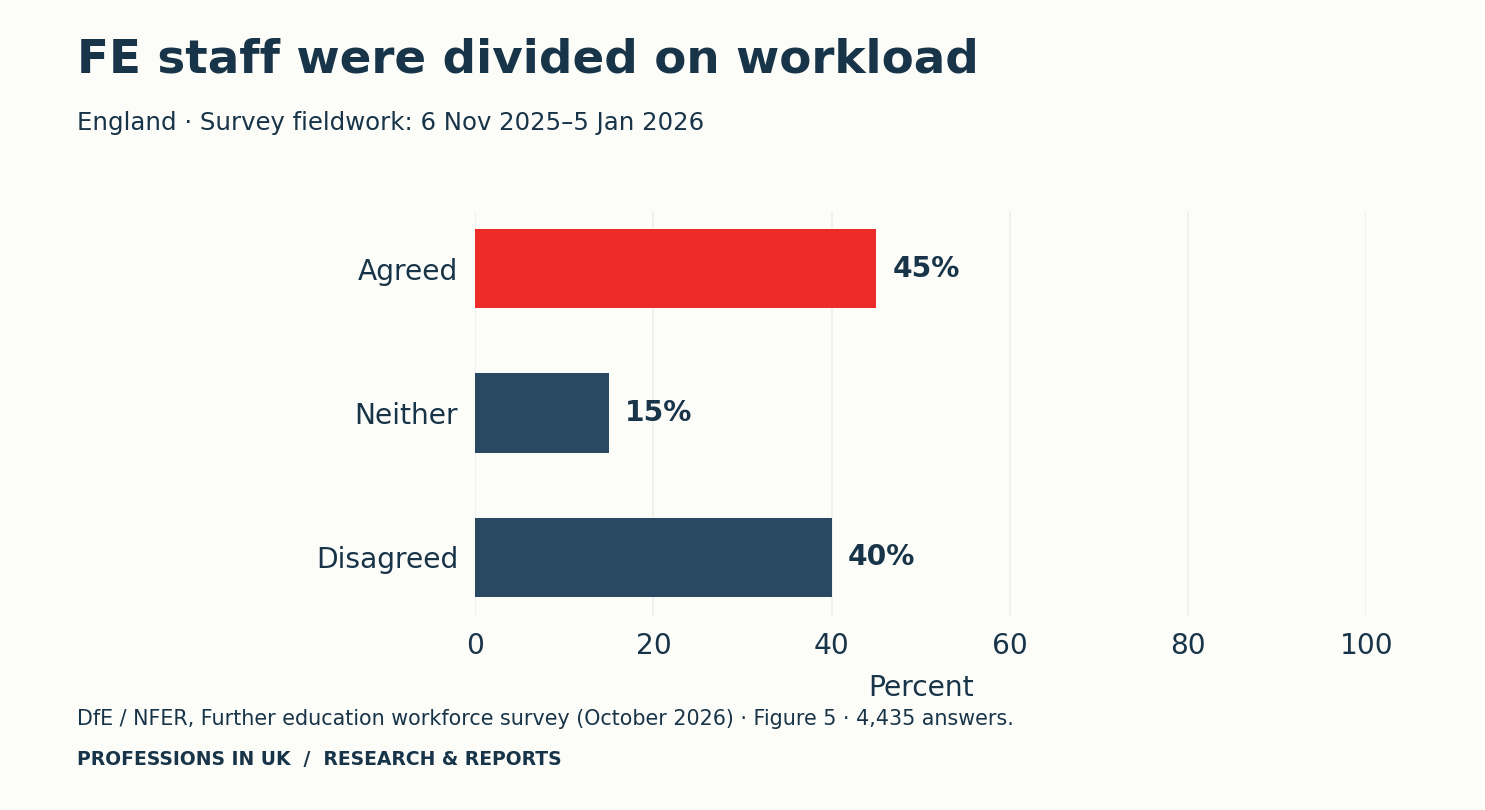
Across roles, 45% agreed that their workload was acceptable, 40% disagreed and 15% chose the middle response. In a separate question, 44% agreed that unfilled vacancies had increased their workload. A respondent could agree with both statements. So ask the college how it handles gaps in staffing, especially during busy assessment weeks.
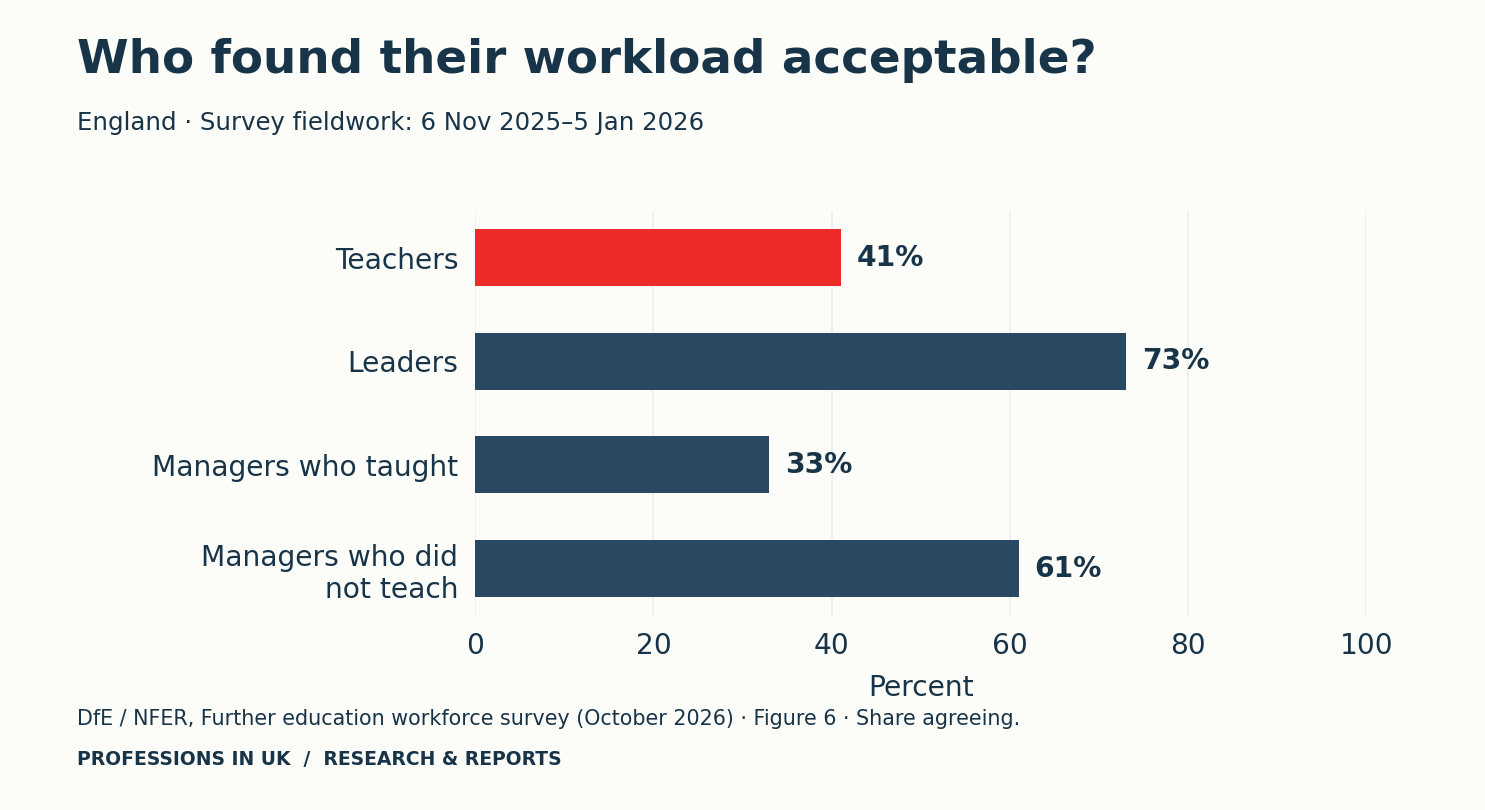
Views also varied by role. For example, 41% of teachers and 33% of managers who taught found their workload acceptable. The shares were 73% for leaders and 61% for managers who did not teach. These differences describe groups of respondents. They cannot tell you how well one college supports a particular team.
Put the whole teaching week on paper
Ask for contact hours, the number of distinct classes and the mix of levels. For example, two offers might both involve 22 teaching hours. However, the one with more courses may require you to prepare more lessons. Also ask if the timetable includes tutorials, placement visits or online teaching.
Next, list what happens between classes. Include lesson design, marking and feedback, learner meetings, team meetings, records and training. Count each task once. For instance, if a learner meeting falls inside a scheduled tutorial, avoid adding it again.

Try a lighter and a heavier week
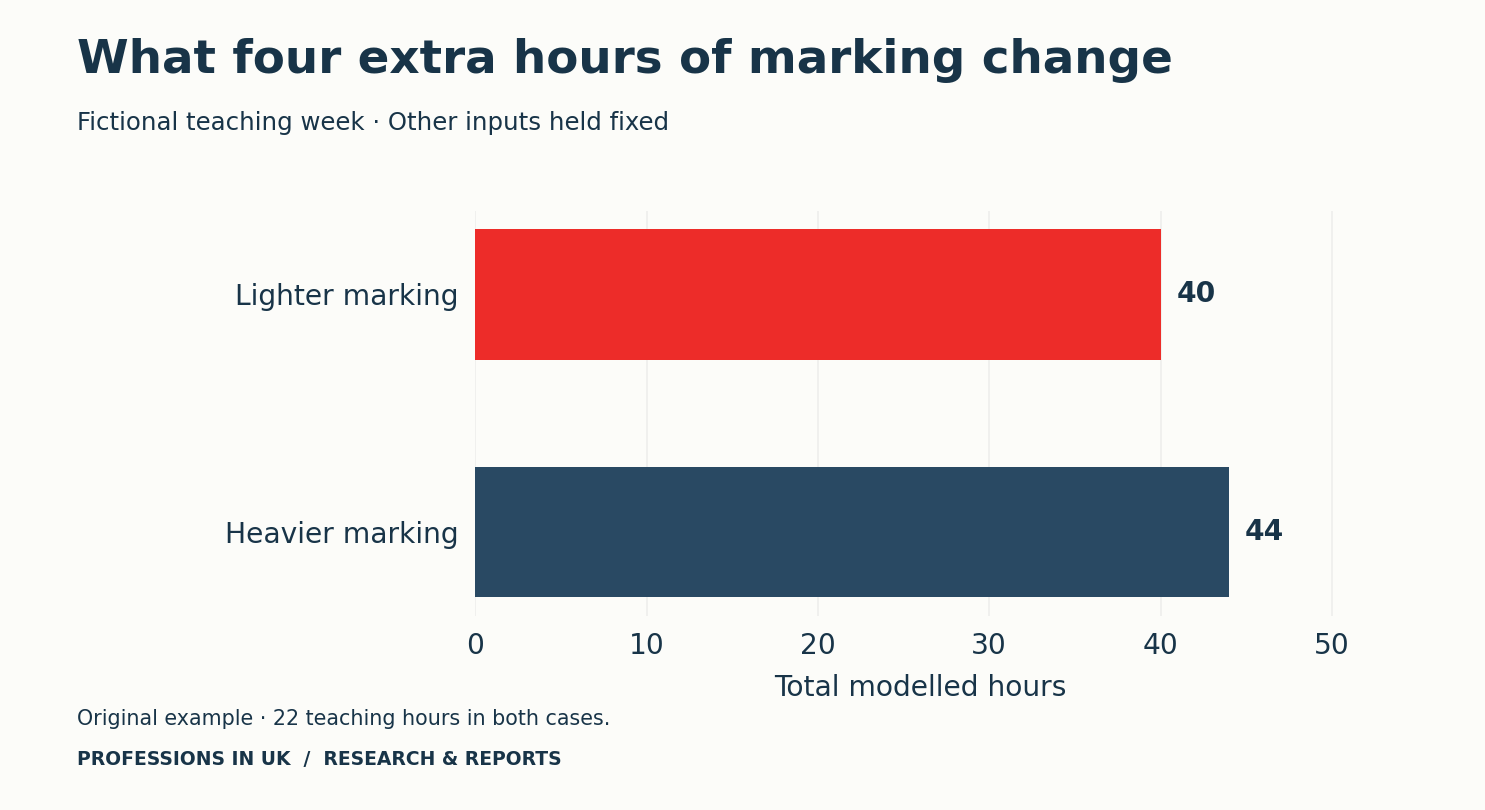
In our fictional example, teaching stays at 22 hours and preparation at seven. The lecturer also allows two hours each for learner support, meetings and records, plus one for development. Marking takes four hours in the lighter week. Together, the tasks take 40 hours.
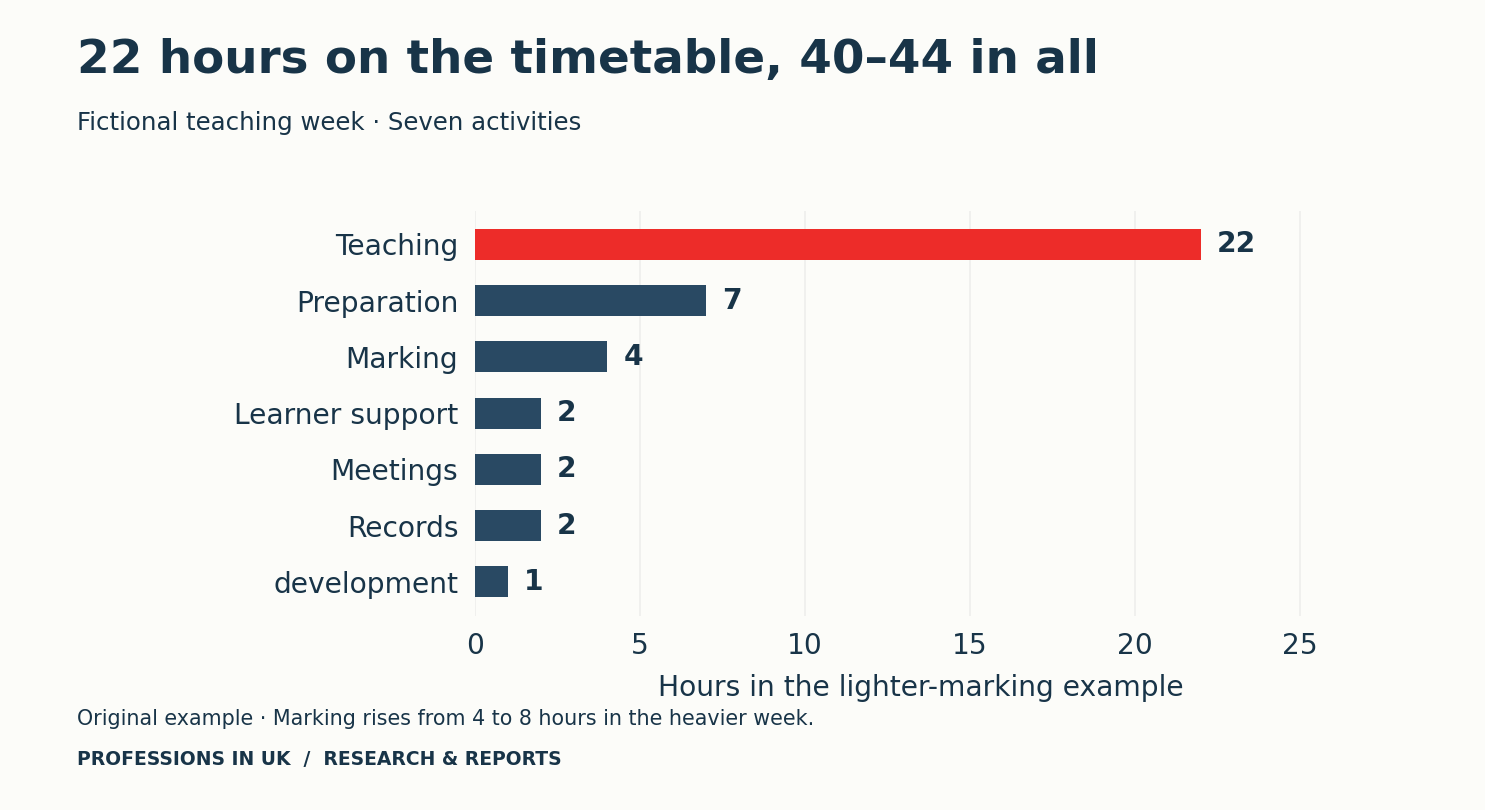
If marking rises to eight hours while everything else stays fixed, the total becomes 44 hours. Those four extra hours are visible even though the timetable stays the same. You can use the same calculation for other changes, such as another course to prepare or a late meeting that affects your travel plans.
Questions to ask the hiring manager
- Teaching: How many different courses and levels will I teach? May I see a representative week?
- Preparation: Which materials already exist? Who maintains them, and what time can I use to adapt them?
- Assessment: When do deadlines cluster? How many learners submit work, and who helps with moderation?
- Learner support: Which tutorials or placement visits sit outside the teaching timetable? Who handles follow-up?
- Cover: How does the team handle unexpected vacancies, sickness or additional groups?
- Training: Who pays for any required course? Which hours will the college set aside for study, observation or mentoring?
For each answer, record where it came from. A written term, a manager’s verbal description and your own estimate carry different weight. If an allocation is unknown, leave the cell blank and add a question. An empty cell should never silently count as zero hours.
If you are moving from industry, the DfE’s teaching job search guide points to current vacancy routes. Our retraining cost study offers a separate way to work through the time and cash needed for a qualification.
Compare the estimate with the written offer
Ask for the contract and the relevant workload policy. Check what period the college uses when it states an allocation. A weekly contact target and a total across the academic year answer different questions. Also find out when the team revisits the allocation if duties change.
Then add your commute separately when you consider how the role fits your life. The DfE working-hours measure leaves it out. If the heavier week would create a conflict, ask when it occurs and what the college can move. A concrete answer about assessment dates or training time gives you more to work with than a general assurance.
Sources, method and downloads
The DfE and NFER research report provides the source values on pages 29–30 and in figures 5–6. The survey used weights, but some differences from administrative workforce data remained. The researchers grouped independent training and adult community learning providers because the samples were small.
Personalized UK Career Consulting
Receive tailored career guidance designed just for you. Get actionable steps and expert support to boost your career in 1-3 days. Take control of your career now.
Get StartedThe averages describe self-reported hours during fieldwork in England. They cannot establish a college’s contractual hours, how much work an applicant would do or whether any hours went unpaid. Our worked example adds distinct activities. It uses chosen inputs and does not represent an advert audit or a typical week across colleges.
- Reported working hours and confidence intervals (CSV)
- Published workload responses (CSV)
- Worked example with lighter and heavier marking (CSV)
- Blank offer-audit worksheet (CSV)
Suggested citation: Professions In UK, “Further Education Teaching Workload in England: Check the Offer,” 4 November 2026. For survey estimates, also cite DfE and NFER, report RR1667/1. If you reuse the example, label it as fictional and carry over its assumptions.


