




UK construction recruitment difficulties in 2026 do not tell you your chance of getting hired. They describe employers’ experiences. Your next useful step is to check a suitable advert against evidence of your own work. This report combines the latest British Chambers of Commerce findings with our dated audit of 24 trade adverts.
We set a target of 30 adverts across three trades and two English search areas. However, the bricklayer searches supplied fewer eligible examples. We report that shortfall, preserve unclear terms and provide a downloadable audit. You also get a private skills-evidence worksheet to prepare a more specific application.
Research checked: 27 October 2026. Survey fieldwork: 18 August–15 September 2026. Vacancy information is a snapshot, not a promise that an employer will still be recruiting when you read this.
What UK construction recruitment difficulties in 2026 measure
The BCC release of 22 October covers more than 4,300 businesses; 92% were SMEs. Among businesses attempting recruitment, 71% reported difficulties, compared with 73% in the previous quarter. Construction’s rate was 79%, while retail’s was 64%.
Those percentages use the recruiting subset. They do not mean that 79% of construction firms have an opening for you. Nor do they show a 79% success rate for applicants. A firm can struggle to fill one specialist role while receiving many unsuitable applications.
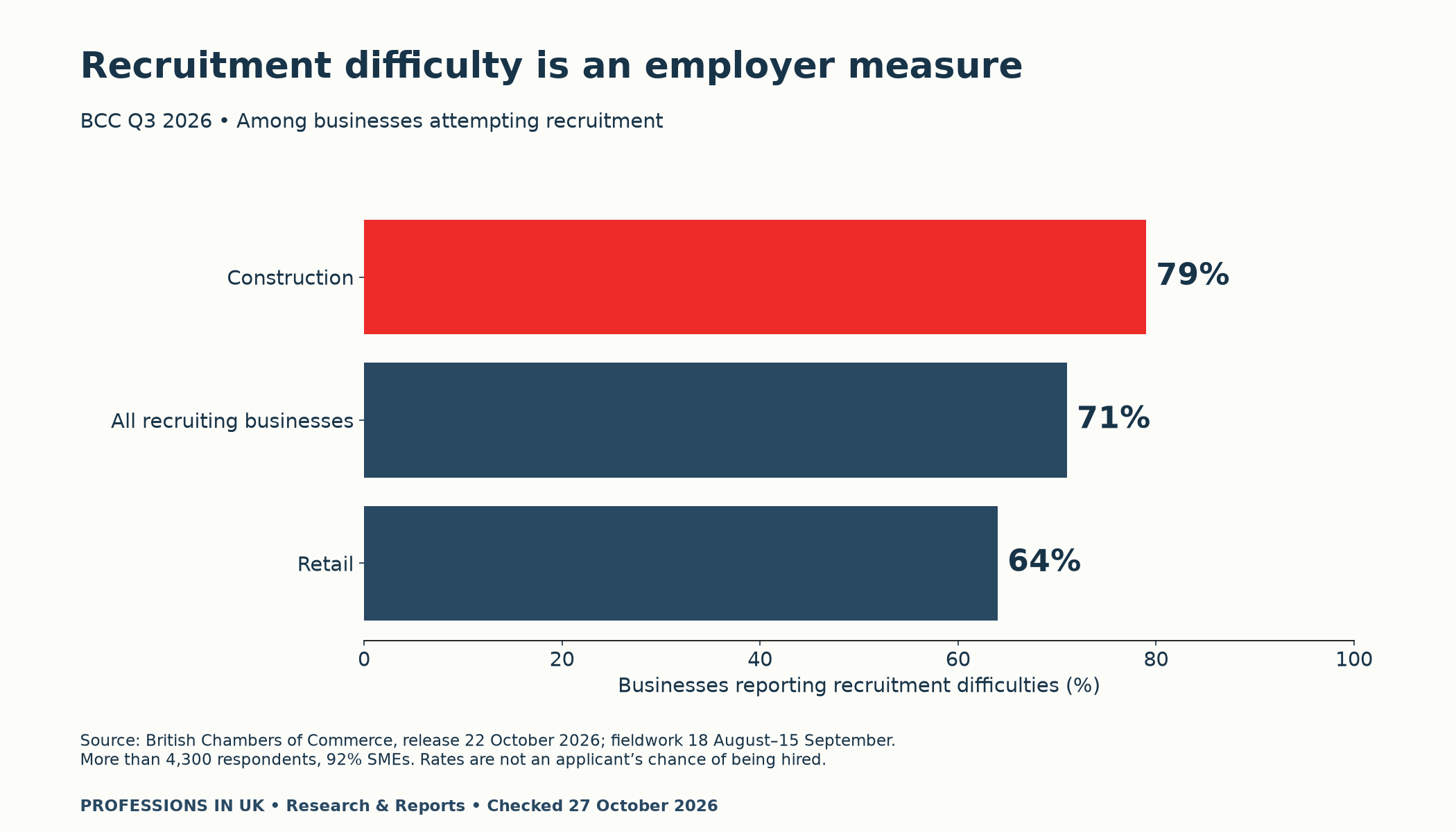
Separately, 23% of firms planned workforce expansion. That is an intention, not a count of vacancies or completed hires. The release does not establish every cause of recruitment difficulty. Therefore, a shortage headline should prompt investigation rather than an assumption that any certificate will secure an offer.
Training investment is a different question
The same release reports increased training investment at 20% of firms, unchanged investment at 63% and reduced investment at 17%. These responses describe changes in investment. They do not establish how many firms offer entry training, pay course fees or recruit beginners.
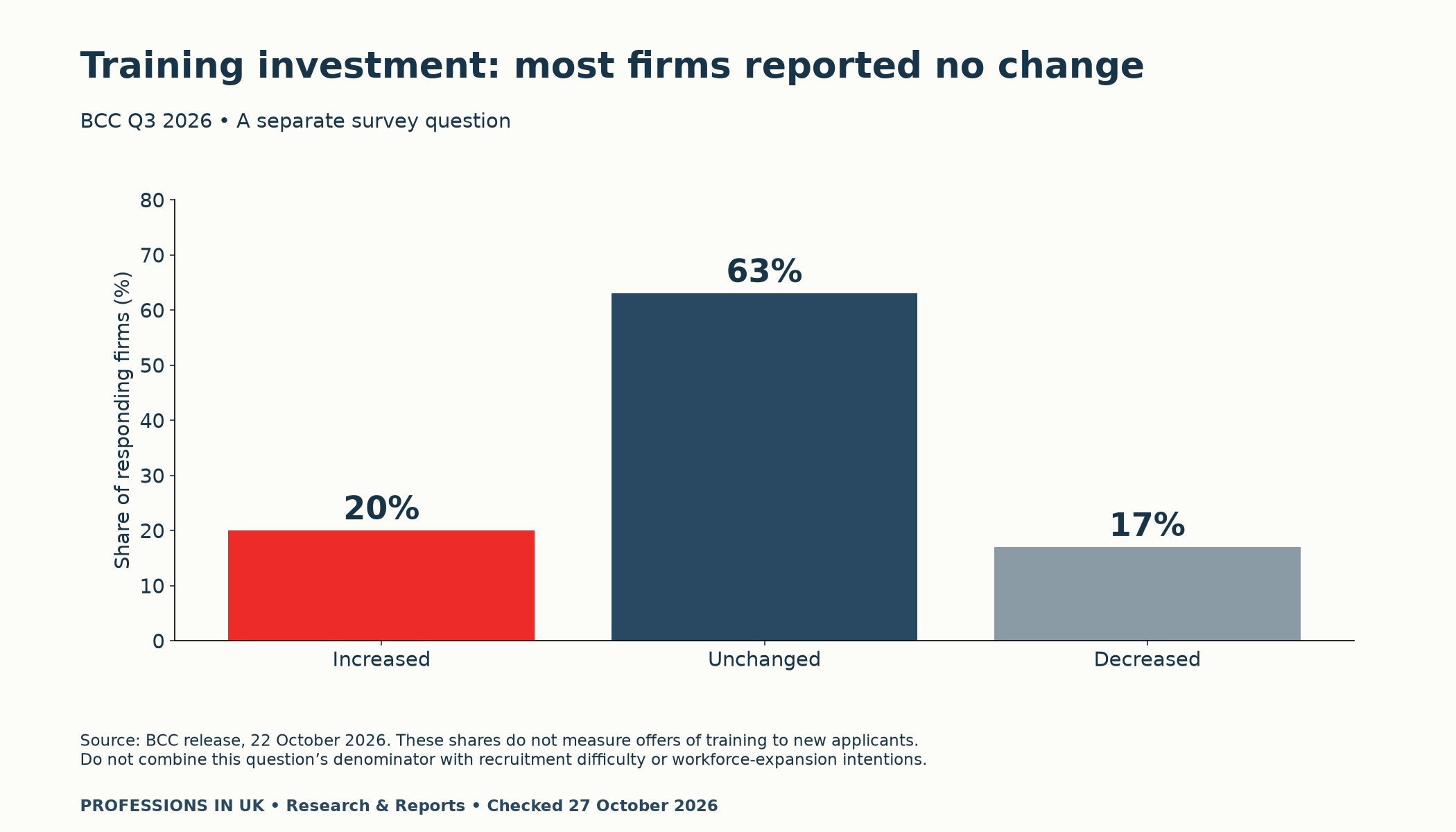
For example, an employer might increase training for existing staff while still requiring an experienced recruit. Another might advertise development only after appointment. Consequently, ask what training covers, who pays, when it starts and whether it leads to a specific assessed qualification.
Our vacancy audit: 24 examples, with the shortfall shown
Before selection, we defined six search cells on GOV.UK Work Hub: carpenter/joiner, electrician and bricklayer, each around London and Manchester. The service offered 20-mile and 40-mile filters, so we used 20 miles consistently. This is a platform search filter, not an independently measured commute.
Next, we reviewed results in newest-first order where that control was available. We retained the first five eligible adverts in each cell, removed obvious duplicates and excluded unrelated or out-of-area roles. The three-result Manchester bricklayer search had no sort control; we retained both geographically eligible adverts.
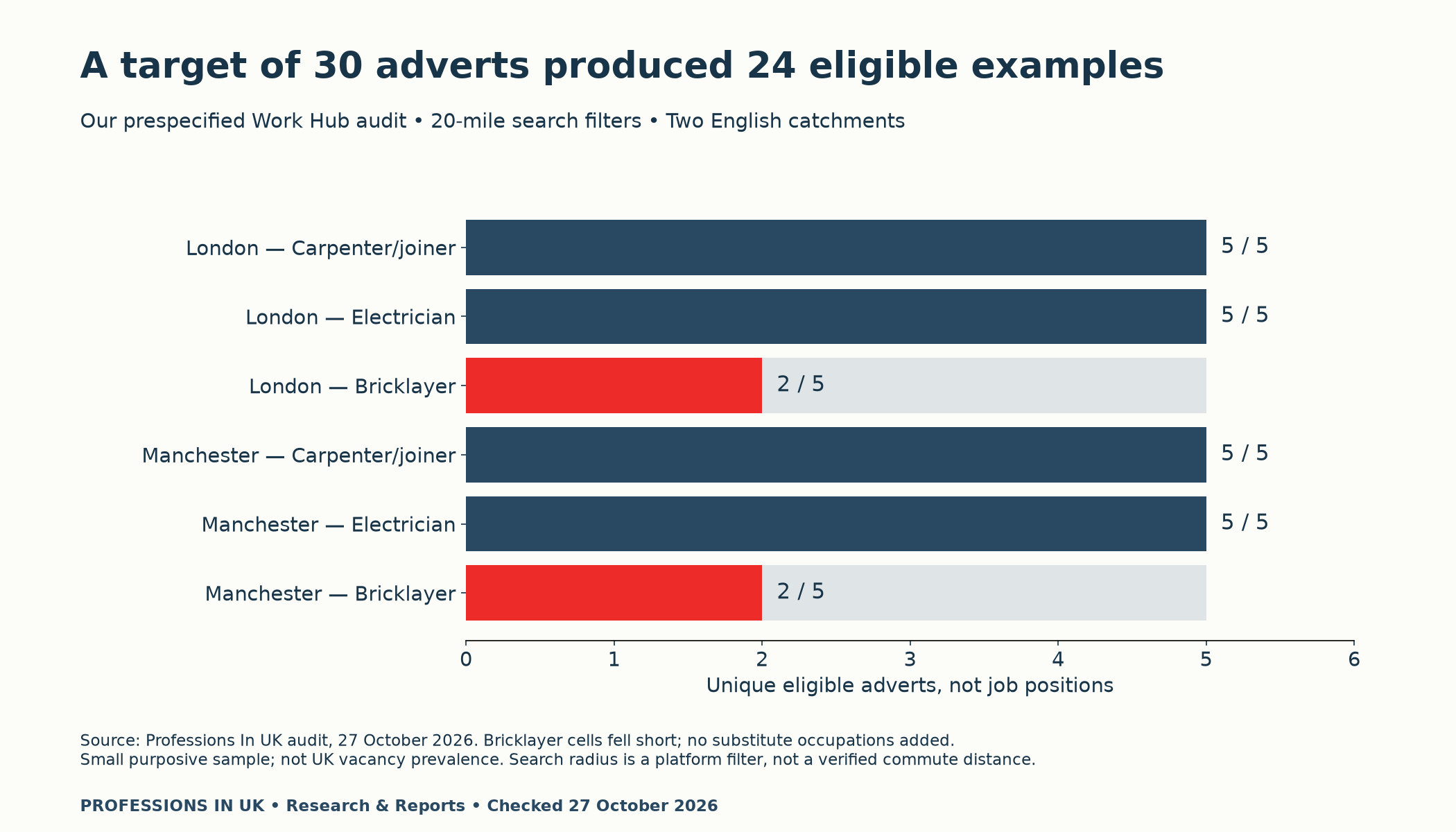
Each carpenter/joiner and electrician cell reached five. Each bricklayer cell supplied two eligible adverts, giving 24 in total rather than 30. A multi-role advert counts once, even when it mentions several positions. Repeated agency wording at different locations remains in the sample; we cannot establish whether the underlying clients are independent.
We opened every retained advert, checked its displayed closing date and recorded its job ID, source URL, location, contract description and pay. All displayed closing dates were after the checking date. Nevertheless, employers may close recruitment early, and a live advert is not confirmation of an unfilled position.
What the adverts specified—and what they left unclear
Of the 24 retained adverts, 23 displayed numeric pay in the header, 20 explicitly required relevant experience and 13 named an essential trade credential. Six explicitly mentioned training, development or apprenticeships. These overlapping counts describe this sample only; they are not estimates for UK construction recruitment.
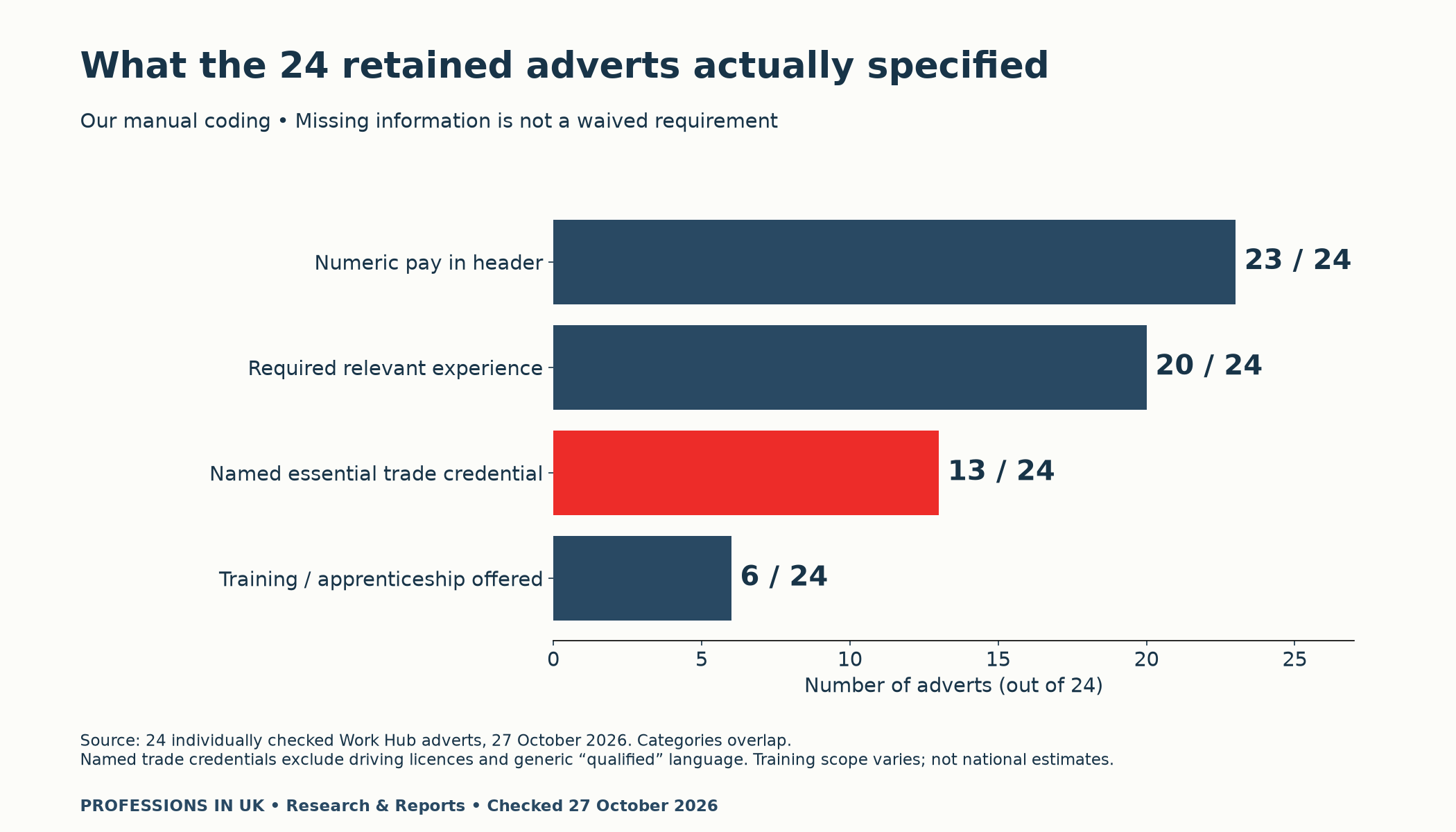
Our credential count excludes driving licences and generic language such as “qualified electrician”. It also excludes a card described only as advantageous. Where an advert omits a requirement, we record “not specified”. Silence does not mean the employer has waived it.
Consider these examples before deciding which application or course deserves your time:
Personalized UK Career Consulting
Receive tailored career guidance designed just for you. Get actionable steps and expert support to boost your career in 1-3 days. Take control of your career now.
Get Started- The Wythenshawe joinery advert required relevant experience, a vehicle and tools. It described CSCS or trade qualifications as advantageous.
- The Manchester Airport electrical advert named several essential credentials. It also mentioned training, which does not make it a beginner route.
- The Bermondsey multi-role advert separated main roles from apprenticeships, with different pay and residency conditions. Expected starts were two to three months away.
- The Trafford Park bricklayer advert required an in-date IPAF qualification for its specific work at height.
Several adverts also contained inconsistent header and body terms. For instance, a carpenter role’s header showed £20–35 an hour while its body showed £25–35. Another described both an own-van requirement and a supplied van. Our CSV retains these conflicts so readers can ask for clarification. We have not silently chosen the more attractive version.

Build evidence around a suitable role
Start with the essential requirement, then identify evidence that directly addresses it. For example, describe the type of joinery completed, your responsibility and the quality checks involved. Use work samples only when you have permission to share them, and remove client addresses or other private information.
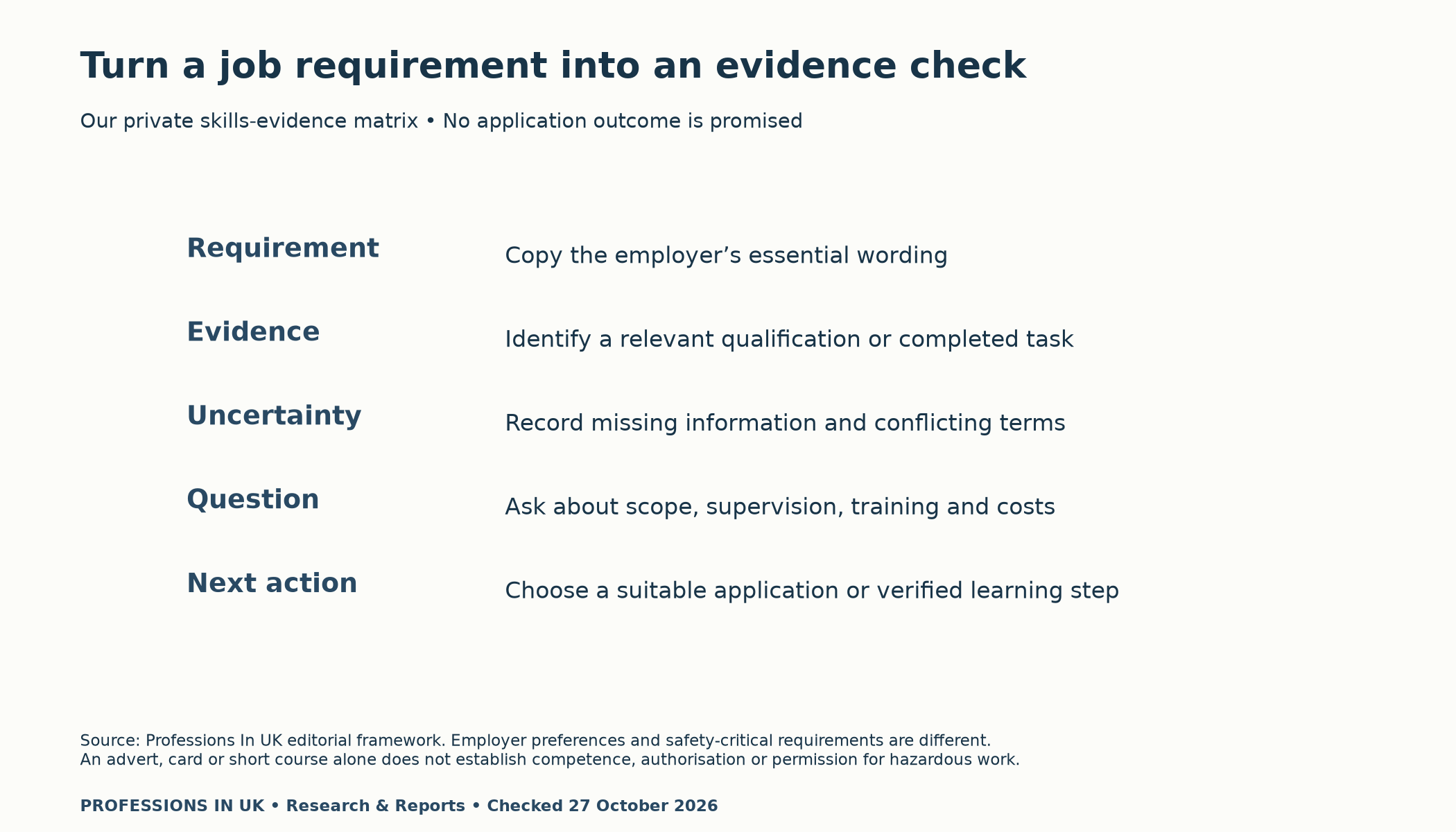
Then separate three questions: do you meet the advertised requirement, can you demonstrate the relevant task, and has the employer confirmed the role’s scope? A preference is different from an essential condition. Equally, an advert, card or short course alone does not establish competence or authorisation for hazardous work.
Ask the employer or relevant credential body about the precise requirement before paying for training. Also clarify supervision, working hours, travel, tools, employment status and any deductions. This audit reports advertised terms; it does not certify qualifications or provide a legal assessment of a contract.
Download the audit and private worksheet
- Construction vacancy audit: 24 adverts and verification notes (CSV)
- Blank skills-evidence matrix (CSV)
Keep your completed matrix private. Use it to decide whether to apply now, ask a question or investigate a specific learning gap. For a different route into work, our entry-level opportunity verification guide explains how to distinguish an announcement from an open application. Our occupational pay comparator guide covers the limits of national pay evidence.
Methodology and limits
This is a small purposive sample from one public service and two English catchments, collected on 27 October 2026. It is not a national survey, a complete vacancy inventory or an explanation of the BCC findings. Advertisers’ statements were not independently confirmed with employers. Missing information, agency concentration and search-location errors limit comparisons.
The five figures keep survey questions, sample coverage, manual coding and our editorial worksheet distinct. No calculation turns employer recruitment difficulty into applicant success. A more useful next step is a verified role, a clear evidence gap and a specific question to the employer.


