





A nursing public health portfolio UK example should make your contribution visible without inventing outcomes. The practical question is simple: what did you do, what evidence supports it, and what remains unknown? A completed record can show a process was documented. It cannot, by itself, show that somebody became healthier.
Nursing public health portfolio UK: what changed this week
The 16 November 2026 announcement introduces a shared framework for nurses and midwives across the UK, and nursing associates in England. It says this does not add duties, targets or paperwork. Treat it as language for explaining existing work, rather than a reason to invent another performance target.
The published practice framework sets out five interconnected principles: promoting wellbeing, protecting from harm, preventing ill health, partnering for equity and preserving the planet. It also describes four prevention stages. These are dimensions for understanding practice, not five identical tasks that every practitioner must demonstrate in every role.
Choose a narrow example that fits your actual role
Start with an activity you can explain accurately. Define the setting, the period and your responsibility. Then identify which part of the work was yours, which was shared and which depended on another team. A modest account supported by evidence is more useful than a broad claim without a traceable basis.
For example, a learning exercise might examine whether a defined documentation field was completed. That is a process question. It is different from asking whether people understood information, accessed support or experienced a health improvement. Each of those questions needs its own measure and an appropriate way to collect evidence.
A fictional example: eighteen of thirty becomes twenty-four of thirty
Our synthetic dataset contains two exercise periods, each with thirty eligible records. Eighteen meet the stated completion rule in period A, compared with twenty-four in period B. The rates are 60% and 80%. The difference is six records, or twenty percentage points.
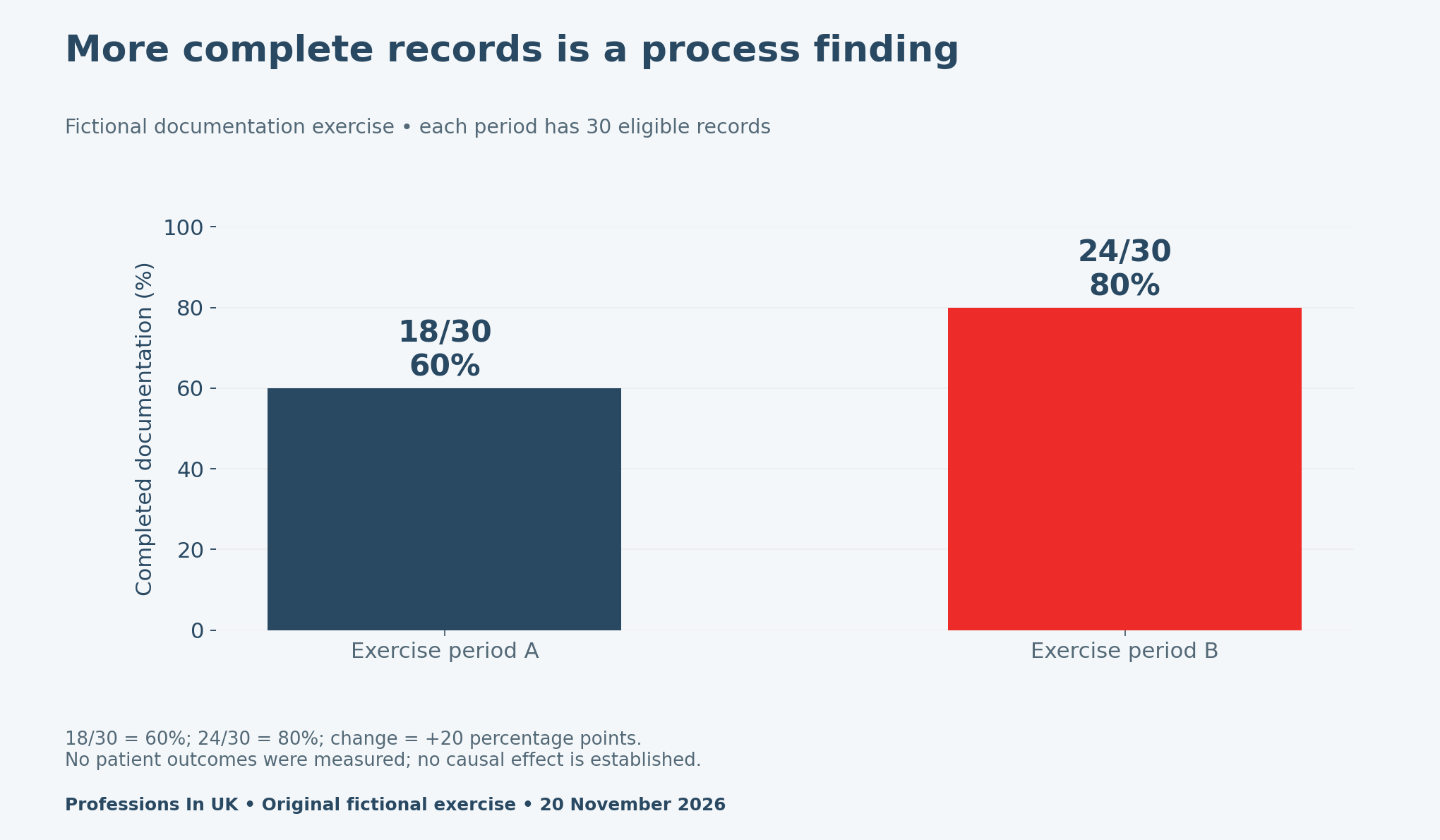
| Fictional measure | Period A | Period B | Difference |
|---|---|---|---|
| Completed records | 18 | 24 | +6 records |
| Eligible records | 30 | 30 | Same aggregate count |
| Completion rate | 60% | 80% | +20 percentage points |
A twenty-percentage-point increase is not the same as a twenty-percent relative increase. Relative to 60%, the change is about 33.3%. Both calculations can be reproduced in the CSV, but the percentage-point version is clearer for describing the absolute change in this exercise.
Keep activity, process, outcome and attribution separate
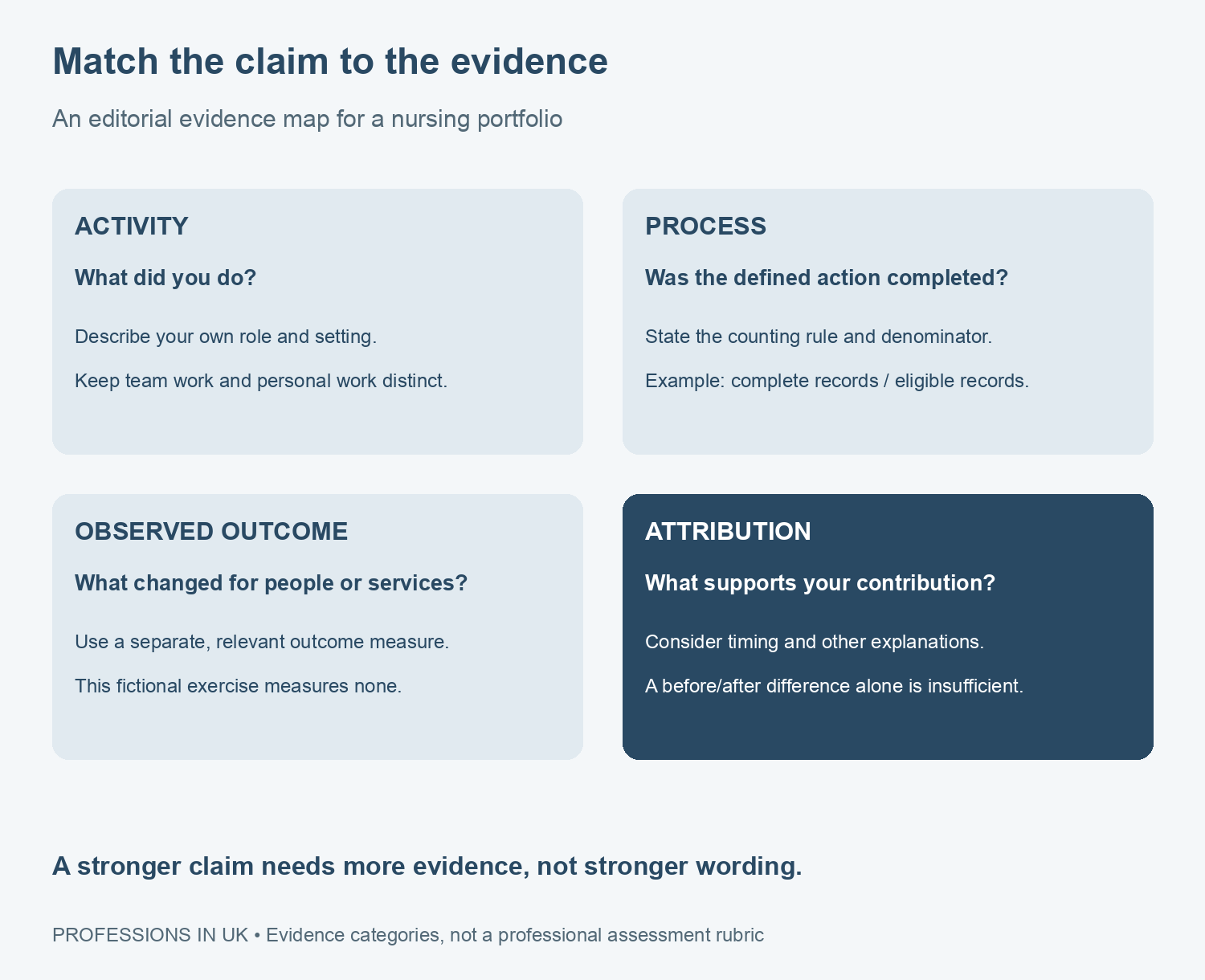
An activity description explains what happened. A process measure tests a defined feature of delivery or documentation. An observed outcome concerns a relevant result for people or services. Attribution asks what evidence supports the claim that an action contributed to that result. Moving between these categories requires additional evidence.
Avoid turning a change in documentation into a claim that six people benefited. We do not know that from these numbers. We also cannot isolate an individual practitioner’s effect from two aggregate snapshots. Changes in eligibility, recording instructions, staffing or the mix of records could influence the comparison.
Define the denominator before choosing the headline
Write the eligibility rule before you count. Explain what qualifies as a completed record and how missing or inapplicable fields are treated. Keep the same rule across periods when a comparison is intended. If the rule changes, explain the break instead of presenting the rates as directly comparable.
Equal totals of thirty do not prove equal populations. For a real, authorised review, a supervisor may need to understand whether the periods cover comparable work and whether the documentation system changed. The exercise files deliberately contain no patient-level records and cannot answer those questions for a real service.
Protect confidentiality in the portfolio evidence
Keep patient names, identifiers and case details out of a public work sample. Removing a name alone may leave a combination of details that identifies someone. Use invented data for public demonstrations and follow your employer’s rules for any actual evidence retained within an approved professional process.
The blank contribution map asks for an evidence reference rather than a copy of a clinical record. Use it to plan a supervisor discussion, not to create an unofficial patient database. Do not paste protected records into a portfolio tool or public upload to make an example look more convincing.
Use supervision to test the wording
Bring a specific question to the discussion: does the evidence support the sentence I want to write? Ask whether your role is described fairly, whether the denominator is defensible and whether a process result has been confused with a health outcome. Record the limits as well as the achievement.
Our planning analyst portfolio guide uses the same discipline of defining a measure before interpreting it. The FE finance mapping exercise shows why traceable source and revision records matter. Those analytical habits transfer; the professional context and governance still differ.
Personalized UK Career Consulting
Receive tailored career guidance designed just for you. Get actionable steps and expert support to boost your career in 1-3 days. Take control of your career now.
Get StartedDownload the fictional exercise and evidence tools
- Fictional record-completion source data (CSV)
- Reproducible rate and change calculations (CSV)
- Fictional example and blank contribution map (CSV)
- Portfolio measure and inference dictionary (CSV)
Methodology and limits
We checked the government announcement and framework on 20 November 2026. The two periods, counts and documentation measure are entirely fictional and were created for this article. Rates use completed records divided by eligible records. We retain one substantive chart because the exercise has one process comparison; extra plots would repeat the same evidence.
This nursing public health portfolio UK guide is an evidence-writing exercise, not clinical advice or a revalidation guarantee. It does not certify competence or replace current professional standards, employer procedures or supervision. Its useful output is a bounded, reproducible account of a contribution and the evidence still needed for a stronger claim.


