





An FE finance portfolio accounts mapping exercise should show what happened to every source amount. Our fictional twelve-code ledger totals £120,000. Its first mapping version accounts for £118,500, leaving £1,500 unresolved. The useful skill is investigating and documenting that difference, rather than inserting a balancing figure.
FE finance portfolio accounts mapping: the current reminder
The DfE update of 18 November 2026 reminds colleges in England that quarter-two dry-run submissions for July–September are due by 20 November 2026. This is a reminder about an existing exercise, not an announcement of a new requirement. Check the current official guidance for actual submission instructions.
The supporting dry-run guidance, updated 22 October, sets three-month submissions and a quarter-three collection window of 18 January–12 February 2027. Its mapping process connects local account codes with DfE codes. Our portfolio uses invented codes and figures instead; none should be copied into an official return.
Build a safe, reproducible source ledger
The downloadable exercise has twelve local codes and thirty-six monthly rows. Each row has a stable identifier, a month, a code, a GBP amount and a fictional-data label. These fields let a reviewer check completeness without needing access to a real college’s accounts.
Keep the source snapshot separate from mapping decisions. If you overwrite a source code to make a join work, you may lose the evidence needed to explain the result. Correct an identified source problem through a documented revision, preserving the earlier version and the reason for the change.
What the first mapping version leaves unresolved
Eleven codes have an exercise target group. EX-L12 has none. It contributes £300 in July, £450 in August and £750 in September. Those three amounts explain the £1,500 quarter difference. A blank target is visible evidence of an unresolved decision, not permission to discard the rows.
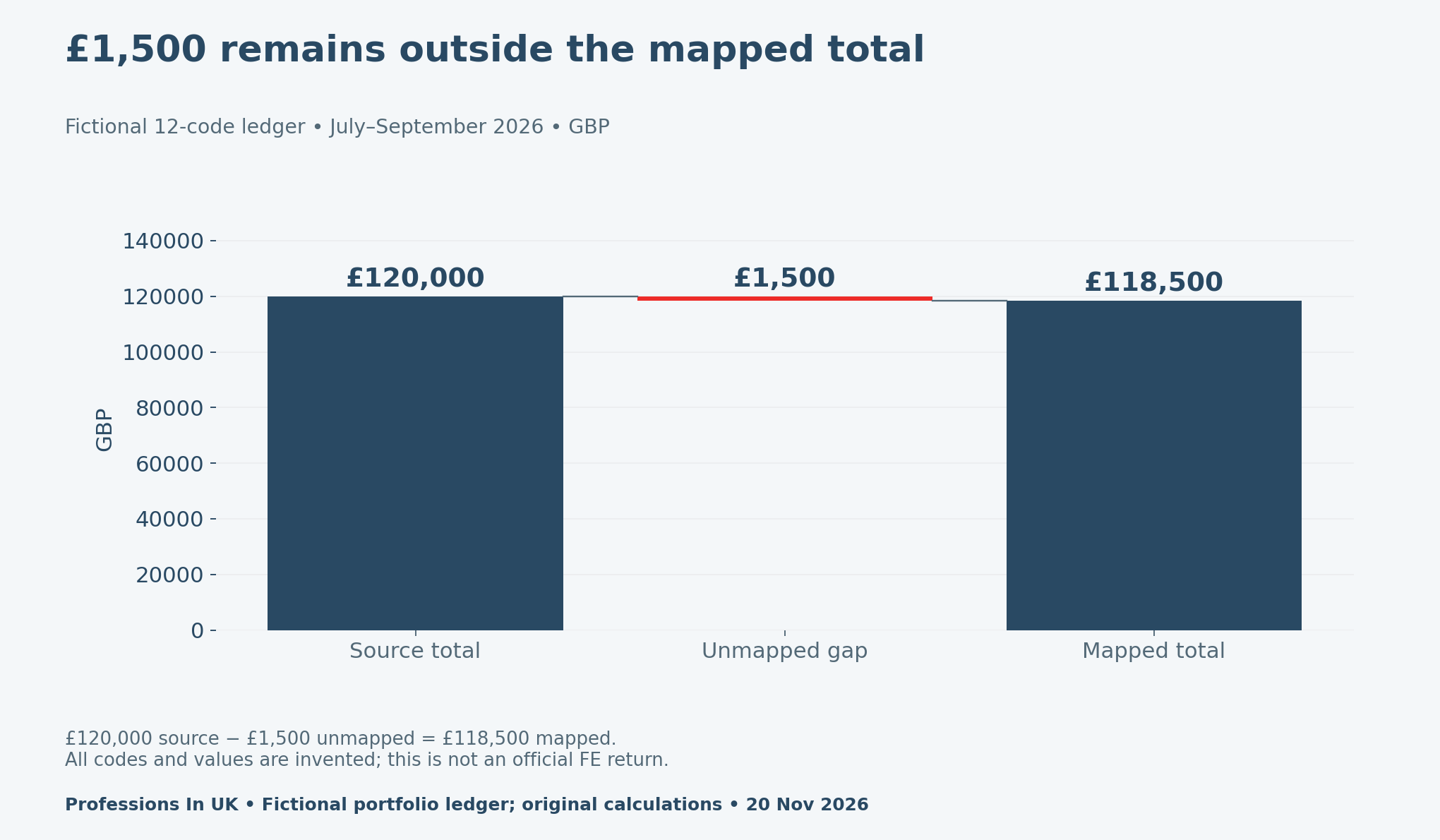
A clean-looking total can hide a poor mapping process. For example, routing every unknown code to a convenient group may make the arithmetic tie while changing the meaning. The portfolio should show the unresolved code, the supporting question and who can authorise a defensible mapping.
Reconcile the months as well as the quarter
| Period | Source GBP | Mapped GBP | Unmapped GBP |
|---|---|---|---|
| 2026-07 | 24,000 | 23,700 | 300 |
| 2026-08 | 36,000 | 35,550 | 450 |
| 2026-09 | 60,000 | 59,250 | 750 |
| Quarter total | 120,000 | 118,500 | 1,500 |
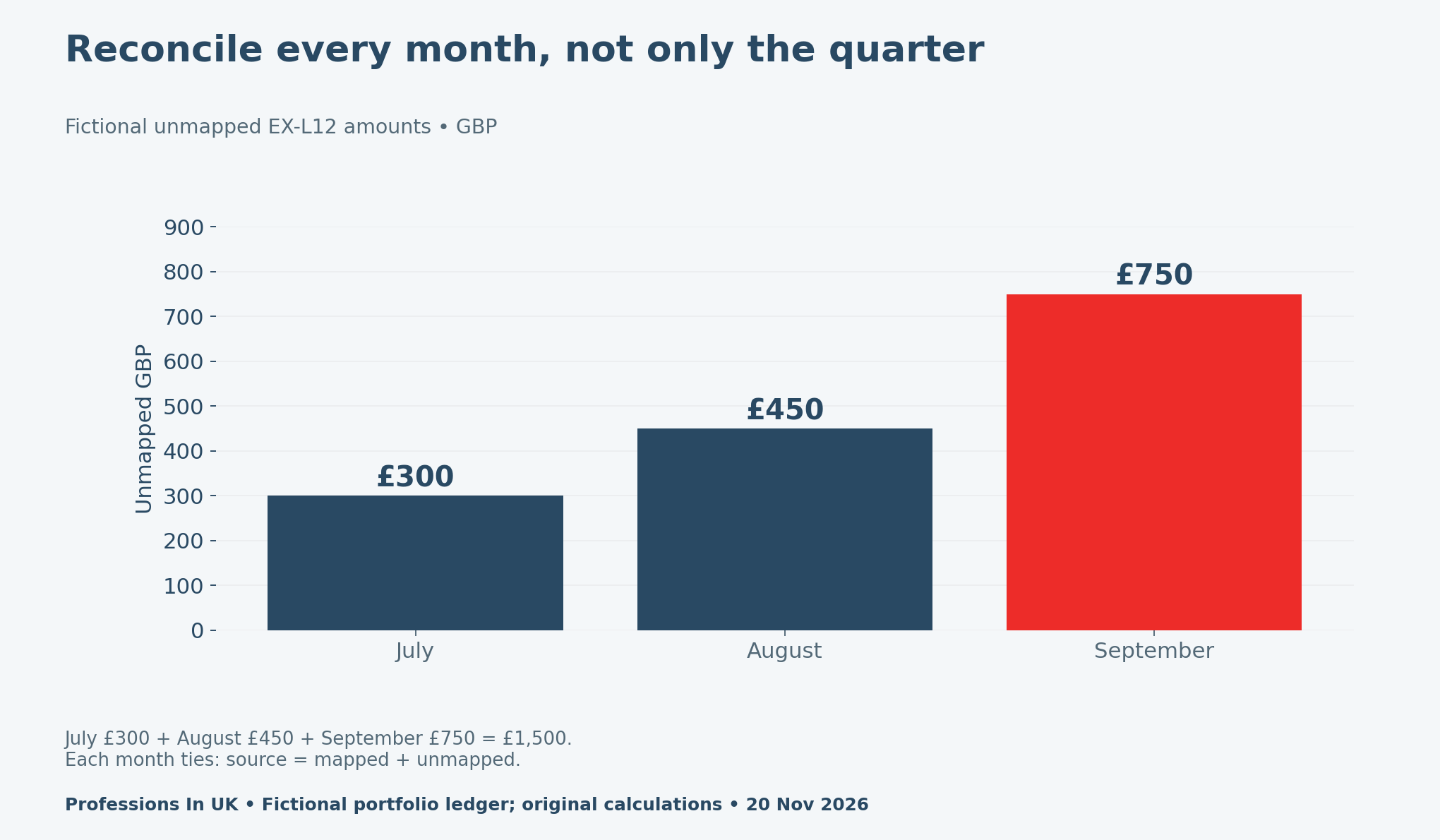
For each month, verify that the source amount equals mapped output plus unresolved amounts. Then sum the three monthly results and compare them with the quarter. If a quarter ties but two months do not, investigate the timing difference instead of assuming the aggregate proves accuracy.
Also check record counts. A duplicate mapping row can multiply an amount during a join, while a missing mapping can remove it from an inner join. Preserve unmatched rows in a separate exception output and confirm that each source code has the intended mapping cardinality.
Version the mapping decision, not just the spreadsheet filename
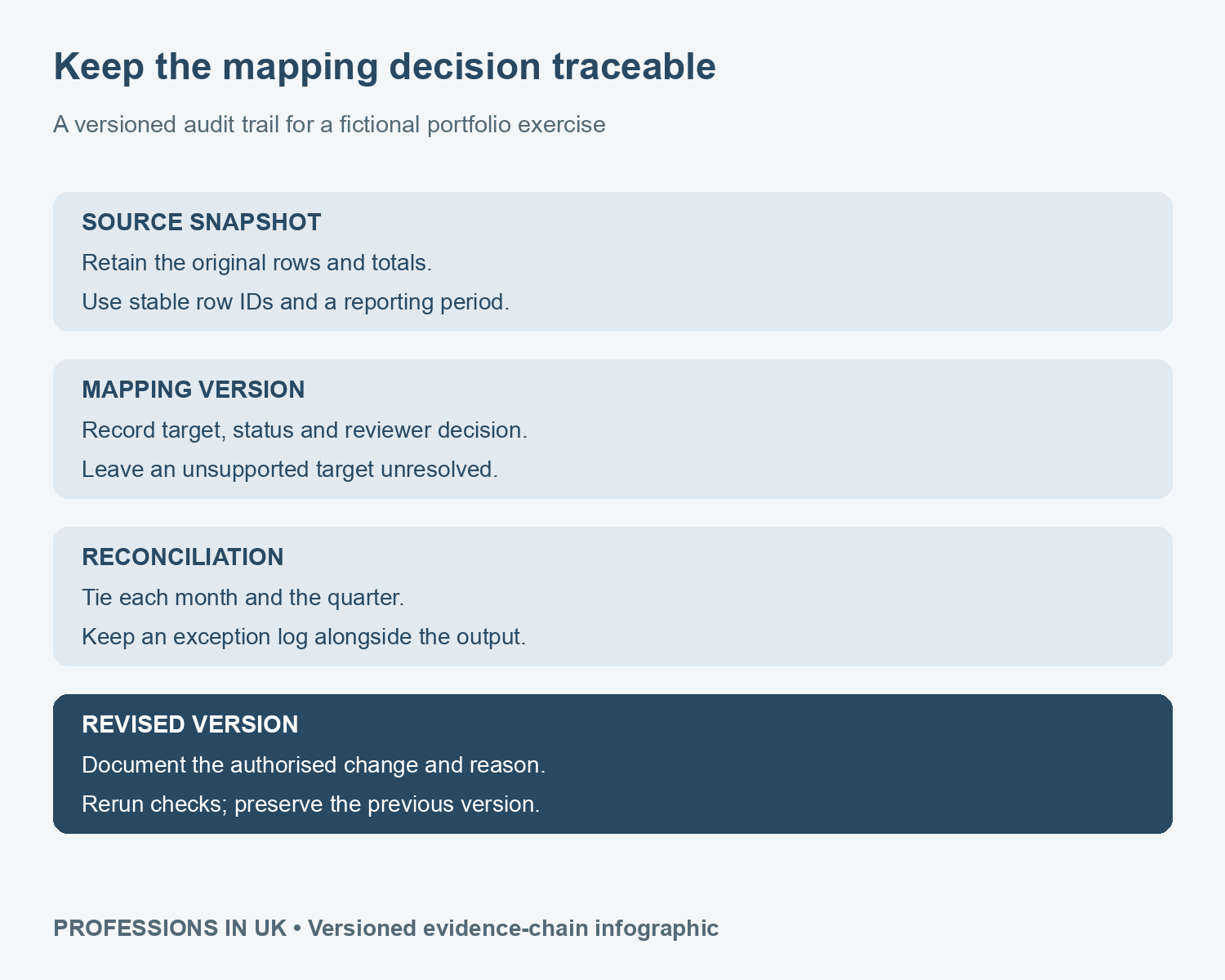
Version one deliberately leaves EX-L12 open. A later exercise revision would need an authorised target and a recorded reason before the output changed. The exception log should identify the affected code, version, amount, reviewer role, evidence reference and decision date.
A file named “final” does not explain a decision. Use a short change log that connects the revised mapping to its evidence and shows which reconciliations were rerun. Keep the source ledger unchanged unless a separate source correction is justified and recorded.
Test the checks before calling the work sample complete
Try introducing a duplicate mapping for one code in a copy of the exercise. Does your review detect the multiplied output? Next, remove a month from that copy. Does the month-level completeness check identify it? Keep these controlled tests separate from the retained baseline files.
Describe the expected response in plain language. A duplicate target needs review of the mapping relationship, while a missing month needs a source-completeness investigation. Neither is solved by posting an unexplained adjustment to make the total match.
Present the portfolio as evidence of a process
An interview explanation can be brief: identify the source scope, show the first reconciliation, explain the unmapped code and describe the approval needed for a revision. Then show how another reviewer can reproduce the totals. This demonstrates traceability without claiming experience with a real statutory return.
Our planning analyst portfolio guide uses a related discipline: define the cohort, clock and inference before writing the conclusion. For finance mapping, define the source, version and reconciliation boundary before claiming the output is complete.
Personalized UK Career Consulting
Receive tailored career guidance designed just for you. Get actionable steps and expert support to boost your career in 1-3 days. Take control of your career now.
Get StartedDownload the fictional ledger and controls
- Fictional twelve-code monthly source ledger (CSV)
- Exercise mapping register, version one (CSV)
- Monthly and quarterly reconciliation calculations (CSV)
- Fictional example and blank exception log (CSV)
Methodology and limits
We checked the DfE reminder and guidance on 20 November 2026. All portfolio amounts, row identifiers, local codes and target groups were created for this article. Monthly amounts use twenty, thirty and fifty percent of each fictional code’s quarter total. The same ledger drives the charts and downloadable reconciliations.
This FE finance portfolio accounts mapping exercise is a learning aid, not an official workbook, compliance certification or advice to alter a live return. Actual reporting requires the current DfE instructions and an organisation’s authorised review process. Keep real college data out of public portfolio files unless its disclosure is properly authorised.


