



A construction V Level vs T Level surveying decision begins with the intake you can actually join. Ofqual’s November consultation places the planned construction V Level in September 2028. That is different from the first V Level subjects planned for September 2027, and from a current T Level offered by a local provider.
The two routes also use hour counts for different things. A V Level’s 360 guided learning hours describe qualification size. The T Level’s 315-hour minimum concerns its industry placement. Putting those numbers on one “course length” bar would create a misleading comparison. Keep their meanings separate before comparing options.
What the new construction consultation covers
The Ofqual consultation published on 26 November 2026 concerns proposed subject-level conditions for construction design, surveying and planning in England. It closes on 22 January 2027 at 11:59pm. At our 29 November check it was an open consultation, rather than a final construction specification or an invitation to enrol at a particular college.
The tranche 2 collection identifies September 2028 as the planned first-teaching cohort. The consultation’s introduction distinguishes the initial September 2027 subjects: accounting and finance, digital systems and data, and education. Do not transfer that earlier date to construction merely because a headline says that V Levels begin in 2027.
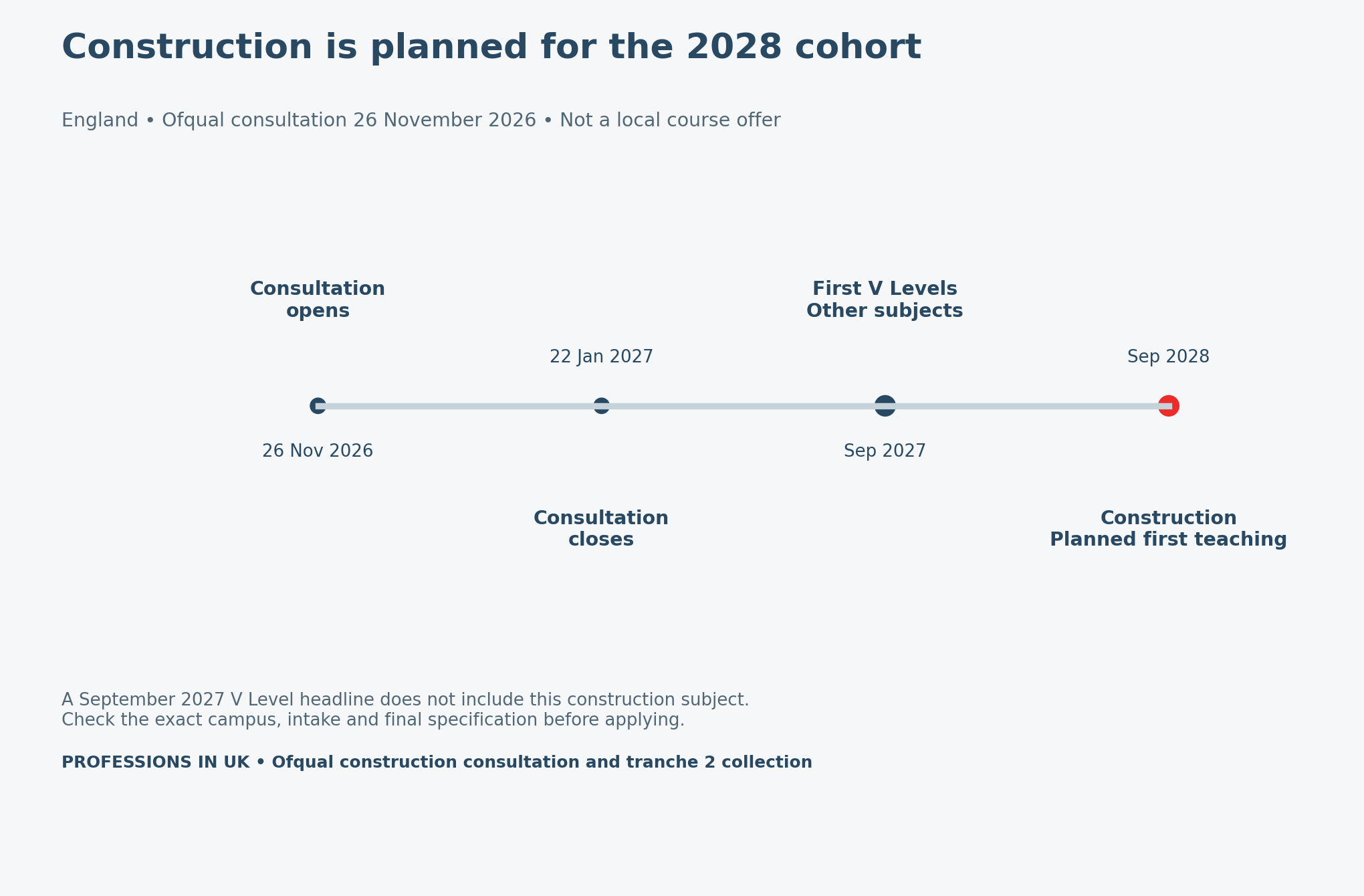
For a student planning a 2027 start, the practical task is to check qualifications that a provider will actually offer for that intake. A future national reform is useful context, but it is not a current admissions option. Ask for the exact course title, campus, start date and application arrangements in writing.
Construction V Level vs T Level surveying: compare the right hours
Ofqual’s general V Level regulatory decisions specify a size of 360 guided learning hours. That figure belongs to the learning design of the qualification. It does not state that a student will spend 360 hours with an employer, and it does not settle the student’s whole weekly timetable.
The current Design, Surveying and Planning for Construction T Level page describes a two-year programme. Separately, DfE’s placement guidance sets a minimum of 315 industry placement hours for this route. Those hours form one component of the programme, rather than its total teaching or study time.
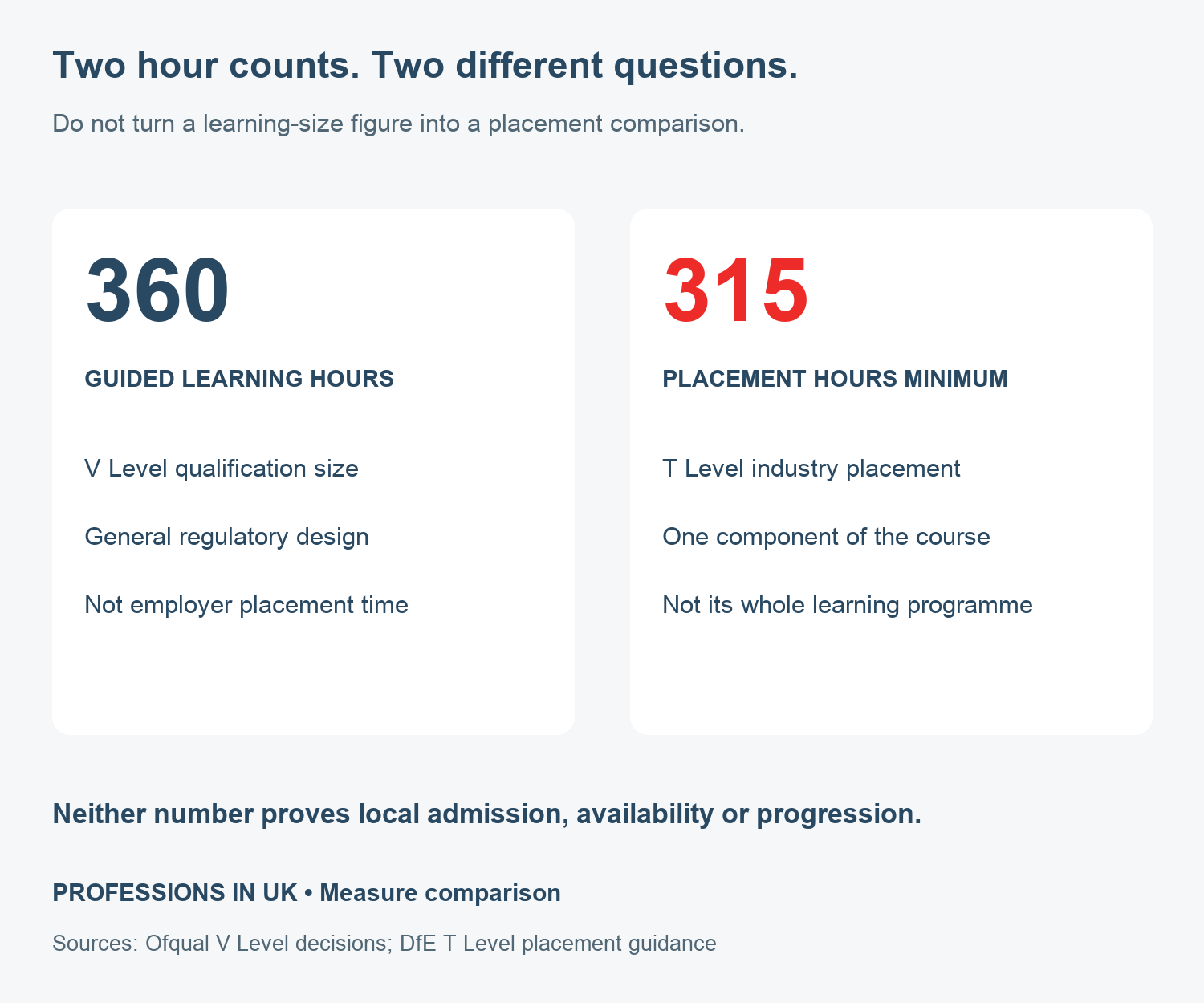
Do not subtract 315 from 360 and describe the result as an extra amount of training. Nor should a ratio between them be sold as the share of practical learning. The numerator and denominator do not measure the same component. Your useful comparison needs the full provider timetable and a clear account of each activity.
| Field | Construction V Level | Current construction T Level |
|---|---|---|
| Intake status | Planned September 2028 subject | Check the provider’s actual intake |
| Hour figure used here | 360 guided learning hours | 315 minimum industry placement hours |
| Meaning | Qualification learning size | Placement component |
| Local confirmation | Campus, offer and final specification | Admission, timetable and placement arrangements |
What the proposed assessment split does and does not mean
The construction consultation proposes 40% assessment by examination and 60% non-exam assessment. These percentages concern overall assessment. They do not tell a student that 40% of the week will be classroom teaching or that 60% will be employer placement. Keep marks, taught hours and workplace time in different columns.
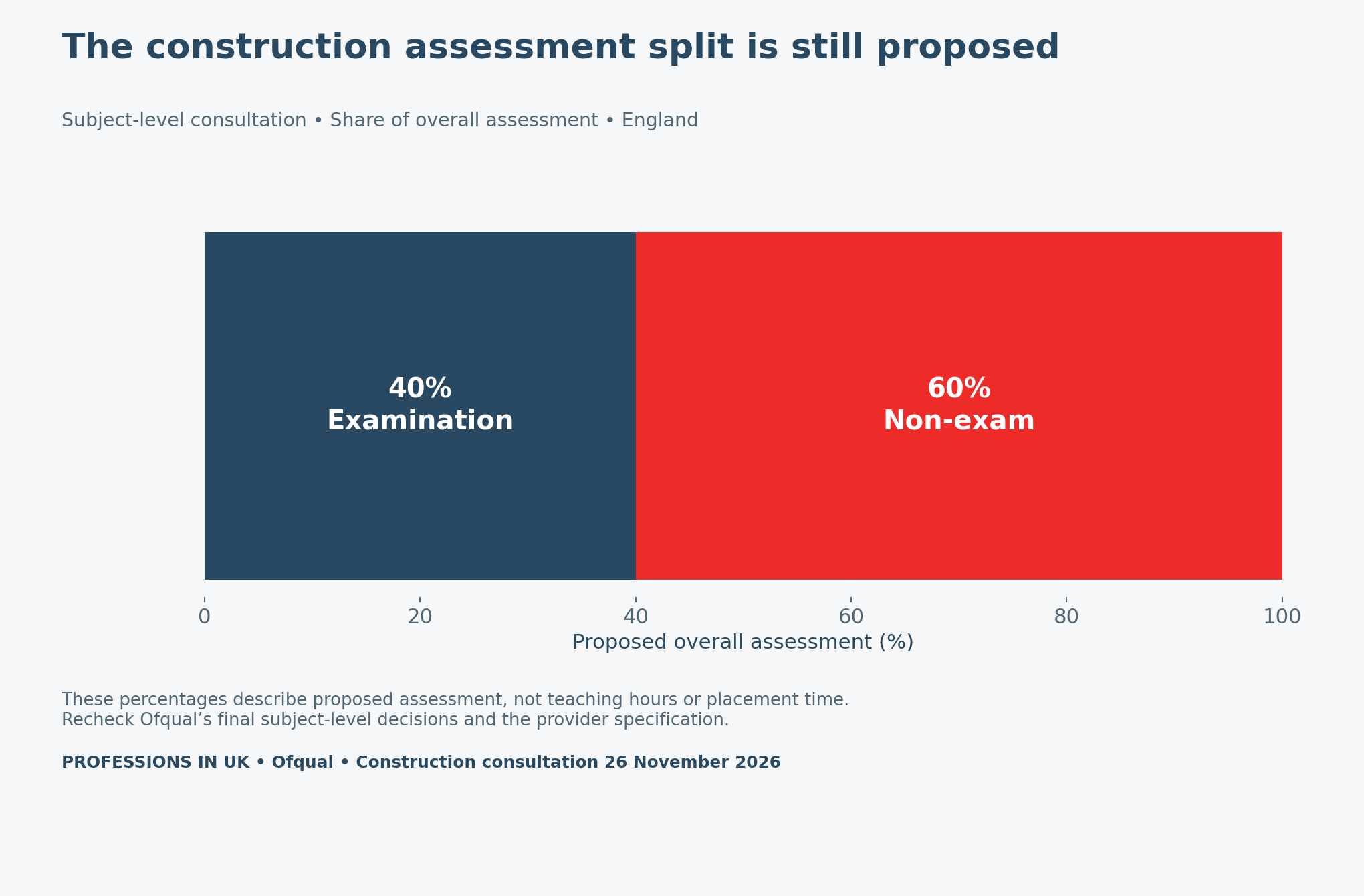
The proposal is helpful when asking how learning will be assessed, but an awarding specification and provider course information will still matter. Record the version and status of the document you read. A consultation question, an adopted regulatory requirement and a college’s planned delivery are three different evidence stages.
Build a 2027 and 2028 intake planner
Use one worksheet row per provider and intake year. Start with the exact qualification name and the campus where teaching would happen. Then record entry requirements and the actual application window. The T Level subject page says individual schools or colleges set their own entry conditions; a general national description does not replace those details.
Next, ask how placement arrangements work in practice. Record the location, pattern, travel expectations and the provider’s support. Keep your own travel-cost estimate separate from any confirmed support. Do not assume a placement guarantees paid employment or that a course title guarantees a particular employer match.
For progression, identify the specific degree, apprenticeship or other next step you have in mind. Ask the receiving provider what it accepts for that intake and keep its written answer. Broad statements about possible progression do not establish admission to every surveying course or a professional status.
For example, a fictional student can start locally in 2027 but sees a construction V Level announcement for 2028. The planner should show the timing difference and the unresolved local offer. It should not imply that delaying a year is automatically better. The decision depends on actual admissions options, personal constraints and confirmed progression.
Our surveying skills and qualifications overview offers wider career context. For changes in professional tools, see technology in UK surveying. Use current provider and regulator documents for this particular intake decision.
Personalized UK Career Consulting
Receive tailored career guidance designed just for you. Get actionable steps and expert support to boost your career in 1-3 days. Take control of your career now.
Get StartedMethods, limitations and free planning tools
Research checked on 29 November 2026. We compared Ofqual’s new construction consultation, its tranche list, the general V Level decisions, the current T Level subject information and DfE placement guidance. No provider admissions survey or local place count was collected. The two charts show timing and proposed assessment, while the separate infographic explains the hour measures.
The assessment percentages total 100%, but no arithmetic converts guided learning into placement time. Dates remain labelled as announced or planned. This construction V Level vs T Level surveying planner applies to England; it does not transfer the policy to Scotland, Wales or Northern Ireland. Recheck final decisions and the local offer before applying.
- Qualification measures and source status (CSV)
- Dated construction V Level timeline (CSV)
- Blank 2027 and 2028 intake planner (CSV)
- Hours, assessment and availability dictionary (CSV)
Suggested citation: Professions In UK, “Construction V Level or T Level? What Surveying Students Can Apply For”, 29 November 2026. Credit Ofqual and the Department for Education for the source information and Professions In UK for the original comparison and planning tools.