



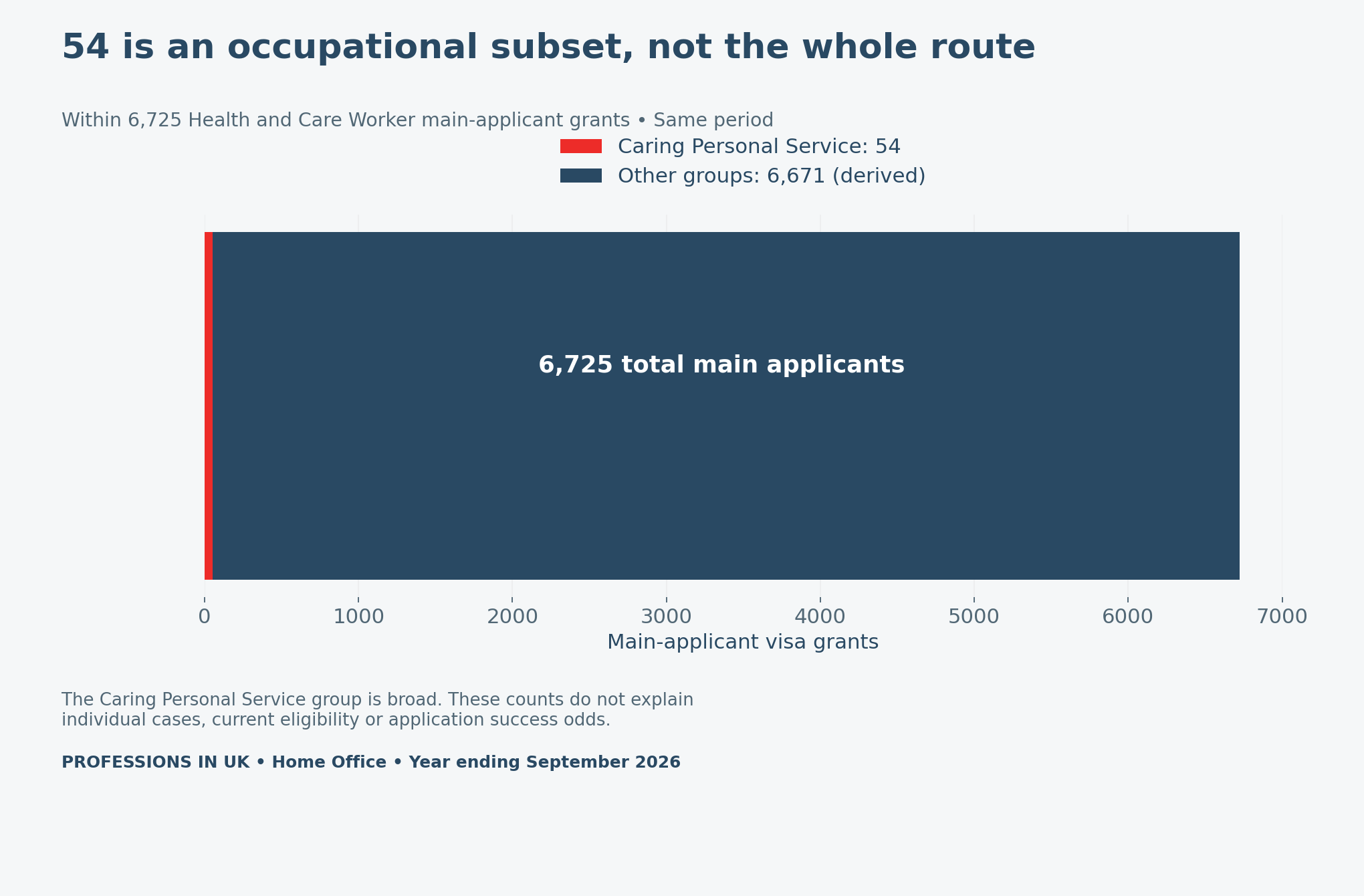
UK care worker visa sponsorship from overseas 2026 cannot be assessed from a grant headline alone. A November Home Office release reports 54 main-applicant grants in the broad Caring Personal Service group. That count does not reopen new overseas care-worker applications or explain how those individual grants arose.
The practical first step is to separate an occupational count from the rule governing an application. Check the actual job code and whether the proposal concerns entry from abroad or permission to stay. Only then assess the evidence required for the relevant branch. Do not pay an intermediary on the strength of a headline.
What the 54 grants actually count
The Home Office work-visa release, published on 26 November 2026, covers the year ending September 2026. Here that means 1 October 2025 to 30 September 2026. Its 54 figure concerns main applicants in a broad occupational group within the Health and Care Worker route, rather than every applicant on that route.
The release separately records 6,725 main applicants and 24,048 dependants across the whole Health and Care Worker route. These are different scopes. Do not label all 6,725 as care workers or all 24,048 as workers. The figures describe grants, not vacancies, applications awaiting a decision or a person’s chance of success.
| Published measure | Grants | Scope |
|---|---|---|
| Caring Personal Service main applicants | 54 | Broad occupational subset |
| Whole-route main applicants | 6,725 | All Health and Care Worker occupations |
| Whole-route dependants | 24,048 | Dependants across that route |
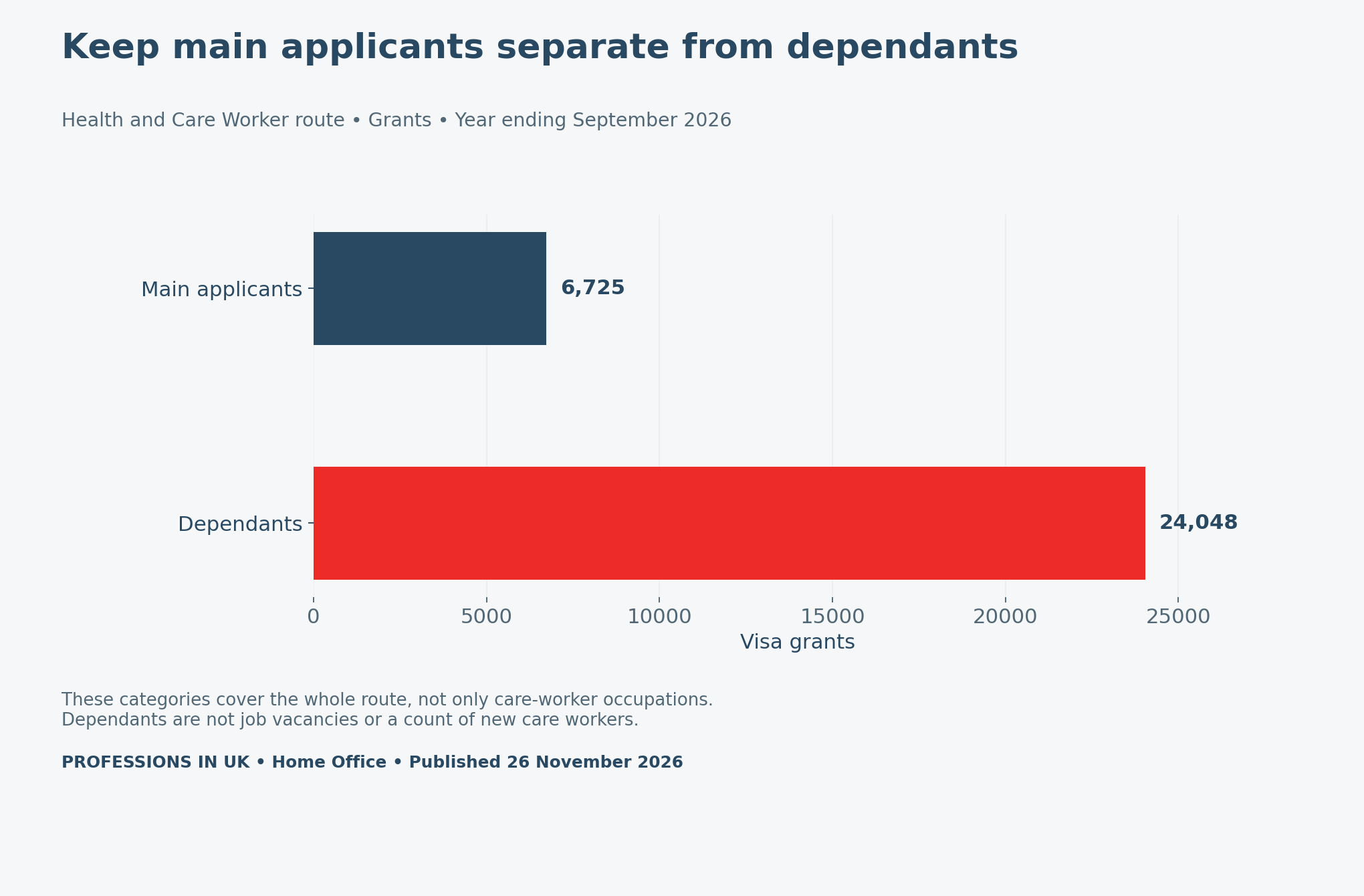
Adding the two whole-route applicant types gives 30,773 grants. That arithmetic has a clear use: it reconciles the route total. It does not show that a particular employer can sponsor a particular job today. Nor does it show that dependants received permission because of a new worker grant in the same year.
UK care worker visa sponsorship from overseas 2026: read the rule
The official overseas health-and-care recruitment guidance says new overseas applications for care workers and senior care workers closed from 22 July 2025. Keep that closure specific to these roles. It does not mean that every healthcare occupation or every Health and Care Worker application has the same position.
A count can remain positive without answering why a case was decided as it was. This release does not give the case histories behind the 54. Do not invent an exemption, a reopened channel or an explanation for individual grants. A numerical observation and an available application route are different kinds of evidence.
For example, a fictional applicant abroad sees an advert claiming that “54 visas prove the route is open”. The right response is to request the precise occupation code and current official rule supporting the claim. The statistic alone cannot validate the proposed route. This example does not describe a real recruiter or allege wrongdoing.
Permission to stay has distinct branches
In Appendix Skilled Worker, SW 6.1B, sponsorship in SOC 2020 codes 6135 or 6136 requires an application for permission to stay. Branch (a) requires at least three months of legal work for that sponsor in the specified codes before the certificate of sponsorship, and an application before 22 July 2028.
Branch (b) instead addresses applicants with Skilled Worker permission sponsored in the specified current care codes or the listed legacy codes, 6145 and 6146. Read its exact wording and exceptions. Do not automatically copy branch (a)’s three-month condition or its date into branch (b). Other requirements elsewhere in the rules still apply.
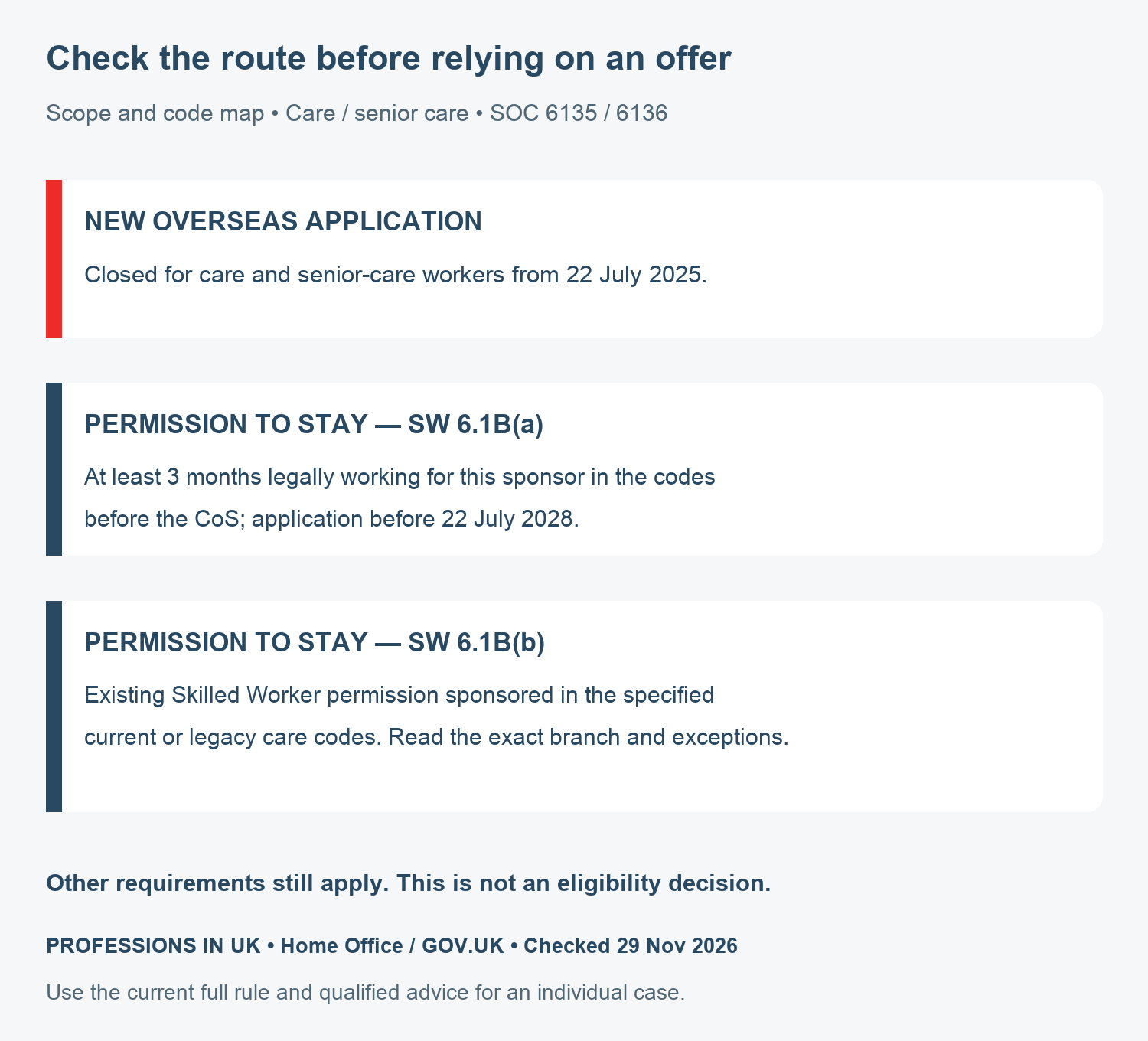
The scope map is deliberately a reading aid. It does not assess a person’s immigration history, right to work, salary, sponsor compliance or other conditions. A reader should obtain advice from a suitably authorised immigration adviser for an individual decision. A document described as an offer is not itself a grant of permission.
A useful evidence card before relying on an offer
Begin with the job’s actual duties and the code proposed by the sponsor. Record the legal employer and official source used to check it. Keep a dated copy of the relevant public information. A job title that sounds similar to a listed occupation does not establish that the proposed code fits the duties.
Next, identify the proposed application type in writing. Record the current rule branch, the evidence requested and who will answer unresolved questions. Keep historical employment dates and certificate dates in the individual case file where appropriate; do not publish personal identity or immigration records inside a shared worksheet.
Finally, separate claims from documents. A recruitment message may make a promise, while the official rule may impose conditions. Use the blank checklist to record the source of each statement and the question still outstanding. Leave a field unresolved when you do not have the evidence. A completed-looking sheet is less useful than an honest record of a missing answer.
Our sponsorship advert-verification guide demonstrates a related evidence-reading method for another occupation. Our immigration-adviser compliance study separates current requirements from proposals. Neither makes the care-worker route available to an individual.
Personalized UK Career Consulting
Receive tailored career guidance designed just for you. Get actionable steps and expert support to boost your career in 1-3 days. Take control of your career now.
Get StartedMethods, limitations and downloadable tools
Research checked on 29 November 2026. We transcribed three grant measures from one Home Office release and checked separate official recruitment guidance and the current Skilled Worker rule text. The charts show applicant-type totals and a nested occupational subset. These answer different scope questions; additional charts would repeat the same small evidence base.
Derived calculations are 6,725 plus 24,048, and 6,725 minus 54. The subset percentage is 54 divided by 6,725, multiplied by 100. It uses grants as both numerator and denominator. We do not estimate application success, migration flows for individual employers or the causes of the 54 grants.
Use this UK care worker visa sponsorship from overseas 2026 evidence card before relying on a claim. Recheck the official rule and guidance on the actual decision date. Rules can change, and this article does not resolve an individual case. The downloadable tools organise verification; they are not application forms or legal advice.
- Published visa-grant scopes and counts (CSV)
- Route total and subset calculations (CSV)
- Blank scope-and-code evidence checklist (CSV)
- Rule and measure scope register (CSV)
Suggested citation: Professions In UK, “UK Care Worker Sponsorship: What the 54 Visa Grants Mean”, 29 November 2026. Credit the Home Office and GOV.UK for source information and Professions In UK for the original scope charts and verification tools.