





Comparing term time only actual salary vs full time equivalent starts with the annual gross amount you would receive. A school pay scale can be much larger than the actual salary printed beside it. Read both figures, then check the hours, weeks and payment schedule separately.
Two November 2026 adverts show why this matters. The Leeds careers-adviser post pairs a £35,570–£37,562 scale with £31,518–£33,288 actual annual pay. A Warwickshire training-coordinator post lists £28,427 as its full-time reference and £13,829 actual. These are individual adverts, not estimates of typical school pay.
What the two adverts actually say
The Leeds Teaching Vacancies listing, dated 27 November, specifies 37 hours a week, term time plus two working weeks. It describes maternity cover from March 2027 to March 2028 and gives an 11 December 2026, 9am closing time. Check the live vacancy before applying.
The Warwickshire Teaching Vacancies listing, dated 26 November, explicitly gives 18 hours a week. It describes a permanent part-time role, gives £13,829 as the annual salary received and closes on 7 December 2026 at 11:59pm. Do not relabel it term-time-only: that working pattern is not established by the fields used here.
| Advert | Scale / FTE annual reference | Actual annual gross | Weekly hours stated |
|---|---|---|---|
| Leeds careers adviser | £35,570–£37,562 | £31,518–£33,288 | 37 |
| Warwickshire coordinator | £28,427 | £13,829 | 18 |
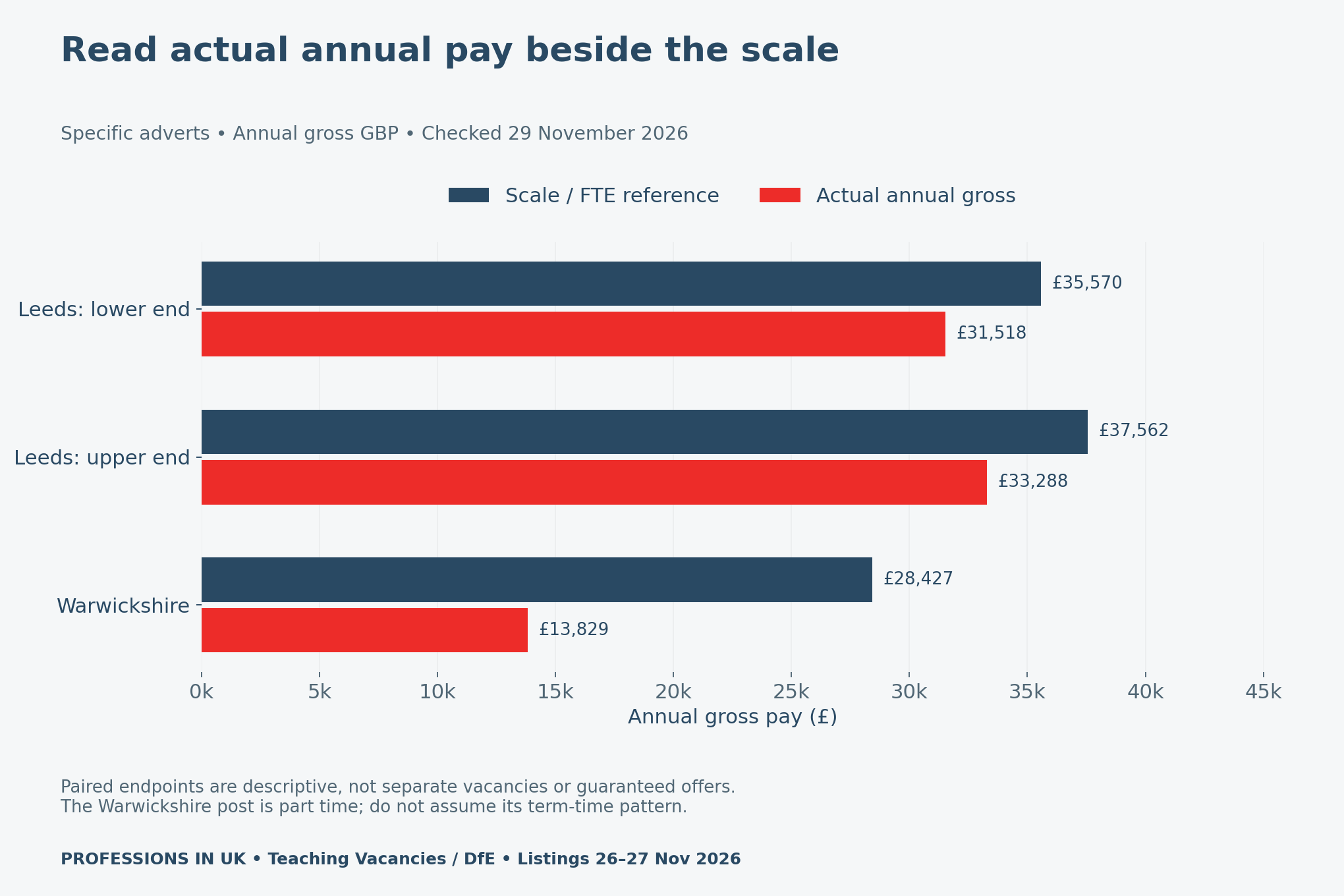
Term time only actual salary vs full time equivalent: the arithmetic
The lower Leeds pair differs by £4,052 a year: £35,570 minus £31,518. At the upper end, the difference is £4,274. Warwickshire’s paired figures differ by £14,598. Those subtractions describe the adverts; they do not establish a pay loss, an unlawful deduction or a difference in job quality.
Next, divide actual annual pay by the matching reference amount. The Leeds lower endpoint is about 88.61%; its upper endpoint is about 88.62%. Warwickshire’s ratio is about 48.65%. Keep each endpoint paired: dividing the lowest actual figure by the highest scale figure would answer a different question.
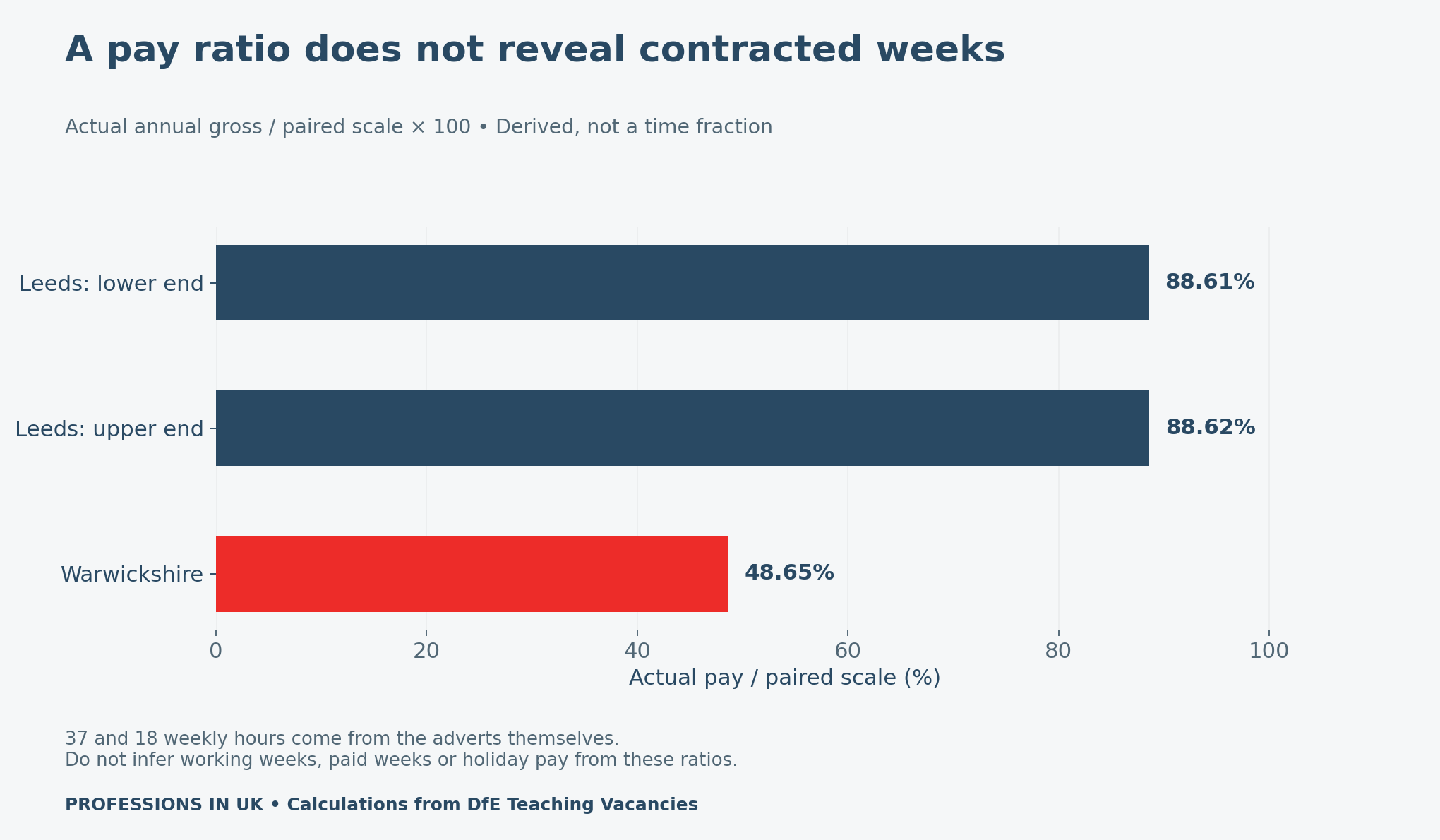
A ratio alone cannot separate several inputs. The reference working week, working weeks, holiday-pay treatment and employer payroll basis may all matter. Use the stated 37 and 18 hours from the adverts. Do not reverse-engineer a contract from a salary fraction or assume that a rounded result reveals exact paid weeks.
Keep five offer fields separate
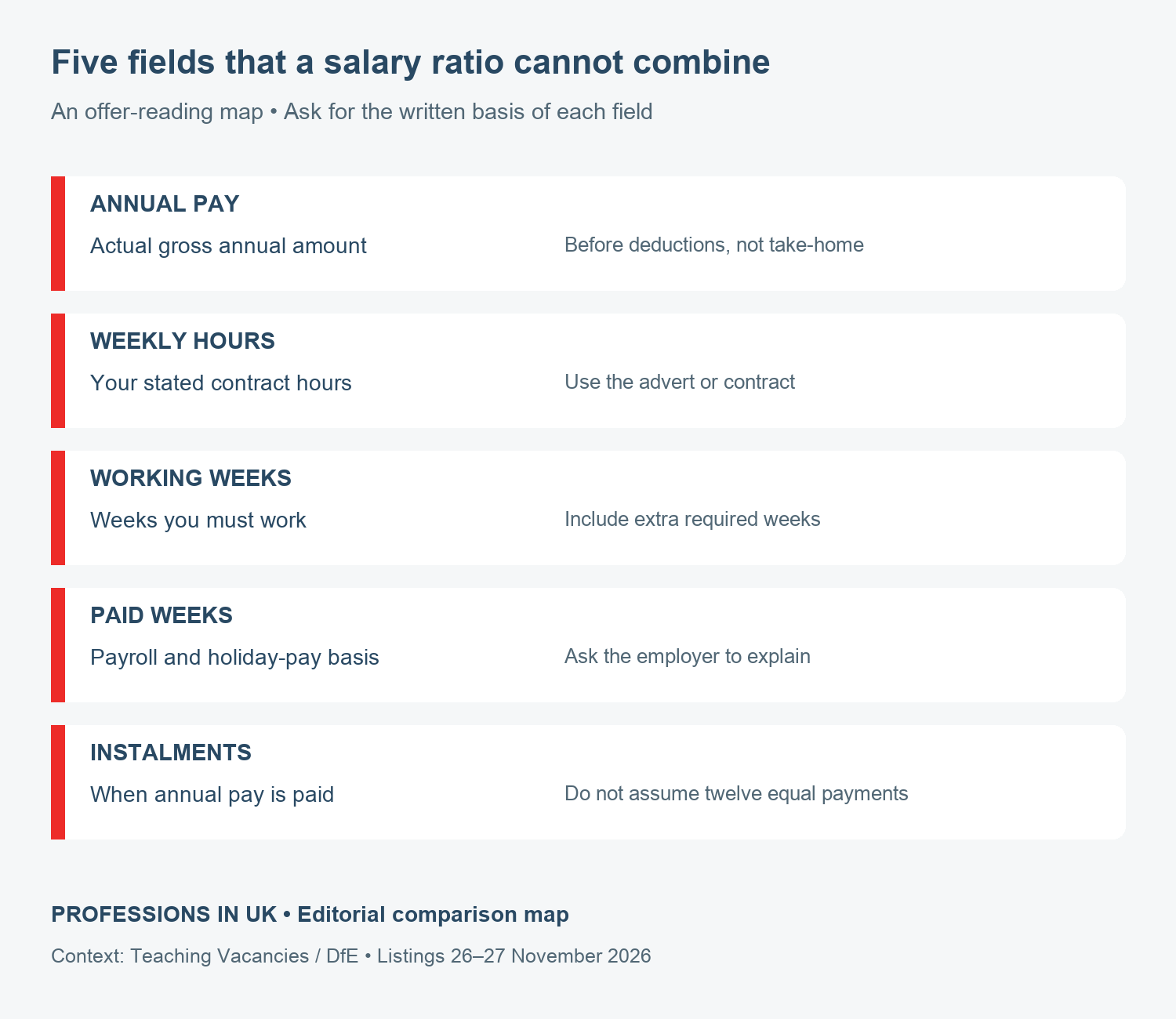
First, ask which annual amount applies to your own offer. A published range does not mean every applicant starts at its top. Record the agreed point, the effective date and whether the amount covers a complete year of employment. A fixed-term contract can also start or finish within a payroll year.
Second, distinguish weeks worked from weeks paid. An advert may identify extra working weeks but leave the payroll explanation elsewhere. Request that explanation in writing. Keep its source and date beside the number instead of filling a blank with a common school-year assumption.
Third, confirm pay instalments. Annual gross salary divided by twelve is a useful conditional calculation only if twelve equal payments are confirmed. It is not proof of the employer’s schedule. Ask how a part-year start, unpaid absence or contract end affects the actual payments before relying on a monthly budget.
Build a comparison that fits your household
Start your own worksheet with the actual annual gross salary. Put commuting, childcare and other personal costs in separate columns using your own figures. Keep these estimates distinct from the employer’s terms. An advert does not supply your pension choices, tax code or net income.
Then compare practical constraints. Which days require attendance? Where is the worksite? Are the additional weeks fixed? What happens during the school holidays? Record the employer’s answer and any unresolved question. A role that fits one household may be difficult for another even when the annual amounts are similar.
For example, a fictional applicant has two offers but only one confirms its payroll schedule. The useful next action is to obtain the missing schedule, not to assume that both employers use the same method. This example contains no personal tax calculation and no recommendation to choose a particular vacancy.
If school work also changes your care arrangements, our childcare costs and working-pattern study provides a separate planning context. For the workload behind employer activities, see the school employer-engagement capacity planner. Neither replaces the written terms of a current offer.
Methods, limits and downloadable worksheets
Research checked on 29 November 2026. We transcribed two official Teaching Vacancies listings and paired each actual annual gross amount with its corresponding published reference. Calculations use those displayed integers: annual difference equals reference minus actual; the percentage equals actual divided by reference, multiplied by 100.
Personalized UK Career Consulting
Receive tailored career guidance designed just for you. Get actionable steps and expert support to boost your career in 1-3 days. Take control of your career now.
Get StartedThe two charts answer different reading questions: which annual sums are stated, and what the pay ratio can and cannot tell you. The separate infographic organises contract fields. Extra charts would repeat the same evidence. This is a two-advert comparison, not a representative salary survey, a payroll audit or a legal finding.
Use this term time only actual salary vs full time equivalent checklist as a starting point for written questions. Recheck vacancy status, dates and terms through the official employer route. A saved advert can support your notes, but a later reader should not assume that applications remain open.
- Advert salary and working-pattern data (CSV)
- Paired annual differences and ratios (CSV)
- Blank school-job offer comparison worksheet (CSV)
- Salary measure definitions and limits (CSV)
Suggested citation: Professions In UK, “Term-Time School Jobs: Compare Actual Salary, Not the Scale”, 29 November 2026. Credit Teaching Vacancies / DfE for the adverts and Professions In UK for the original calculations and comparison tools.


