





A dental nurse apprenticeship paid hours GDC qualification check should answer two different questions. What time will the employer pay you for? And which exact qualification supports the registration route? A course label and an annual wage cannot answer both on their own.
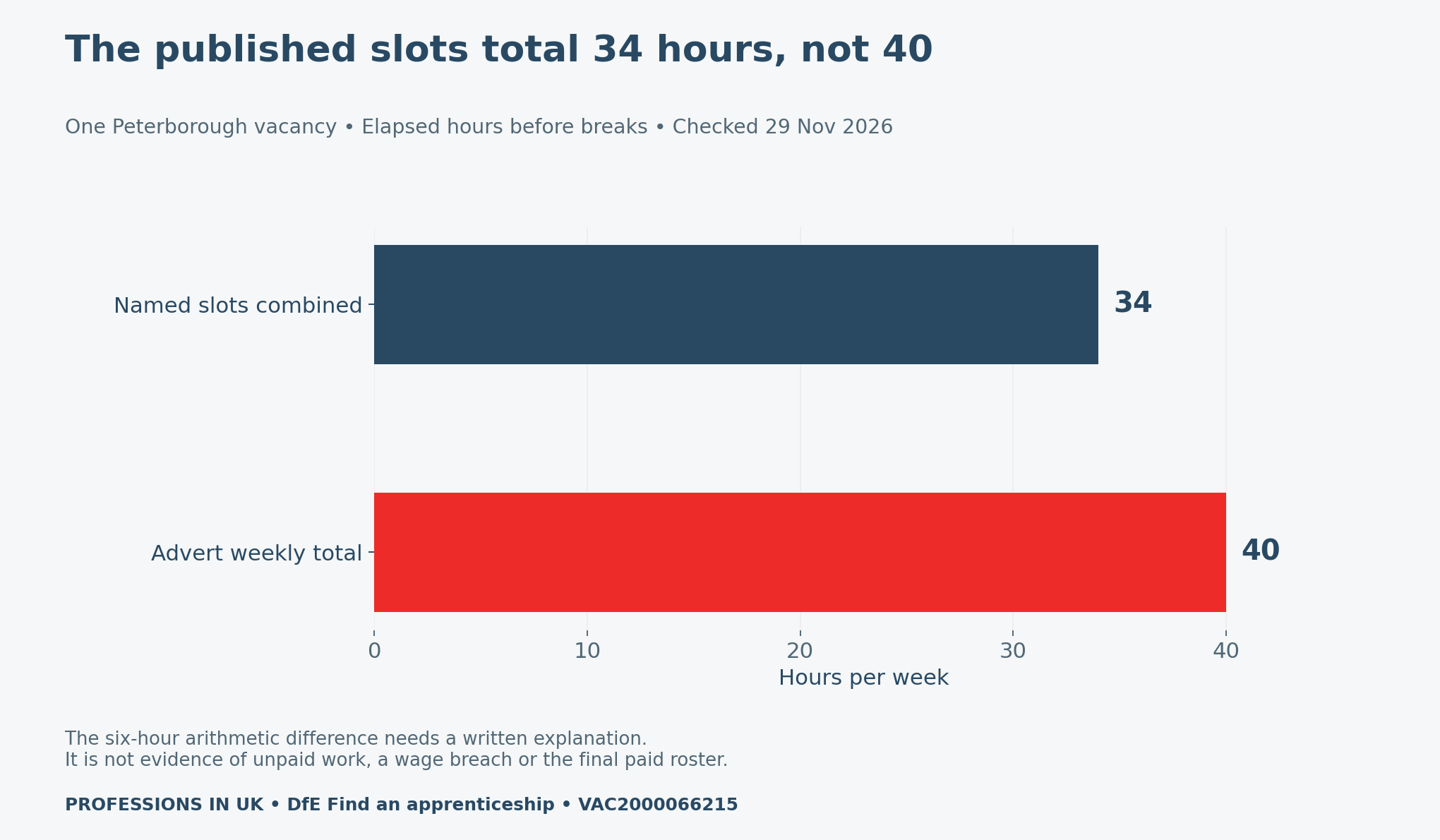
A Peterborough vacancy posted on 27 November 2026 makes a useful worked example. It advertises £16,640 for the first year and 40 hours a week. However, its named work and training slots total 34 elapsed hours before breaks. Ask for a complete written roster rather than guessing what fills the difference.
What the Peterborough advert states
The official Find an apprenticeship listing, VAC2000066215, names Molar Matrix Limited as the employer and I & F Limited as the training provider. It offers one place over 18 months, with a proposed 14 December 2026 start. At our 29 November check, the stated closing date was 13 December, but the employer warns that it may close earlier.
The vacancy describes an integrated Level 3 dental nurse apprenticeship. It lists GCSE Maths and English at grades 4–9. Applicants should check the live eligibility and funding conditions with the provider, including the individual assessment of prior learning. Do not treat this single advert as a complete statement of every applicant’s eligibility.
| Day | Published interval | Elapsed time |
|---|---|---|
| Monday | 09:00–18:00 | 9 hours |
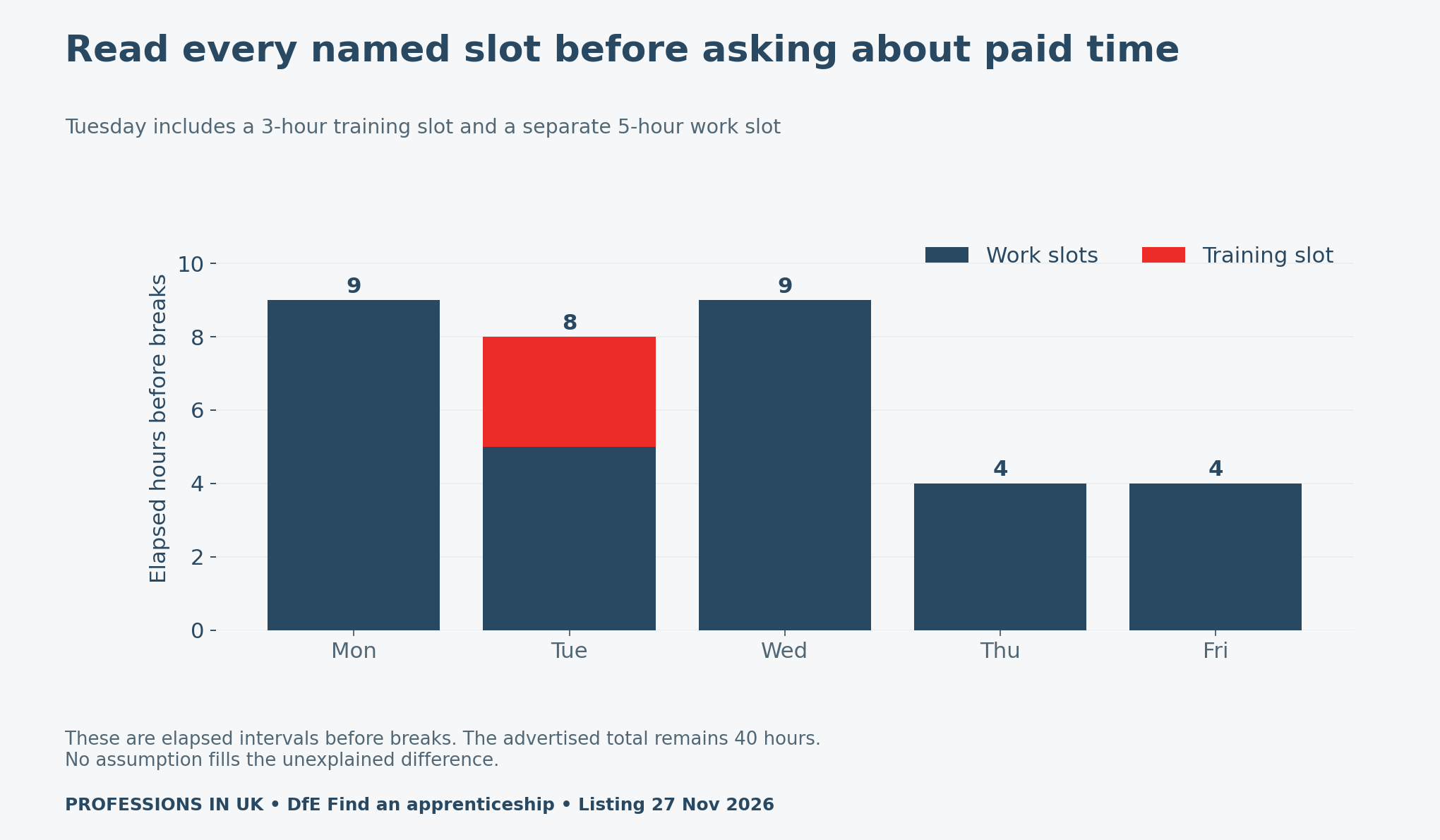
| Tuesday training | 09:30–12:30 | 3 hours |
| Tuesday work | 14:00–19:00 | 5 hours |
| Wednesday | 09:00–18:00 | 9 hours |
| Thursday | 08:00–12:00 | 4 hours |
| Friday | 08:00–12:00 | 4 hours |
Reconcile the timetable without inventing hours
Monday and Wednesday contribute nine hours each. Tuesday contributes five work-slot hours and three training-slot hours. Thursday and Friday contribute four hours each. Adding those intervals gives 9 + 3 + 5 + 9 + 4 + 4 = 34 hours. The advert separately states 40 hours a week.
Therefore, 40 minus 34 gives a six-hour difference between the two published descriptions. That subtraction does not explain the difference. The page does not settle paid breaks, extra duties or a later complete roster. Do not insert any of those possibilities as a fact about this employer.
Ask the employer to return one weekly schedule showing start and finish times, break arrangements, paid training and any other required time. Then compare its total with the written employment terms. Keep both the answer and its date in your offer checklist. A verbal estimate leaves the original question unresolved.
It is tempting to divide the annual wage by a guessed number of weeks and hours. Avoid presenting that result as an actual hourly rate. First confirm the paid-hours basis and the applicable pay terms. This article does not conclude that the vacancy underpays anyone or that its published timetable proves a wage breach.
Dental nurse apprenticeship paid hours GDC qualification: two separate checks
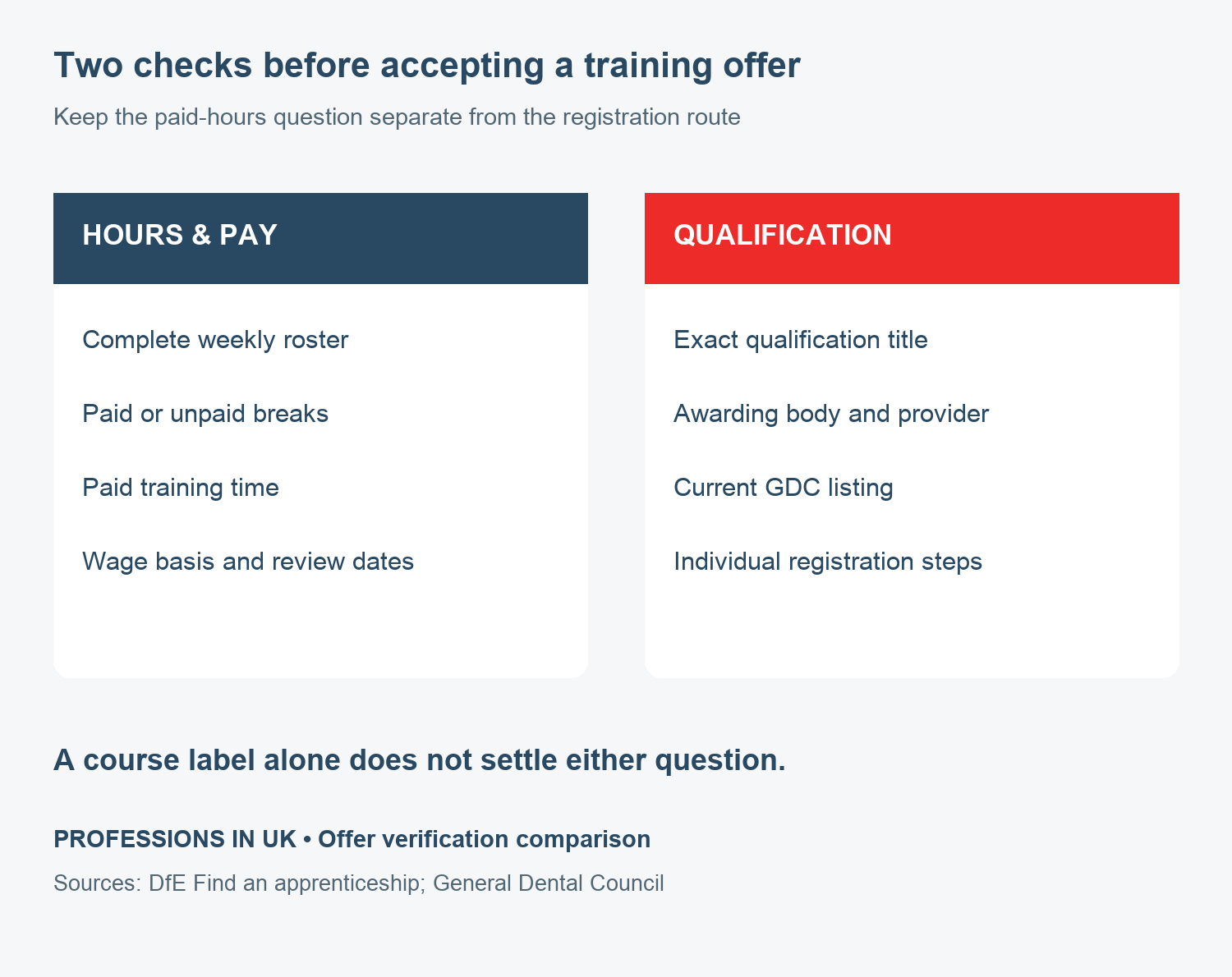
The General Dental Council’s dental nursing list identifies qualifications and providers associated with routes to registration. Ask for the exact qualification title and awarding body, then compare them with the current regulator information. Record the listing date and any conditions; a broadly similar course name is not enough.
The GDC also warns that dental nursing assistant qualifications are not eligible for dental nurse registration. That distinction makes precise wording important. Do not assume that any Level 3 course, or the word “dental” in a course title, establishes the route you need.
A training provider’s name and an awarding body’s name can play different roles. Obtain both in writing. If the offer uses a trading name, ask how it maps to the actual programme and qualification. Where a qualification or its conditions remain unclear, ask the provider and regulator for clarification before relying on it.
Even an appropriate qualification is not a guarantee that an individual has completed registration. Keep entry to training, completion of the qualification and the registration application as distinct stages. This article assesses neither this applicant nor this employer’s registration arrangements.
Questions worth settling before the start date
Ask when formal training begins and where it takes place. Confirm whether the named Tuesday session is included in the stated weekly paid hours. Also ask who pays any examination, resit, travel or other required costs, and which terms explain them. Record an unresolved item instead of inserting a typical industry answer.
Next, check whether the proposed start date remains realistic for your own notice, travel and eligibility requirements. The advert’s one available place is not a placement probability. Its stated duration is not evidence that every learner completes on that exact date. Request the relevant offer documents through the official application route.
For comparison, our actual salary versus full-time scale guide explains why annual pay and working time should remain separate fields. Our medical-practice ethics overview offers wider workplace context, rather than evidence about this apprenticeship.
Personalized UK Career Consulting
Receive tailored career guidance designed just for you. Get actionable steps and expert support to boost your career in 1-3 days. Take control of your career now.
Get StartedMethods, limits and free checks
Research checked on 29 November 2026. We used one official vacancy and the GDC’s public dental nursing information. The calculations subtract each stated start time from its end time and add the six non-overlapping intervals. No break deductions, assumed extra shifts or invented training hours enter the calculation.
The two charts answer distinct questions: the weekly reconciliation and the daily composition of the named slots. A separate comparison infographic organises the employment and qualification checks. More numerical charts would repeat the same small source. This is not a survey of dental nurse wages, a legal assessment or a guarantee of GDC registration.
Use the dental nurse apprenticeship paid hours GDC qualification checklist to keep questions and written replies together. Recheck the vacancy before applying because dates and availability can change. The downloadable blank tool contains no applicant or patient information; use it without collecting confidential clinical records.
- Published work and training slots (CSV)
- Weekly-hours reconciliation and limits (CSV)
- Blank apprenticeship offer checklist (CSV)
- Offer and qualification measure dictionary (CSV)
Suggested citation: Professions In UK, “Dental Nurse Apprenticeships: Check the Hours and Qualification”, 29 November 2026. Credit DfE Find an apprenticeship and the General Dental Council for the underlying information, and Professions In UK for the calculations and verification tools.


