





For an air accidents inspector operations UK application, start with the role boundary: this is a specialist investigation role for an experienced pilot. The AAIB notice published on 23 November 2026 names reference 488618 and a closing time of 11:55pm on 6 December. Check the live advert before preparing an application.
Our evidence card helps you describe your own contribution without borrowing the achievements of a whole team. A separate fictional desk exercise shows why supported, conflicting and uncorroborated statements need different labels. Neither tool is an AAIB application form or selection test.
Read the air accidents inspector operations UK notice
The official AAIB vacancy announcement highlights substantial recent professional flying experience, civil-aircraft knowledge and clear communication. It places operations work within a multidisciplinary investigation. These points help identify the intended professional audience; they do not supply the full application requirements.
The linked Civil Service Jobs page presented a verification screen during our check. Therefore, this report does not reproduce a salary, minimum flying hours, licence threshold, location requirement or selection sequence from an unverified listing. Follow the official notice to the full advert and confirm every applicable condition there.
Record the vacancy reference alongside the source URL and the date you checked it. If you later save a role description, keep its version with your notes. That small habit helps prevent an older recruitment page or a search snippet from becoming your working specification.
Separate operations from adjacent investigation roles
The AAIB recruitment insights distinguish operational, engineering and recorded-data work. The operations account describes deployment, later analysis and communicating safety lessons. The adjacent disciplines contribute different technical evidence. A shared investigation does not make their professional entry routes interchangeable.
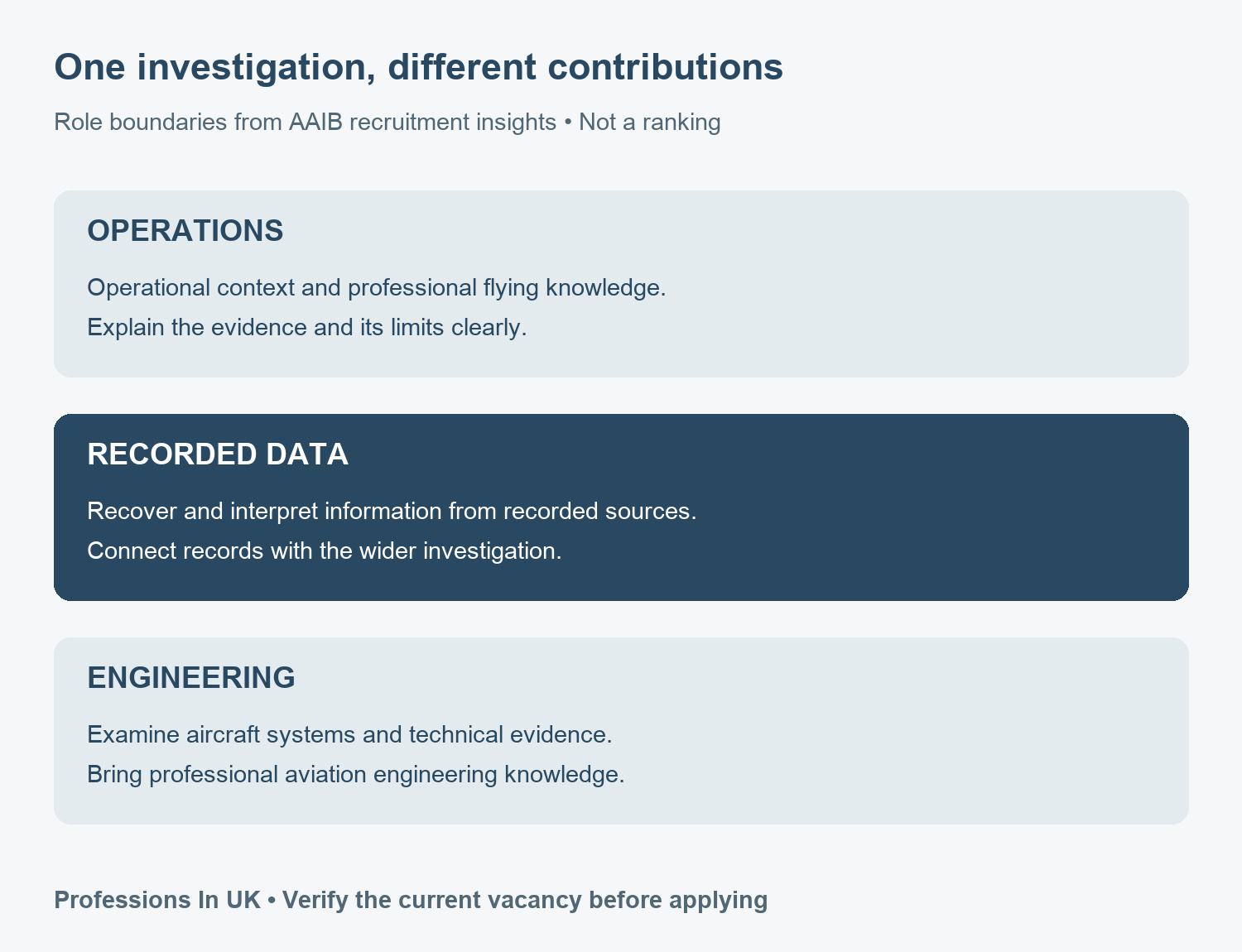
For your own planning, ask which contribution your experience actually supports. A pilot can explain operational decisions and communication examples from their own work. That does not automatically establish expertise in every aircraft system or every recorded-data method. Equally, technical expertise alone does not answer the flying-experience question in this notice.
Keep the boundaries visible in a work sample. For example, describe the record you checked and the question you could answer. Then name what remained outside your remit. This is an editorial approach to clear writing, not a prediction of how an employer will score an application.
Build an evidence card around your actual contribution
The blank CSV asks what you did, when you did it, what role you held and which evidence you can appropriately share. It also leaves space for the official criterion you need to verify. Fill that last column from the current role documents rather than from this article.
| Card field | Useful distinction |
|---|---|
| What I did | Your own action versus a team outcome |
| When and recency | A dated example versus an undated claim |
| Role actually held | Responsibility performed versus responsibility observed |
| Shareable evidence | Permitted reference versus confidential operational material |
A strong example can be specific without disclosing private information. Describe the nature of your responsibility at an appropriate level, and check whether any supporting material may be shared. If permission is uncertain, leave the material out and ask the appropriate owner. Do not upload incident records, passenger details or internal employer documents into an unofficial worksheet.
Next, test whether the example answers the criterion you have confirmed. If the advert asks about communication, a paragraph listing flight experience may not show what you wrote or explained. Record the audience, your own action and the limit of the example. Avoid turning confidence into evidence.
Practise evidence labels with a fictional ground delay
This benign exercise contains no accident and no real operational records. The entire invented desk log says that a readiness message appeared at 09:10 and departure was recorded at 09:30. No weather record or causal evidence is supplied. Those are the only facts available within the exercise.
| Invented statement | Editorial label |
|---|---|
| The fictional desk log records a 09:10 readiness message. | Directly supported |
| The fictional desk log records departure at 09:30. | Directly supported |
| Departure occurred at 09:20. | Contradictory |
| Weather caused the ground delay. | Not corroborated |
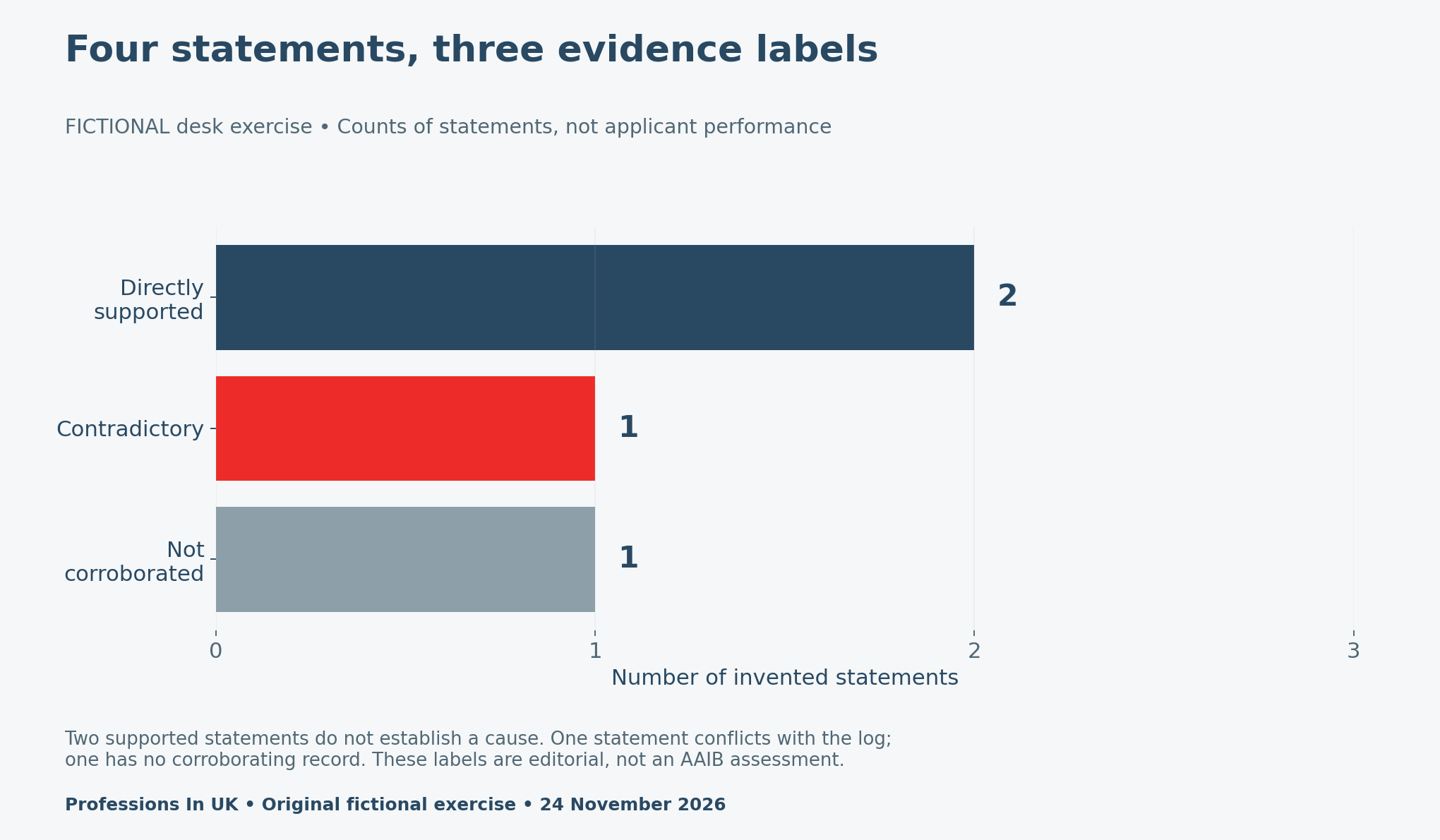
The first two statements restate the supplied log. The third gives a departure time that conflicts with it. The fourth proposes a cause without supporting evidence. Notice that an absent record does not prove the proposed cause false. It means this exercise gives no basis to confirm it.
Write about 120 words explaining what remains unknown and which statements cannot yet be relied upon. That length is an editorial practice choice, not an application instruction. Do not try to determine a cause, reconstruct a flight or produce an investigation procedure. The task is simply to keep a claim proportionate to its evidence.
Use the work sample to find your own gaps
After writing, check whether each sentence points to a supplied record or clearly states an uncertainty. A neat paragraph can still contain an unsupported conclusion. Ask a trusted colleague to identify where your wording goes beyond what the exercise provides, without sharing private workplace material.
Personalized UK Career Consulting
Receive tailored career guidance designed just for you. Get actionable steps and expert support to boost your career in 1-3 days. Take control of your career now.
Get StartedThen return to your own evidence card. An empty field is a useful prompt for a question, not permission to invent experience. You may need a more suitable example, a clearer account of your role or clarification from the official recruitment contact. None of those steps guarantees eligibility or selection.
For broader context, browse our transport and logistics career coverage. This report addresses one specialist vacancy and a writing exercise. It does not replace aviation training, professional advice or the employer’s application instructions.
Methods, limits and four downloadable tools
Research checked on 24 November 2026. We compared the current AAIB notice with its standing recruitment insights. We then created four fictional statements and counted their editorial evidence labels: 2 + 1 + 1 = 4. There are no candidate observations, hiring probabilities or measured career outcomes in this dataset.
The one count chart answers the exercise question; the separate infographic explains roles. Additional statistical graphs would imply data we do not have. Recheck the live vacancy and its deadline before acting, particularly after 6 December 2026. A later reader should not assume the example remains open.
- Fictional statements and evidence labels (CSV)
- Blank application evidence card (CSV)
- Source and verification-status register (CSV)
- Fictional counts and measure dictionary (CSV)
Suggested citation: Professions In UK, “Air Accidents Inspector UK: Check the Operations Role Before Applying”, 24 November 2026. Cite AAIB for the vacancy and role information; cite this report for the original editorial tools and fictional exercise.


