





For mental health AI evaluation careers UK readers are exploring, a useful work sample starts with an evidence question. A polished product demonstration does not show that an evaluation method is valid, or that a product is safe. Keep the question, records and limits visible before presenting a result.
The MHRA and NICE opened a new organisational sandbox on 23 November 2026. This report uses that announcement to explain a professional distinction. Our canvas and ten-row fictional log are learning tools. They contain no patients, advice content or clinical test results.
Understand the mental health AI evaluation careers UK context
The official AI in Mental Health Airlock application guidance concerns approaches for evaluating and monitoring AI-related risks. It is not a call for individual job applicants. The published organisational application deadline is 22 January 2027 at 14:00, with up to five participants to be selected.
The guidance states that there is no participation fee and no funding for participants. It also separates this exploratory work from a regulatory route to market. Do not describe participation as approval of an underlying mental-health product, a promise of NHS adoption or an individual recruitment offer.
The MHRA digital mental health technology collection places the programme within a broader evaluation initiative. That context explains why method design matters. It does not establish how many jobs exist, what they pay or which qualifications an employer will accept. Those questions need actual vacancy evidence.
Choose the assessment object before designing a demo
A product demonstration can show an interface completing a task. An evaluation work sample asks a different question: which claim is being examined, and what evidence would answer it? If those are unclear, adding more screenshots may make the presentation attractive without making its conclusion stronger.
For a benign example, imagine a fictional interface that displays a short label describing its intended scope. Ask whether the label appears consistently across a defined set of screens and versions. Exclude advice generation, clinical scenarios, vulnerable users and real-world deployment. The exercise stays within documentation and interface inspection.
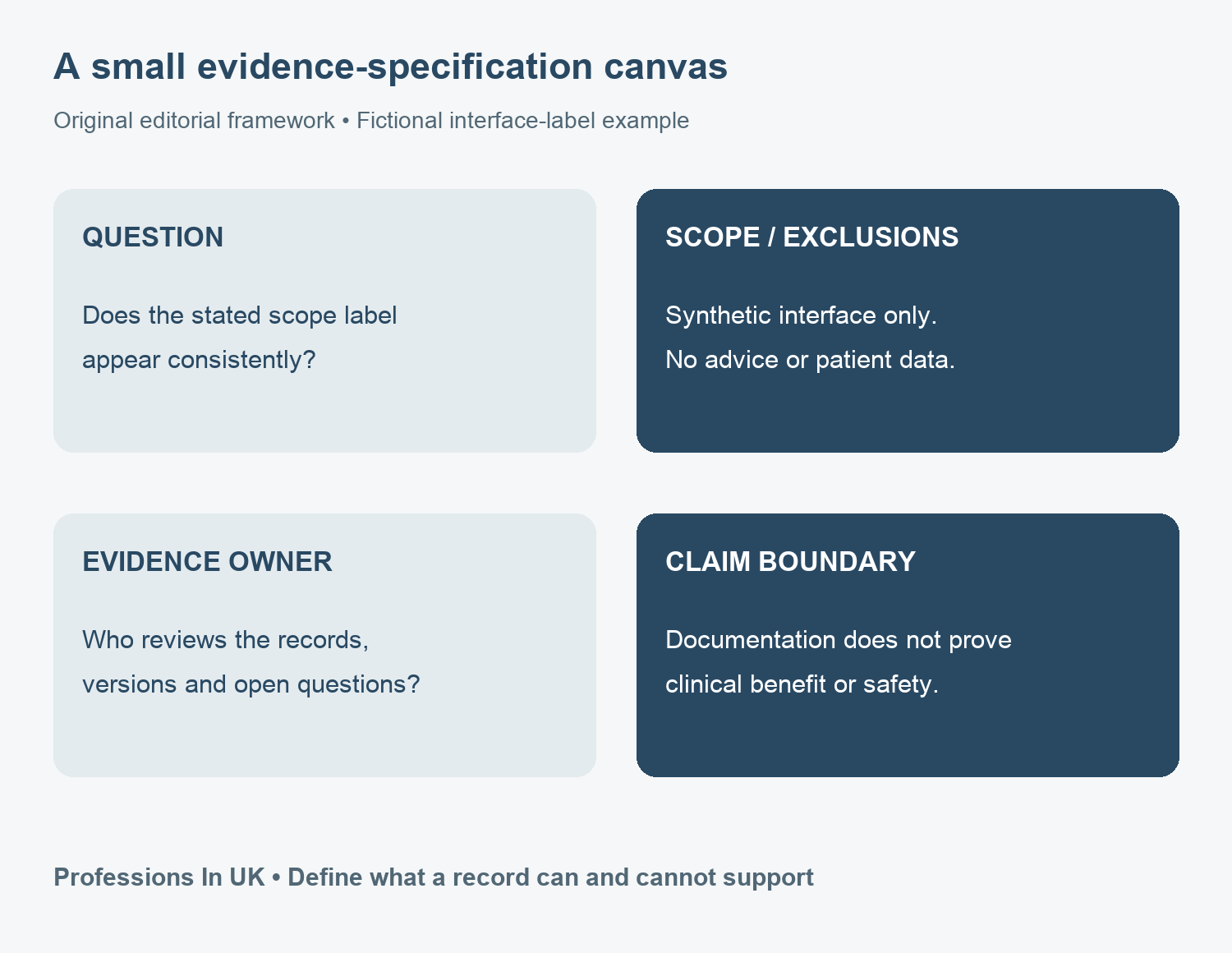
The canvas has four independent fields, not four compulsory stages. You may revise them together as the question becomes clearer. For instance, changing the interface version changes the records needed. However, it does not automatically expand the exercise into a test of clinical benefit.
Count documentation without calling it safety
Our synthetic log plans ten observations. Eight have the documentation required by this fictional exercise; two remain unresolved because a record is missing. The completeness calculation is 8 divided by 10, multiplied by 100: 80%. The remaining 20% describes incomplete documentation in the same fixed total.
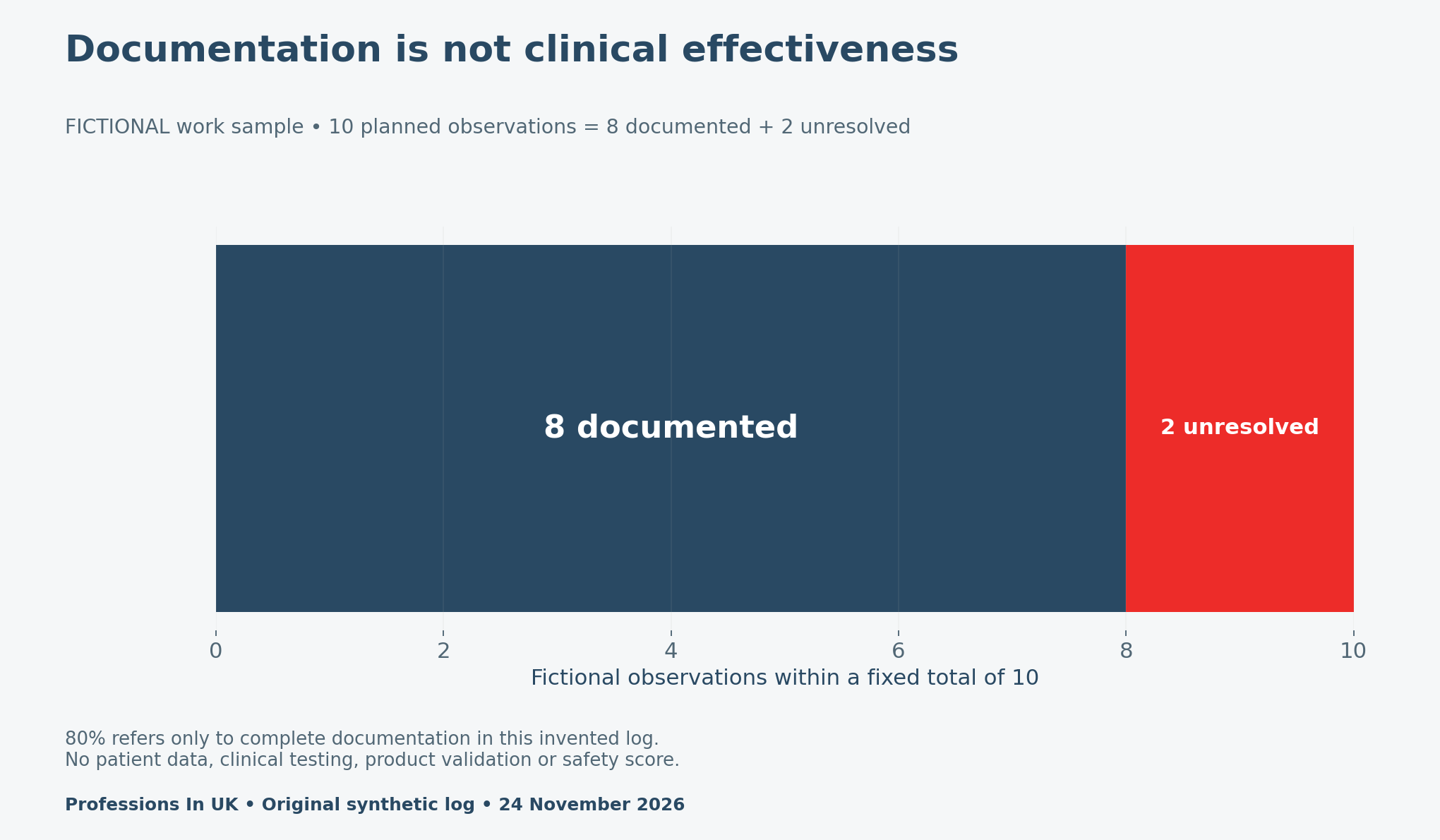
These invented observations are not a sample of patients, deployed products or staff performance. We selected the numbers to make the arithmetic auditable. There is no sampling method, confidence interval or population estimate. A percentage can look authoritative even when its denominator is only a teaching example.
An unresolved record also needs careful wording. It does not prove that the interface failed, and it does not prove that it passed. It means the required evidence is incomplete. Keep that status open until the responsible reviewer has the relevant record and can explain the decision.
| Statement | What this fictional log supports |
|---|---|
| 8 of 10 observations have complete documentation | Supported by the invented rows |
| The product is 80% safe | Not supported |
| The two unresolved observations are failures | Not established |
| The interface has clinical benefit | Not tested |
Make the evidence owner and version explicit
A reusable work sample should let another reader trace the result. Give each observation an identifier, record the interface version and name a responsible role. Describe what is missing without filling the gap with a guess. Our blank worksheet leaves those fields open for your own non-sensitive practice example.
Next, explain who would decide whether the documentation is sufficient. A researcher may frame the question, an analyst may organise the observations and an assurance practitioner may review the claim boundary. These are editorial examples of contributions, not claims that the sandbox is recruiting those job titles.
Avoid collecting personal information just to make the sample look realistic. You can demonstrate traceability with fictional records and blank role fields. A portfolio does not need real patient histories, staff identifiers or private product logs. Do not solicit such material through this article or its downloads.
Show a disciplined handoff in your portfolio
Write a short conclusion in three parts: what you checked, what the records show and what remains unknown. For this exercise, the conclusion is limited to documentation completeness. A separate question about clinical outcomes would need its own design, expertise, safeguards and evidence.
Personalized UK Career Consulting
Receive tailored career guidance designed just for you. Get actionable steps and expert support to boost your career in 1-3 days. Take control of your career now.
Get StartedThen include a handoff note asking the responsible reviewer to resolve the two open records. Keep the requested action specific. “Confirm which version this observation belongs to” is more useful than “approve the AI”. The latter bundles several unsupported conclusions into one vague request.
For related professional research, see our Research & Reports archive. To practise a different evidence-writing boundary, the operations-inspector evidence guide uses a fictional record-consistency exercise. Neither article measures hiring success.
Methods, limits and four downloads
We checked the official guidance and programme collection on 24 November 2026. We created a ten-row synthetic documentation log, counted its two statuses and calculated a completeness ratio. The separate four-field infographic explains the work-sample structure. It is not evidence about a real product, patient population or employer.
Use the live official page for organisational eligibility, programme conditions and any deadline changes. Do not deploy a mental-health model, run clinical testing or infer regulatory compliance from this exercise. Its practical value is a transparent explanation of what a small set of records can support.
- Fictional ten-observation documentation log (CSV)
- Fictional evidence-specification canvas (CSV)
- Blank non-sensitive assurance work sample (CSV)
- Counts, definitions and official source reference (CSV)
Suggested citation: Professions In UK, “Mental Health AI Evaluation Careers: Design Evidence, Not a Product Demo”, 24 November 2026. Cite MHRA and NICE for programme facts; cite this report for its original fictional tools.


