





For Nottingham Broad Marsh careers and construction jobs, follow the evidence from project procurement to a named employer. The latest announcement is a search for a development partner. Its projected jobs figure is not a list of current vacancies, and the bidder questionnaire deadline is not a job-application cutoff.
This report gives you a dated watchlist structure and a fictional four-link exercise. The exercise produces zero verified vacancies because none of its invented links meets the stated check. That result says nothing about the total number of real jobs available around Broad Marsh today.
Read the Nottingham Broad Marsh careers and construction jobs headline carefully
Homes England’s 23 November announcement describes ambitions for around 1,000 homes, 20,000 square metres of mixed-use space and up to 2,000 jobs. These are different units and qualified project ambitions. They are not delivered housing, occupied floor space or open requisitions.
| Published ambition | How to read it |
|---|---|
| Around 1,000 homes | Planned housing, not employment count |
| 20,000 m² of mixed-use space | Area, not a vacancy measure |
| Up to 2,000 jobs | Projected employment ambition, not current openings |
Do not divide the employment ambition by the homes figure to manufacture a jobs-per-home estimate. The announcement does not define such a relationship. Nor does it provide a trade-by-trade vacancy schedule, local hiring quota or guaranteed employment outcome for applicants.
Separate the tender timeline from the recruitment timeline
The official Find a Tender notice was published on 19 November 2026. It carries reference DN815218 and identifier 2026/S 000-109575. That date precedes the 23 November news release. Keep the notice date and announcement date separate in your watchlist.
The published questionnaire checkpoint is 8 January 2027 at 5pm for prospective development partners. Homes England expects a partner appointment in mid-2027. Neither statement confirms when a particular employer will recruit, which occupation it will seek or when a successful applicant would start.
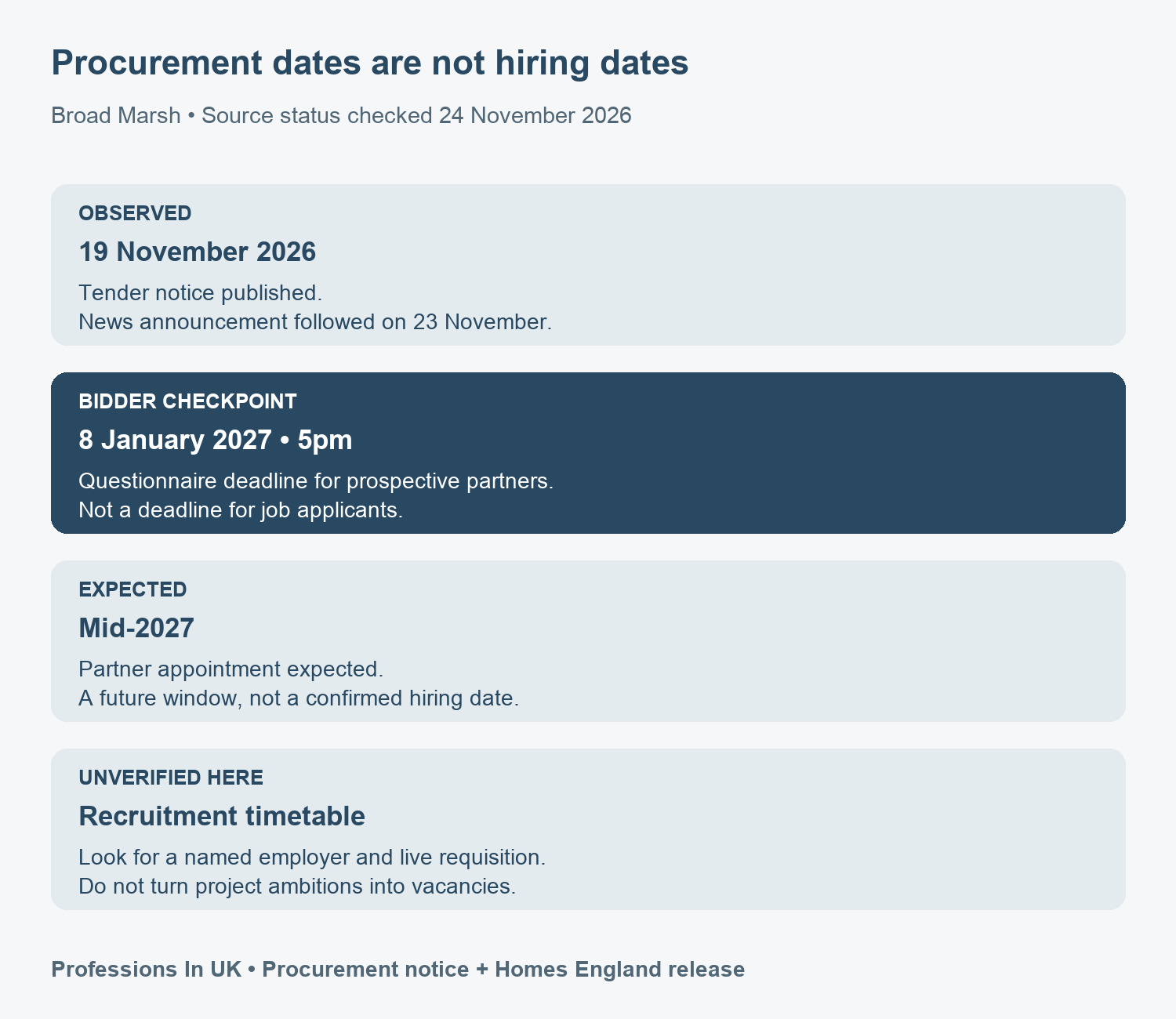
The tender also describes a phased development and says its dates are indicative and subject to revision. For a career decision, that qualification matters more than an attractive project headline. A long project horizon does not tell you when a role matching your skills will become available.
Build a watchlist that can advance only with evidence
Begin with the dated project source and procurement reference. Add a named delivery partner only when an appropriate source confirms it. Then look for a named employer and a live requisition. Record the role, location, closing date and the date you checked the employer’s own page.
These fields form an editorial evidence ladder, not a promise that hiring follows a fixed sequence. A supplier may advertise independently, a role may serve several projects or a requisition may close quickly. The worksheet should preserve those distinctions instead of forcing every update into one story.
| Watchlist question | Evidence that answers it |
|---|---|
| What project update did I read? | Dated official source and reference |
| Who is delivering the work? | Confirmed named organisation and source |
| Who is actually recruiting? | Employer identity and live requisition |
| Does the opening fit my search? | Current role, location, conditions and closing date |
Screen four fictional links without claiming a market finding
Imagine receiving four links: an announcement, a procurement record, an undated hiring rumour and an unrelated old requisition. None identifies a verified current vacancy for the fictional check. The first two may be useful project evidence, but usefulness does not turn them into employer recruitment evidence.
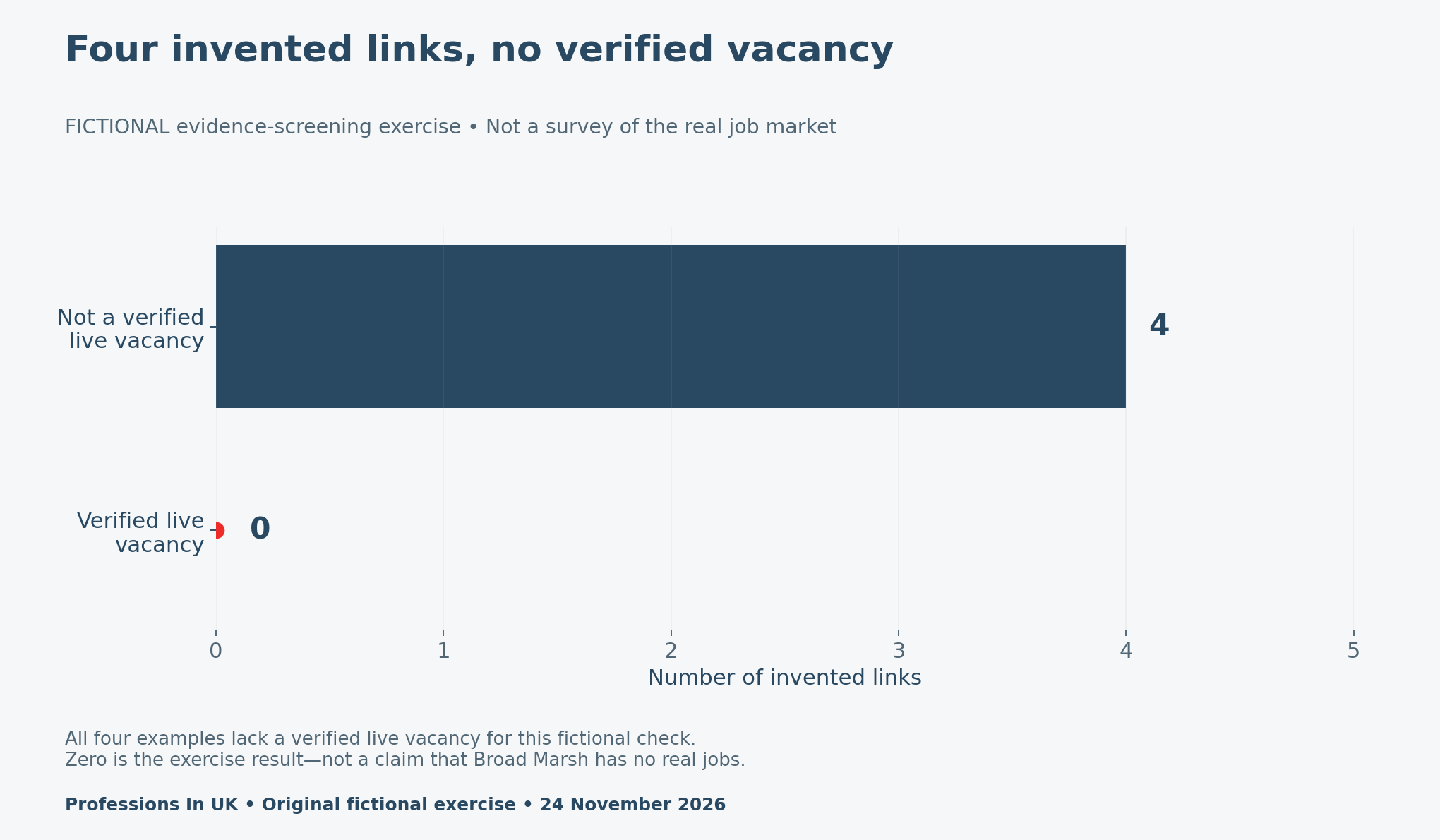
For the rumour, the next question is who is recruiting and where the live requisition appears. For the old advert, check the project, date and status before adding it to a current list. Do not contact a supposed recruiter or supply personal documents merely because a social post mentions a major development.
The exercise deliberately stops at “unverified”. That label is more useful than inventing a vacancy or declaring that no hiring exists anywhere. If a genuine employer advert later appears, add a new dated row with its source. Keep the earlier row as a record of what was known at the time.
Make the watchlist relevant to your occupation
A surveyor might record which actual role asks for their measurement or commercial experience. A technician might check the discipline and named work location. A site coordinator might check the employer’s stated responsibilities and conditions. These examples describe how to read an advert; they do not predict openings in those occupations.
Keep your preparation proportionate to evidence. You can organise a CV and note relevant experience while a project is in procurement. However, avoid paying for a course, travelling or changing employment on the assumption that the headline guarantees a role. Use verified requirements from an actual employer when making a targeted application.
For wider professional context, browse our engineering and technical career coverage. Our operations-inspector evidence guide addresses a different situation: a named live vacancy with its own official notice.
Personalized UK Career Consulting
Receive tailored career guidance designed just for you. Get actionable steps and expert support to boost your career in 1-3 days. Take control of your career now.
Get StartedMethods, limits and four watchlist downloads
We checked the Homes England release and read the official tender notice in Chrome on 24 November 2026. The news date and tender date were recorded separately. We did not audit every contractor, classify all local vacancies or estimate the probability of securing a job.
The four-link dataset is wholly fictional. The count chart and milestone infographic answer different questions: what the exercise verifies, and which real project dates have which status. Update the blank watchlist from current employer evidence; do not treat the January bidder deadline as an instruction to jobseekers.
- Four fictional links and screening reasons (CSV)
- Blank project-to-employer watchlist (CSV)
- Published numbers, milestone statuses and sources (CSV)
- Fictional link-screen counts and scope (CSV)
Suggested citation: Professions In UK, “Nottingham Broad Marsh Careers: Track Procurement Before Searching for Jobs”, 24 November 2026. Cite Homes England and the tender notice for project facts; cite this report for the original fictional exercise and watchlist.


