




The UK entry-level tech jobs plan offers a useful signal for newcomers. However, a large policy number cannot tell you whether an employer is accepting applications today. Our dated route audit shows how to check that difference before spending time or money.
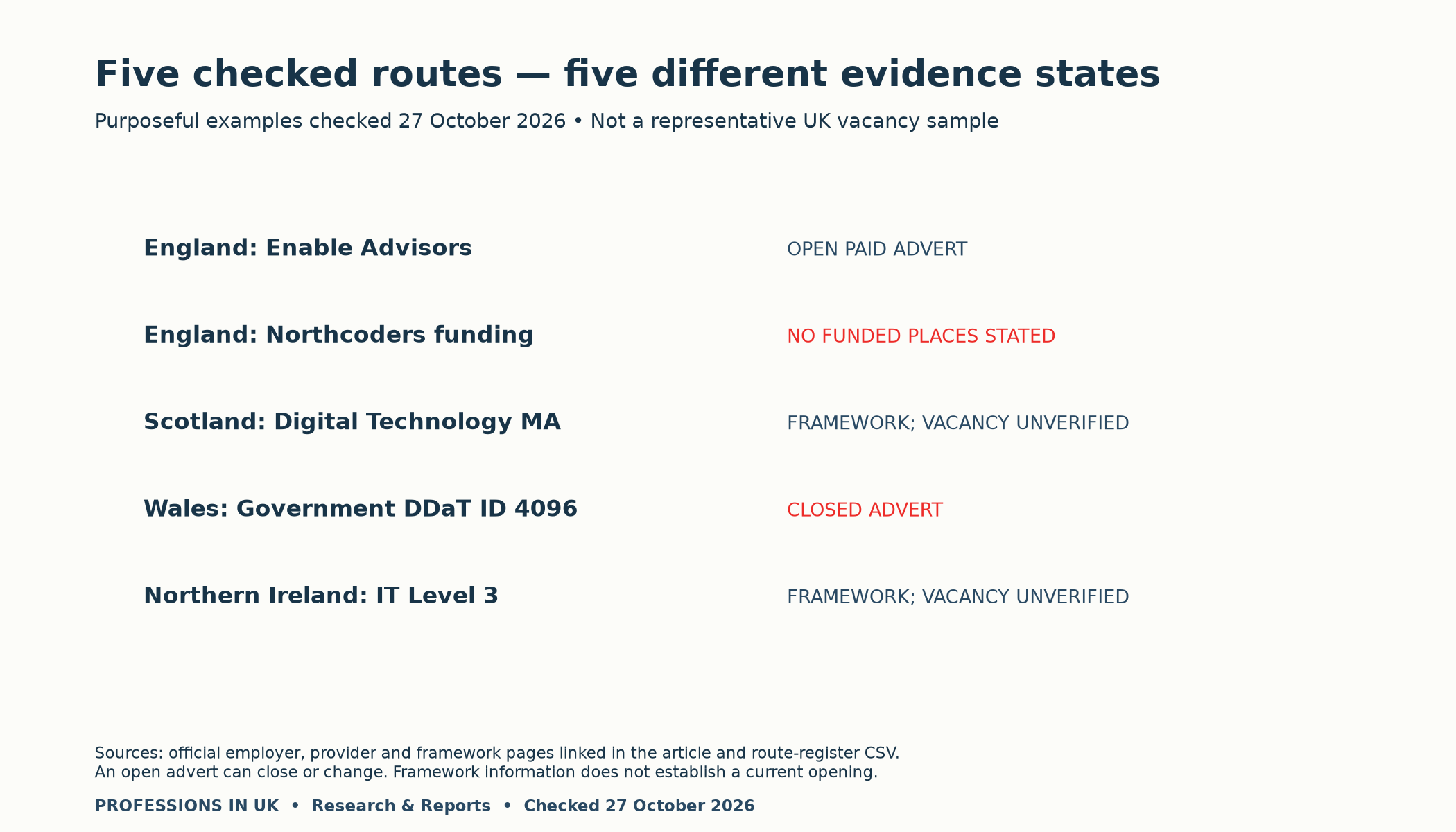
Research checked: 27 October 2026. We examined five deliberately selected official routes across the four UK nations. Only one was verified as an open paid advert. This small register tests a checking method; it does not measure the share of UK opportunities that are open.
What the UK entry-level tech jobs plan actually promises
The government’s Digital and Technologies Jobs Plan, published on 21 October, sets an ambition of around 200,000 entry-level jobs over ten years, including apprenticeships. Its stated annual average is 20,000. Entry-level means less than one year’s relevant experience, rather than a fixed age or qualification.
A separate indicative estimate puts wider hiring needs at around 800,000 for 2025–2035: approximately 550,000 new roles and 250,000 replacements. Replacement needs outside the Digital and Technologies sector are excluded. The calculation extends historical growth and does not model AI.

The sector-only estimate of 488,000 sits within that wider figure. It is not an extra number to add. Nor should the 200,000 ambition be added to 800,000. Neither measure is a count of current vacancies. Up to £250 million supports TechFirst delivery; it is not a cash entitlement for each applicant.
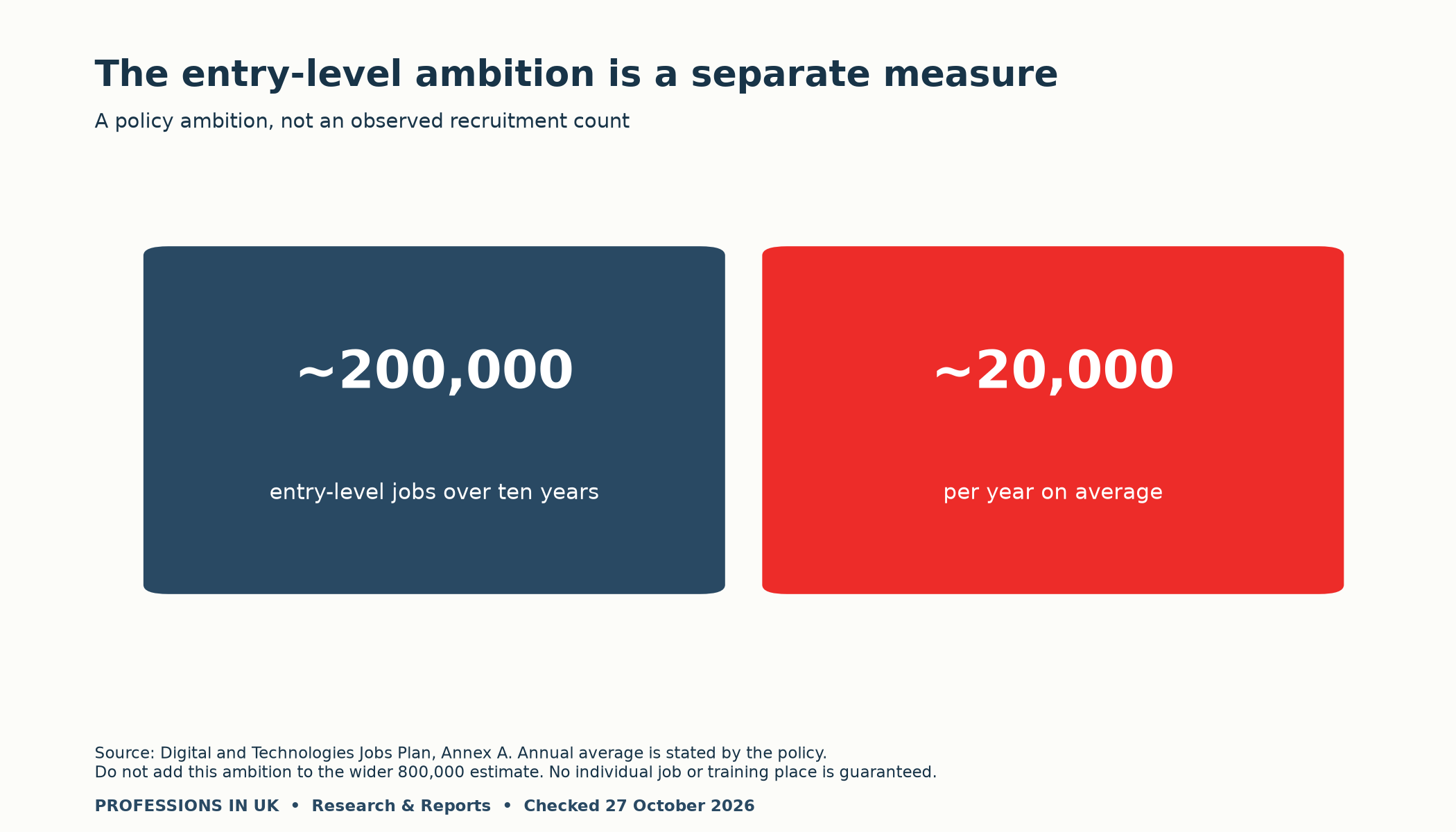
For a reader, the next step is therefore a specific check: who is offering what, where, and on which terms? A course advert may be genuine while offering no paid employment. Similarly, an employer’s future commitment may be useful without opening an application today.
Use six checks before you commit
Our verification ladder starts with the announcement and ends with documented outcomes. Move through each stage using an official page, rather than treating a social post or search snippet as the final answer.
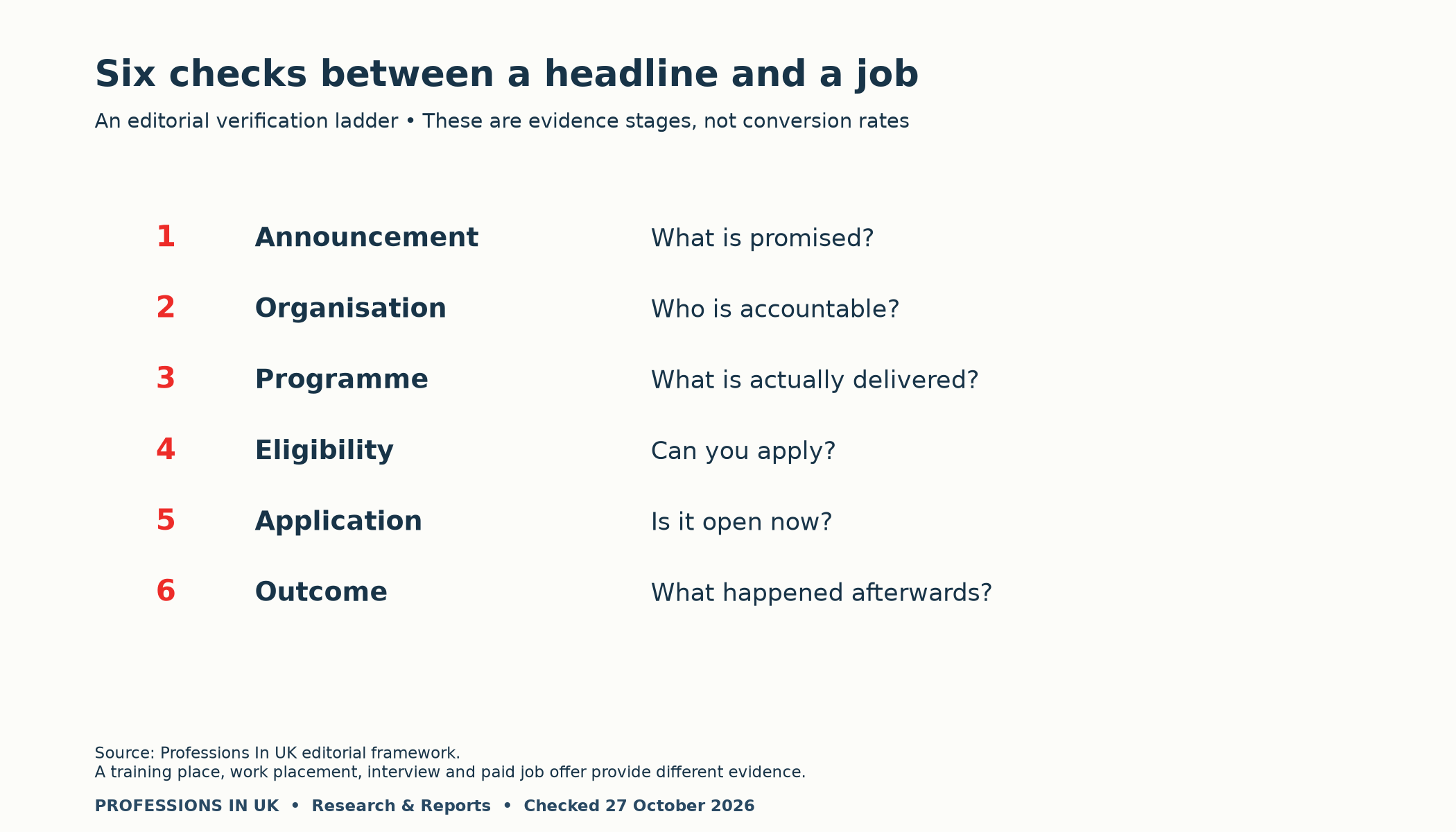
- Identify the organisation. Find its official website and check who delivers the programme.
- Name the actual programme. Record the course or vacancy reference, rather than a broad initiative.
- Check eligibility. Look for location, prior learning, required qualifications and any funding conditions.
- Check the application. Find a current closing date and a working official application route.
- Separate the offer. Is it training, work experience, an interview or paid employment?
- Ask about outcomes. Request the cohort, follow-up period and definition behind any success claim.
An interview is a chance to compete for a role. A paid job offer establishes different terms. Ask providers to state which outcome they promise, and keep the answer with your application notes.
A dated directory of five checked routes
We chose the five route types before collection: an English paid apprenticeship, an English bootcamp funding page, a Scottish digital framework, a Welsh public-sector digital intake and a Northern Irish IT framework. We used official employer, provider or public-service pages. No course commission or employer endorsement influenced selection.
England: an open paid IT apprenticeship
Enable Advisors’ IT Support Apprentice advert in Borehamwood was open when checked. It lists one position, a headline annual wage of £18,000 and a closing time of 11:59pm on 1 November 2026. Elsewhere the advert gives a £18,000–£20,000 range, so confirm the offer.
The employer names Just IT Training and a Level 3 Information Communications Technician apprenticeship. It lists GCSE English and maths at grade 4/C or above. The weekly hours are 37.5, while shifts and the training schedule need confirmation. Read the full advert before applying; this report does not establish your eligibility.
England: a funded place is not established
Northcoders’ payment page states that it currently has no funded places. Its software development and data-engineering routes list a standard price of £8,000 and an early-payment price of £7,500. That page does not establish an available cohort or a free place for you.
Before paying, request the actual start date, attendance requirements, full cost and refund terms in writing. A national training announcement cannot replace those details. Also ask which employment claims relate to the course and cohort you would join.
Scotland: a framework to match against vacancies
The Digital Technology Modern Apprenticeship describes SCQF Level 6 pathways including IT support, software development, data analytics, infrastructure and cyber security. Learners earn a wage alongside training. The expected duration is 12–24 months.
Its recommended entry conditions include Scottish school-leaving age and suitable numeracy. Employers may consider existing workplace skills, which can matter for career changers. However, the framework page does not establish a particular open job. Use its vacancy search and inspect each employer’s terms.
Personalized UK Career Consulting
Receive tailored career guidance designed just for you. Get actionable steps and expert support to boost your career in 1-3 days. Take control of your career now.
Get StartedWales: useful requirements, but a closed intake
The Welsh Government DDaT Apprentice intake, ID 4096, closed on 28 September 2026 at 4pm. Its advertised starting salary was £27,302. It is an example of requirements to study, not an invitation to apply now.
The intake set an age threshold of 16 by 1 September 2026, with no upper age limit. Civil Service nationality conditions, education status and prior qualifications also mattered. A newcomer should read those specific rules rather than infer eligibility from UK residence alone.
Northern Ireland: check employment and the contractor
The official Information Technology Level 3 framework requires employment from day one. It describes entry for a new employee or someone with their current employer for less than six months. It normally expects five GCSE Cs or equivalent, subject to assessment and employer criteria.
We verified the framework, not a current employer vacancy. Ask an approved training contractor and the employer how the route applies to you. Do not transfer Scottish qualification levels or English funding conditions into this scheme.
Prepare evidence for the role you want

Start with a small work sample linked to an advertised task. For example, an IT-support applicant could explain how they diagnosed a test-device problem and documented the steps. A software applicant could show a small project, its tests and the choices they made. These are preparation suggestions, not requirements of every employer.
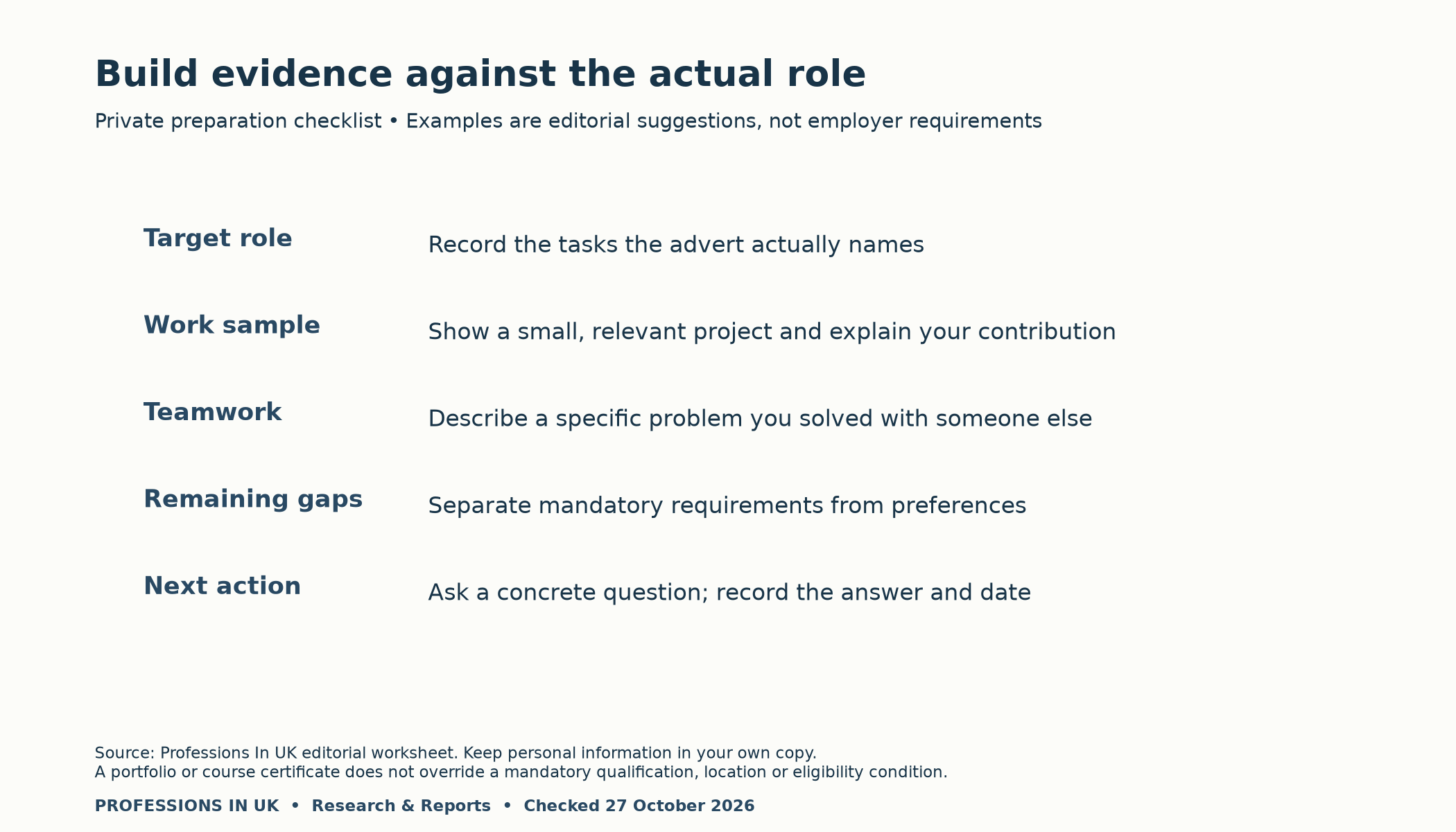
Next, prepare one specific teamwork example. Explain the problem, your contribution and what changed. Finally, list the requirements you still need to meet. Keep mandatory entry conditions separate from desirable experience so you can ask focused questions.
If you are weighing a career change, our retraining-cost study offers a separate budgeting framework. For an actual offer, the changing-jobs pay-rise analysis can help you examine extra work costs. Neither study predicts the outcome of a tech application.
Download the register and private worksheet
Get the checked tech-route register (CSV), including official URLs, status, eligibility notes, fees or pay and checking dates. Use the blank application-evidence worksheet (CSV) to keep your own next steps. No personal information is submitted to this website.
Method, change log and limits
This is the initial snapshot, checked on 27 October 2026. The next scheduled review point for the open advert is 2 November, after its stated deadline; that is a review note, not a promise of an automated update. A later revision should record the old status, new evidence and checking date.
The five routes form a purposeful comparison, not a UK-wide directory or statistical sample. We have not verified individual eligibility, submitted applications or measured employment outcomes. Status can change after checking. Official route pages remain the place to confirm current details.
The two numerical figures reproduce rounded policy measures; the other three figures show our editorial checking frameworks and route audit. They do not estimate conversion rates. Conceptual illustrations were generated with AI and do not depict actual participants. Policy material is attributed to the government under the Open Government Licence where applicable.


