





The UK IT skills shortage 2026 headline can be confusing when applications still lead nowhere. A broad job title can appear in both a shortage list and a surplus list. The useful response is to examine the actual vacancy, rather than assume that the headline predicts your chances.
This guide explains the latest report, then offers a practical way to compare requirements with evidence of your work. It includes three figures, a two-track evidence map and four free CSV tools. The audit templates are blank: no 30-advert study or candidate assessment has been completed. Research checked on 12 November 2026.
UK IT skills shortage 2026: what the report measures
The KPMG/REC release of 9 November describes responses collected from 12–26 October from a panel of about 400 UK recruitment consultancies. Six of ten monitored categories showed rising permanent demand, with IT & Computing and Engineering leading. This is an agency survey, rather than a census of every employer or vacancy.
The original KPMG/REC report records October indices of 48.7 for total vacancies, 46.6 for permanent placements and 48.9 for temporary billings. The measures describe different activities. They are seasonally adjusted diffusion indices, with 50 as the neutral point; they are not percentage growth rates.
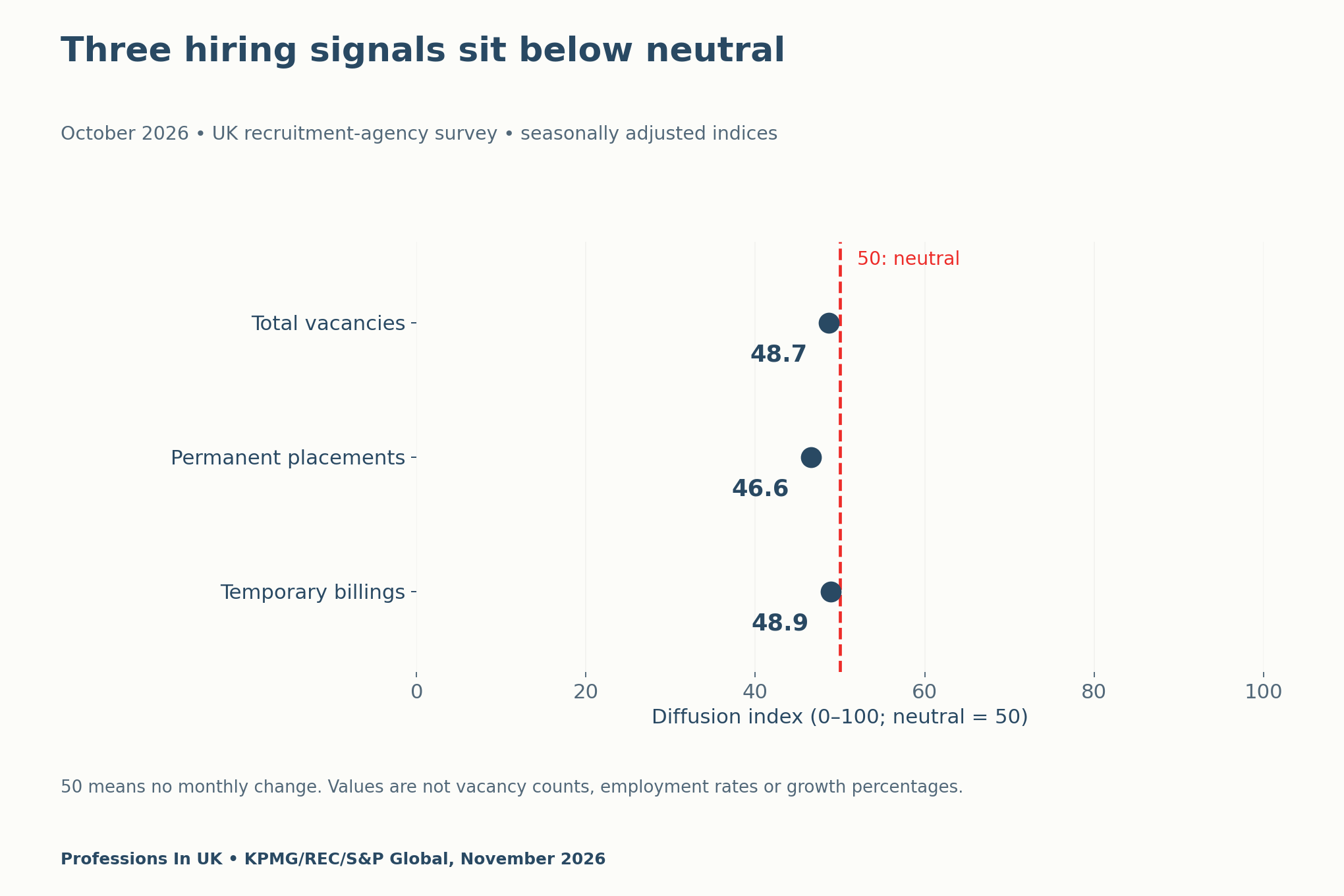
A sector signal and an overall measure answer different questions. Treating either as a personal hiring forecast skips the details that make a role suitable. For example, an applicant who can demonstrate recent infrastructure work may still lack the experience requested for a specialist software role.
Why the same IT job title can sit on both sides
On PDF page 7, three selected permanent-staff examples occur in both the short-supply and excess-supply lists: Analysts, IT Project Managers and Software Developers. The report notes differences between agencies and geographical areas. The lists do not tell us how many recruiters named each label.
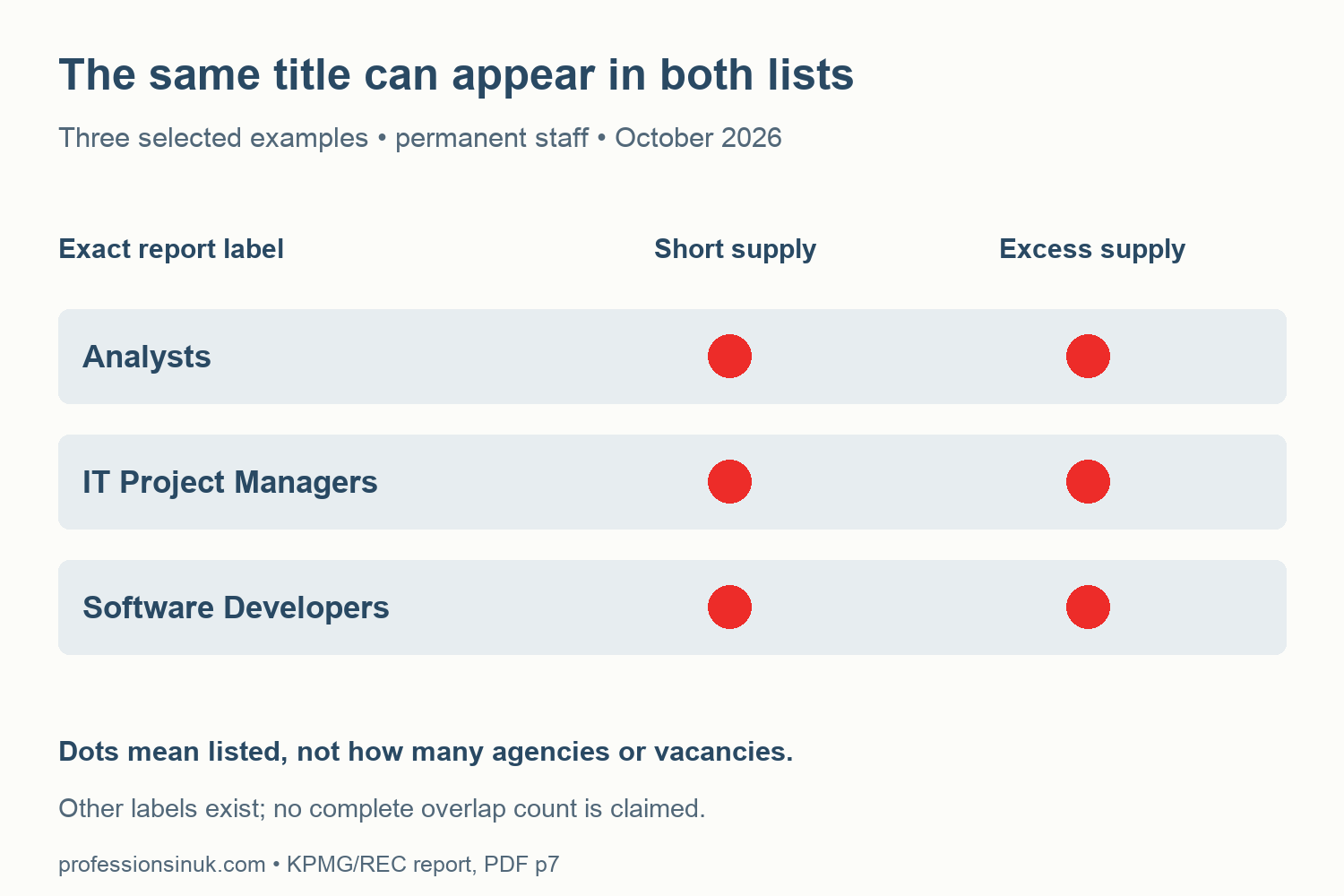
A title is a starting label, not a specification. Two adverts can use it while asking for different systems, delivery responsibilities, seniority and working arrangements. Consequently, keep the employer’s own requirements visible beside the general market story. Do not combine differently worded titles simply because they sound similar.
Nor does a surplus label make your experience worthless. It supplies no assessment of your portfolio, availability or suitability for a particular team. The task is to identify a plausible match and any unresolved requirement, not attach a market-wide verdict to yourself.
Read an index without turning it into hiring odds
For a raw diffusion index, add the percentage reporting an increase to half the percentage reporting no change. Our fictional examples below both equal 50, although their response mixes differ. Seasonal adjustment is not applied to these teaching examples.
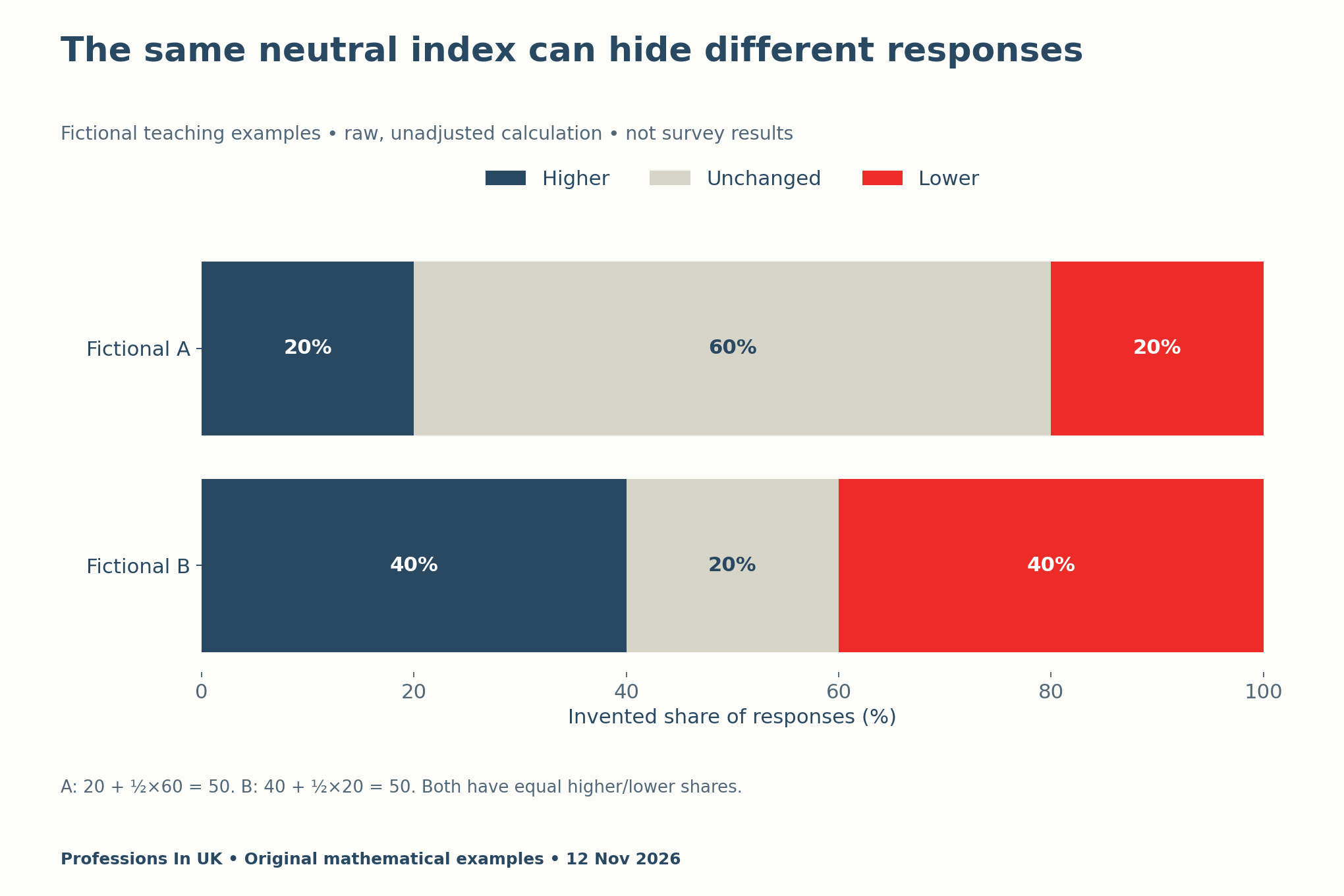
For case A, the calculation is 20 + 0.5 × 60 = 50. For case B, it is 40 + 0.5 × 20 = 50. Neither example is an estimate of the report’s actual responses. The worksheet preserves this distinction so that an explanation cannot quietly become a claim about the market.
Build a vacancy-fit comparison from the actual work
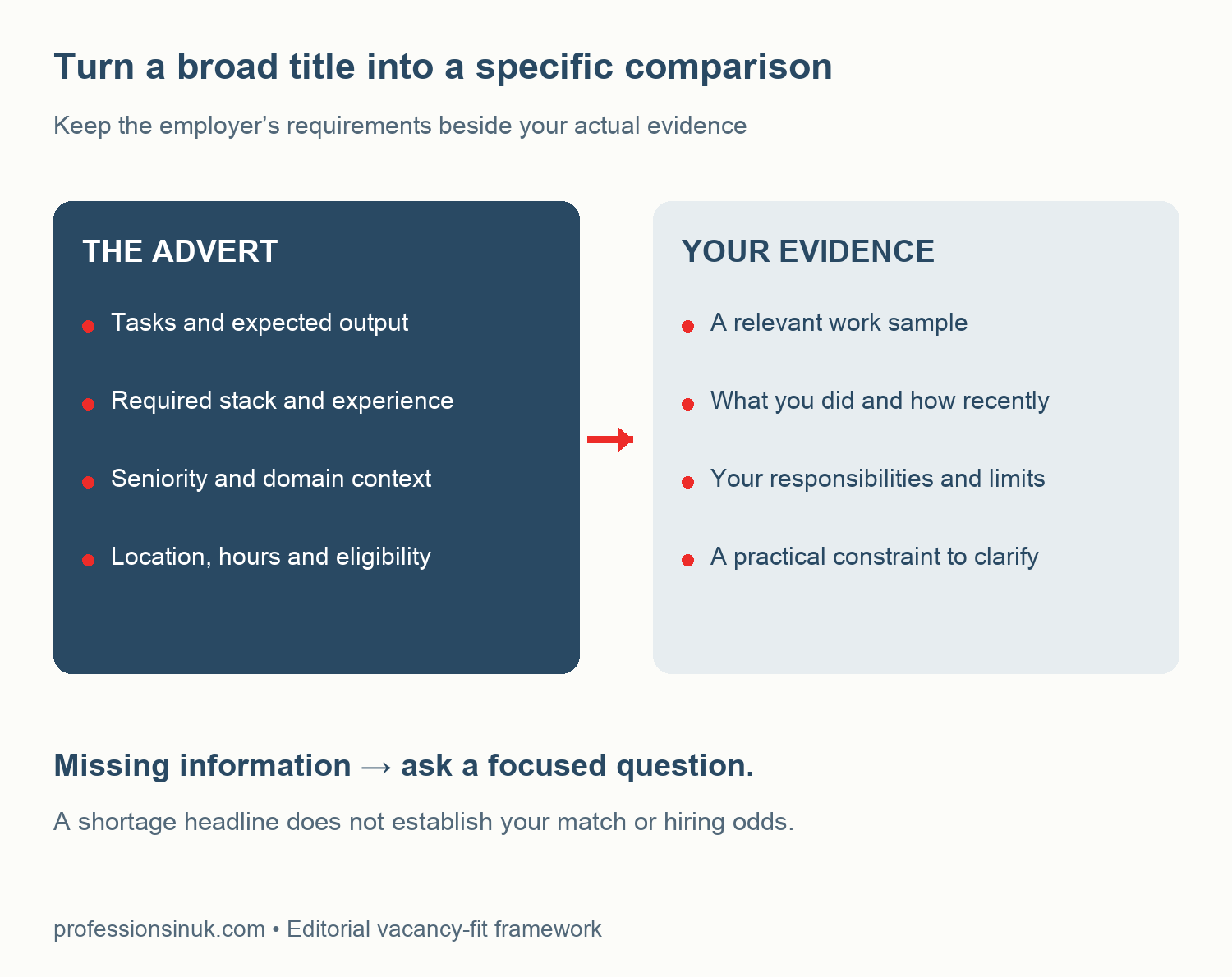
Start with the output. Does the employer need a migration plan, a maintained service, a working product or an analysis presented to decision-makers? Keep required tasks separate from a long list of preferred tools. Then record the responsibility level: contributing to a project is different from owning its delivery.
Next, select one relevant example of your work. Describe the problem, your contribution, the tools used and what you can show without breaching confidentiality. A small, inspectable example can support a claim more clearly than an unsupported list of technologies. It does not guarantee an interview.
| Requirement to clarify | Evidence to compare | Question when unclear |
|---|---|---|
| Specific technical stack | Recent relevant implementation or safe demonstration | Which components are essential on entry? |
| Seniority and responsibility | Your own role and decision boundaries | What would this person own in the first months? |
| Location or attendance | Your realistic travel and working constraints | Which attendance pattern is required? |
| Experience or eligibility | What the advert actually states | Is this mandatory, preferred or still undecided? |
Finally, check the conditions that affect whether an application is practical. Confirm location, hours, contract type and stated eligibility. Keep an unresolved item as unresolved. Our guide to salary ranges in UK job adverts explains how to compare pay on the same hours basis.
Use a shortlist without inventing a success score
The blank ledger gives you a record of the advert, its retrieval date and the evidence you could discuss. Use it to choose where further clarification or preparation is worthwhile. Do not turn the number of checked boxes into a supposed probability of success.
If a requirement appears repeatedly in your own collected adverts, investigate it before buying training. Ask whether the proposed learning addresses that specific gap and offers a suitable way to demonstrate it. A certificate, course advertisement or shortage headline alone cannot establish that an employer will hire you.
Personalized UK Career Consulting
Receive tailored career guidance designed just for you. Get actionable steps and expert support to boost your career in 1-3 days. Take control of your career now.
Get StartedYou can also use our guide to presenting self-taught skills on a UK CV to distinguish learning activity from evidence. Keep examples honest about their setting, limitations and your individual contribution.
Download the data, examples and audit tools
The source file records the three indices and selected label-presence observations. The second file shows the fictional index arithmetic. The blank vacancy ledger and audit protocol support your own collection; they contain no observed advert results or candidate ratings.
- Selected report measures and label observations (CSV)
- Fictional neutral-index calculations (CSV)
- Blank 30-advert vacancy-fit ledger (CSV)
- Prespecified local advert-audit protocol (CSV)
Methodology and limitations
We checked the dated release, original PDF and its table layout. We retained permanent versus temporary distinctions and selected three exact permanent-role labels. No exhaustive text-matching study, employer advert sample or application experiment was performed. The figures do not establish occupation-level vacancy totals, salary premiums or individual hiring probabilities.
For a future local audit, declare the geography, date and title rules before collection. Target ten unique employer adverts per selected title, deduplicate employer/requisition pairs and report the actual sample. Keep undisclosed terms and closed adverts visible. A convenience sample describes its collected adverts, not the whole UK market.
Suggested citation: Professions In UK (12 November 2026), “UK IT Skills Shortage 2026: Why Job Titles Can Mislead”, original vacancy-fit tools and mathematical examples, with KPMG/REC/S&P Global November 2026 sources. Credit the original report when reusing its findings.


