





Salary ranges in UK job adverts help you decide whether an application is worth your time. However, the range alone may leave the starting offer, contracted hours and guaranteed base pay unclear. Record those details separately before comparing one role with another.
The practical question is simple: what amount could this job actually pay you for the hours and terms on offer? A £30,000–£36,000 band has a £6,000 spread. Its midpoint is £33,000, but neither that midpoint nor the top of the band is a promise.
This report separates the November 2026 policy announcement from historical survey evidence. It also provides three charts, a question map and four free CSV resources. All worked salary examples are fictional. Research checked on 12 November 2026.
Salary ranges in UK job adverts: what was announced?
The government’s 5 November announcement proposes requiring salary information in job adverts. It says legislation will be brought forward. That announcement does not provide a settled commencement date or all the implementation details. Treat the new requirement as proposed, rather than judging an employer unlawful solely because an advert currently omits pay.
Separately, the CMA’s response published on 10 November discusses two possible designs: a binding minimum, or a range with a binding minimum and an indicative upper limit. These are recommendations about policy design. They do not settle the final legal wording, coverage or enforcement arrangements.
For an applicant, the useful next step does not depend on predicting legislation. Ask for the actual starting-pay range and retain the employer’s response. Recheck official guidance when a specific legal entitlement or complaint depends on it.
Read the historical salary-disclosure figures correctly
The original CIPD report, printed page 30, records 41% always publishing ranges in external adverts and 18% always publishing specific salaries externally. Its weighted online survey covered 832 UK decision-makers, with fieldwork from 3–24 October 2023. The report was published in February 2024.
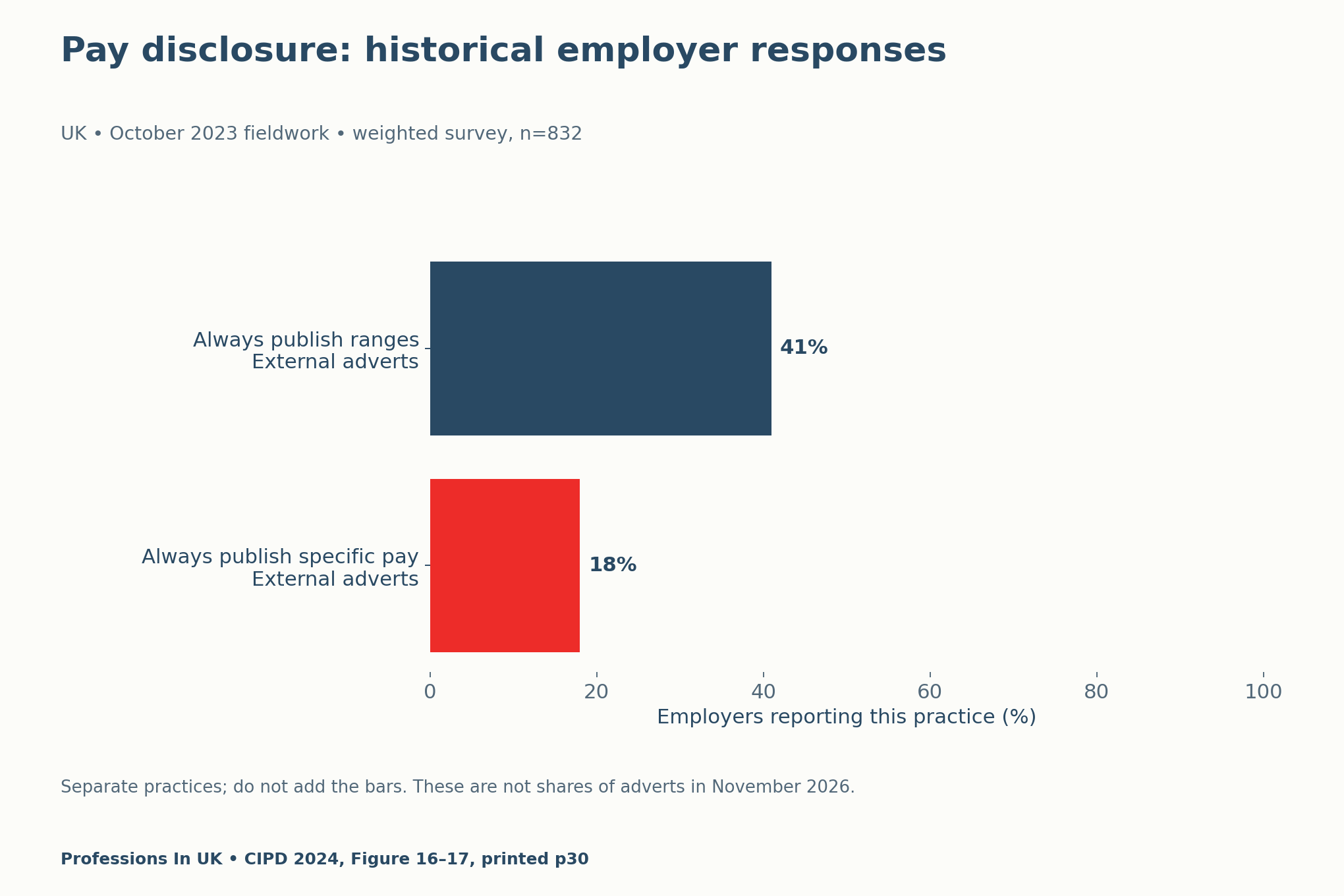
This distinction changes what the headline can answer. A survey of employers is not a count of vacancies, and its collection date is not the date of the policy announcement. Nor do two separate practice questions reveal the probability that your next application will disclose pay.
CIPD’s web summary refers to internal adverts for the 18% claim. We use the original PDF’s explicitly external-advert figure here, rather than mixing the two question contexts. The source file records that choice so readers can reproduce it.
Compare salary ranges in UK job adverts on the same hours
First, write down whether the amount is full-time equivalent, often shortened to FTE. If a fictional role quotes £30,000–£36,000 FTE and offers 0.8 of the full-time hours, a proportional-pay assumption gives £24,000–£28,800 actual annual gross pay. Confirm that assumption with the employer; do not silently treat the advertised number as your contracted amount.
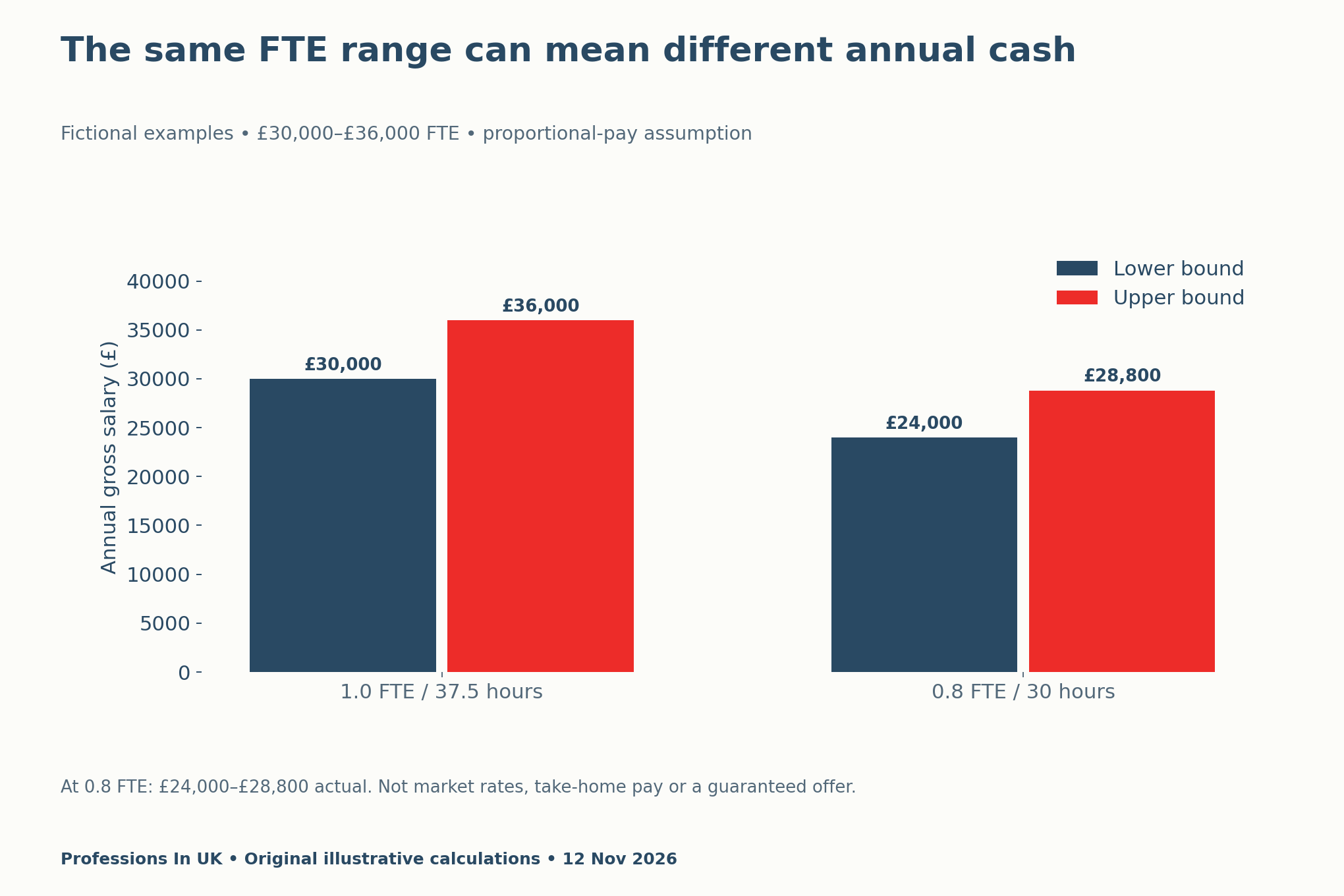
The lower-bound calculation is £30,000 × 0.8 = £24,000. At the upper bound, £36,000 × 0.8 = £28,800. Both examples assume the same full-time reference week of 37.5 hours, making 0.8 FTE equal to 30 contracted weekly hours.
Next, keep the hours definition visible. Paid breaks, overtime, shift premiums and weeks worked can change a comparison. If any of these is unclear, leave the relevant field unresolved. A neat spreadsheet should not conceal a missing contract term.
Keep guaranteed salary separate from variable pay
Consider two further fictional offers. Offer A has £30,000 guaranteed base and an assumed £6,000 variable component. Offer B has £34,000 base and an assumed £2,000 variable component. Both reach £36,000 only when the full contingent sum is paid. Their guaranteed amounts differ by £4,000.
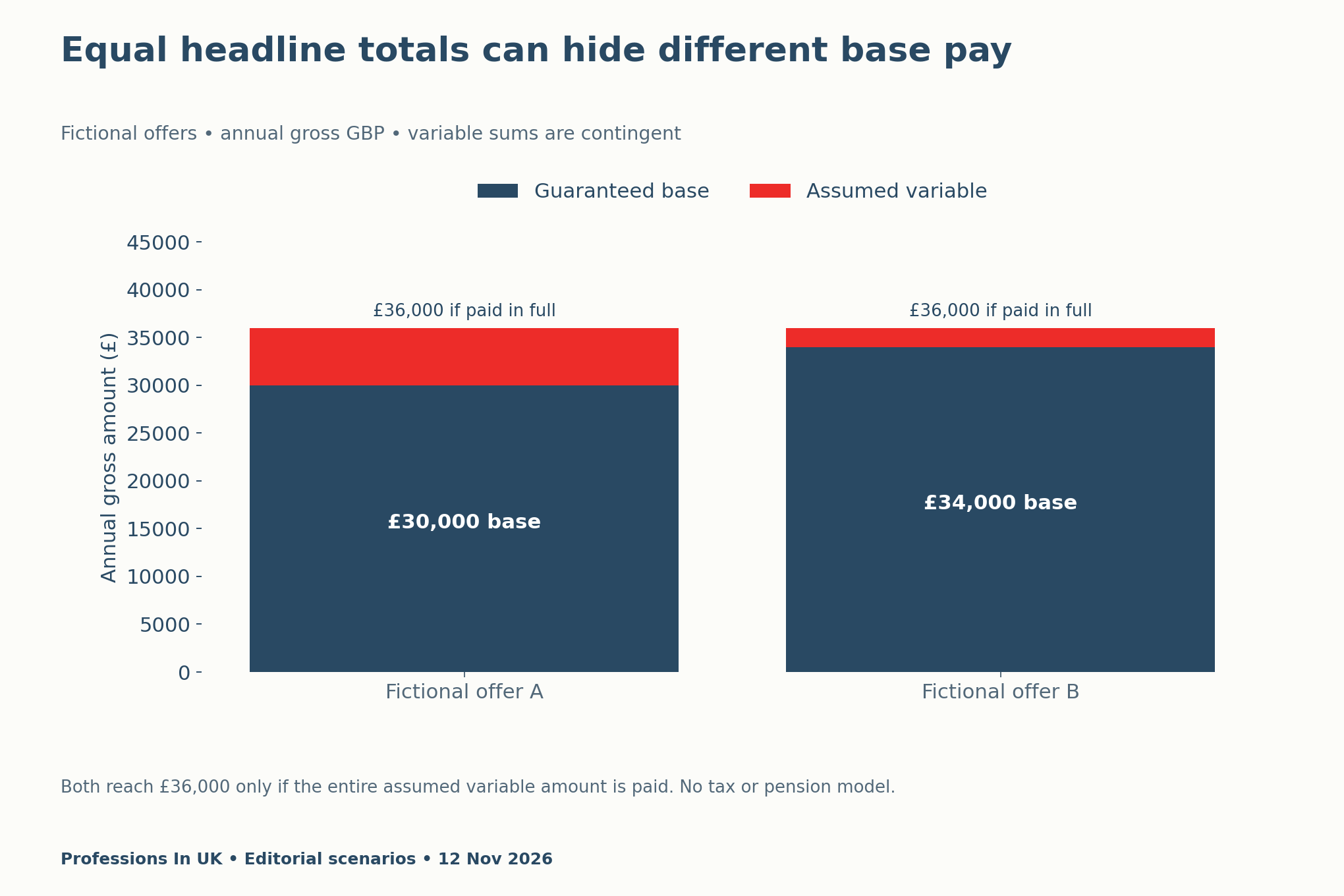
Therefore, ask what the advert includes in its total. Record commission, discretionary bonuses and guaranteed allowances on separate lines. If the employer supplies target earnings, ask what conditions apply and where the supporting terms can be read. Do not invent a payout probability to turn a target into expected cash.
This is especially useful when a move must cover recurring household commitments. Compare the confirmed base with those commitments first. Then consider variable rewards, pension terms, leave, travel and flexibility using their actual conditions. This worksheet does not calculate tax, benefits eligibility or a personalised budget.
Personalized UK Career Consulting
Receive tailored career guidance designed just for you. Get actionable steps and expert support to boost your career in 1-3 days. Take control of your career now.
Get StartedQuestions to ask about salary ranges in UK job adverts
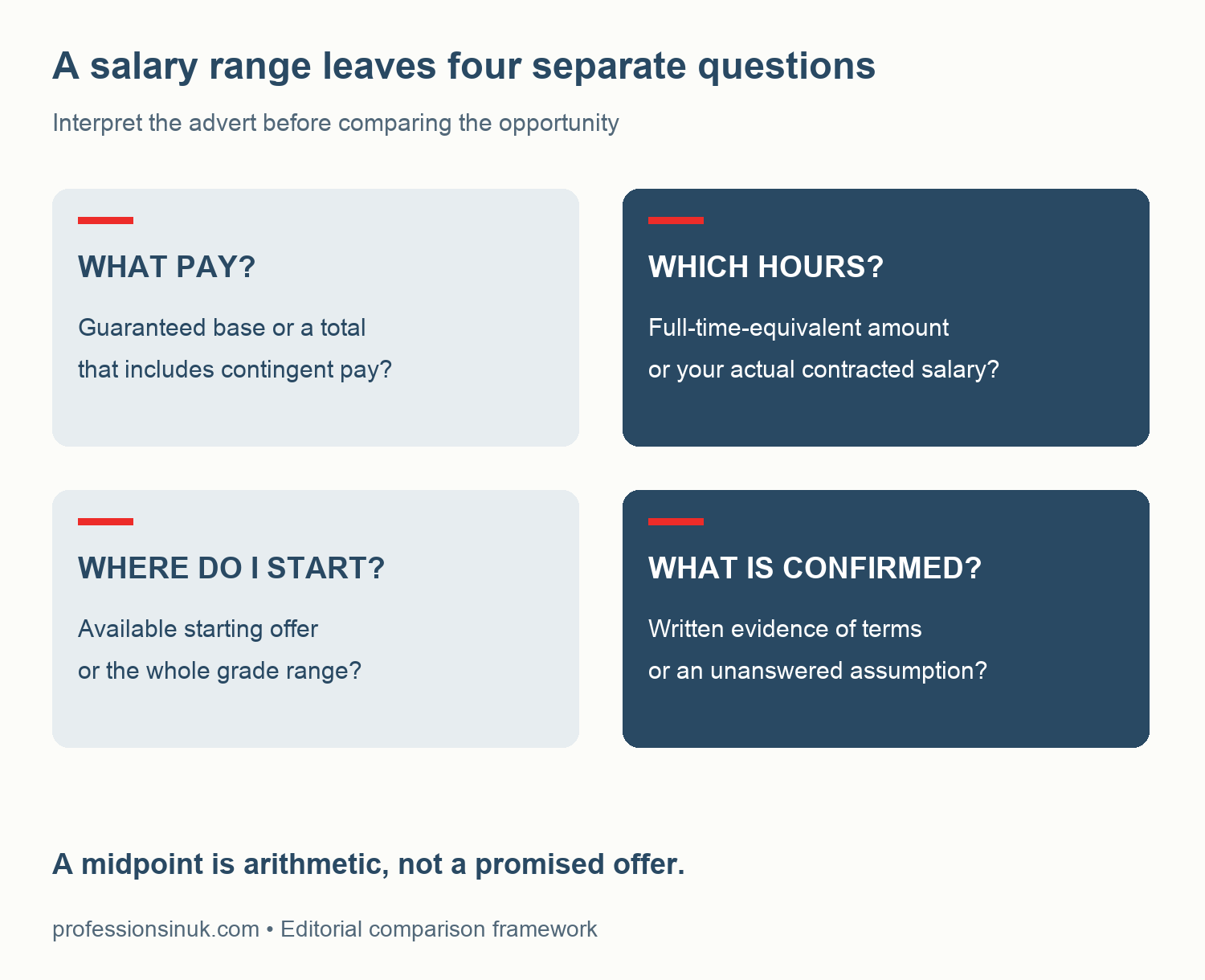
Ask whether the published band covers the available starting offer or a whole grade. A grade maximum may concern later progression. Also ask how the employer determines an entry point and whether the same rules apply to every location or working arrangement. Record the answer without assuming where you would be placed.
A concise message can ask: “Could you confirm the starting base-pay range, whether it is FTE or actual contracted pay, and the weekly hours? Please also identify any variable component included in the advertised amount.” Add one role-specific question, rather than sending a long generic checklist.
| Advert detail | What to record | Do not assume |
|---|---|---|
| £30,000–£36,000 | Currency, annual basis and both bounds | An offer at £33,000 or £36,000 |
| Pro rata / FTE | Full-time reference and contract fraction | The headline is actual part-time cash |
| Up to / target earnings | Guaranteed base and contingent terms | The target will be paid |
| Grade range | Available starting band and progression rules | Every point is available on entry |
Our related guides to changing jobs for a pay rise and pay after rent when moving for work can help you broaden the comparison. Use current employer terms for the final decision.
Download the source data and comparison tools
The source-data file preserves the two historical measures and their question context. The scenario sheet contains the explicit FTE calculations. Use the blank comparison ledger for actual adverts and the protocol for a possible 60-advert study. Empty rows are not completed observations.
- Historical external-advert source data (CSV)
- Fictional FTE comparison calculations (CSV)
- Blank advert and offer comparison ledger (CSV)
- Prespecified 60-advert audit protocol (CSV)
Methodology, limitations and suggested citation
We checked the dated government announcement, the CMA response and the original CIPD PDF. Our arithmetic uses range width = upper minus lower; width as a percentage = width divided by lower × 100; actual annual salary = FTE amount × contract fraction. The £6,000 example width is 20% of £30,000. Formulas do not establish an offer or a legal entitlement.
No 60-advert audit, applicant survey or employer compliance test was completed. The protocol proposes ten unique adverts in each of six preselected job-family/location cells. It retains missing-pay adverts and deduplicates employer/requisition pairs. Any future convenience sample would describe only the collected adverts, with exclusions and dates reported.
Historical employer responses cannot establish current disclosure rates, applicant outcomes or the effect of a proposed law. The fictional examples are teaching aids, not salary benchmarks. Source versions and legal status may change; confirm the current position before relying on a specific requirement.
Suggested citation: Professions In UK (12 November 2026), “Salary Ranges in UK Job Adverts: Check the Starting Offer”, original comparison tools with CIPD 2024 and November 2026 government/CMA sources. Cite the original evidence alongside reused statistics.


