







UK quantum PhD industry training needs a closer check than a programme name or partner logo. Ask whether the course offers a placement, an industry-linked project or an industrial supervisor. Then ask what the current written terms actually guarantee. These mechanisms can offer different kinds of experience.
A new independent evaluation gives useful historical context. It reviews approximately £300 million of EPSRC quantum investments from 2014 to 2024. However, its training figures are not a current list of funded places. Nor can they tell an applicant their chance of admission or employment.
This report preserves the funding categories, checks two illustrative official pages and provides a blank comparison pack. It does not rank universities or claim to have audited every UK programme. Research checked on 8 November 2026. The featured image is an AI-generated concept of research connecting to industry, not a real programme facility.
What the new quantum evaluation covers
UKRI published the quantum hubs and skills evaluation on 5 November 2026. Fortia Insight’s report examines Research Hubs, Training and Skills Hubs and Centres for Doctoral Training. These structures support different activities, so their figures need their original labels.
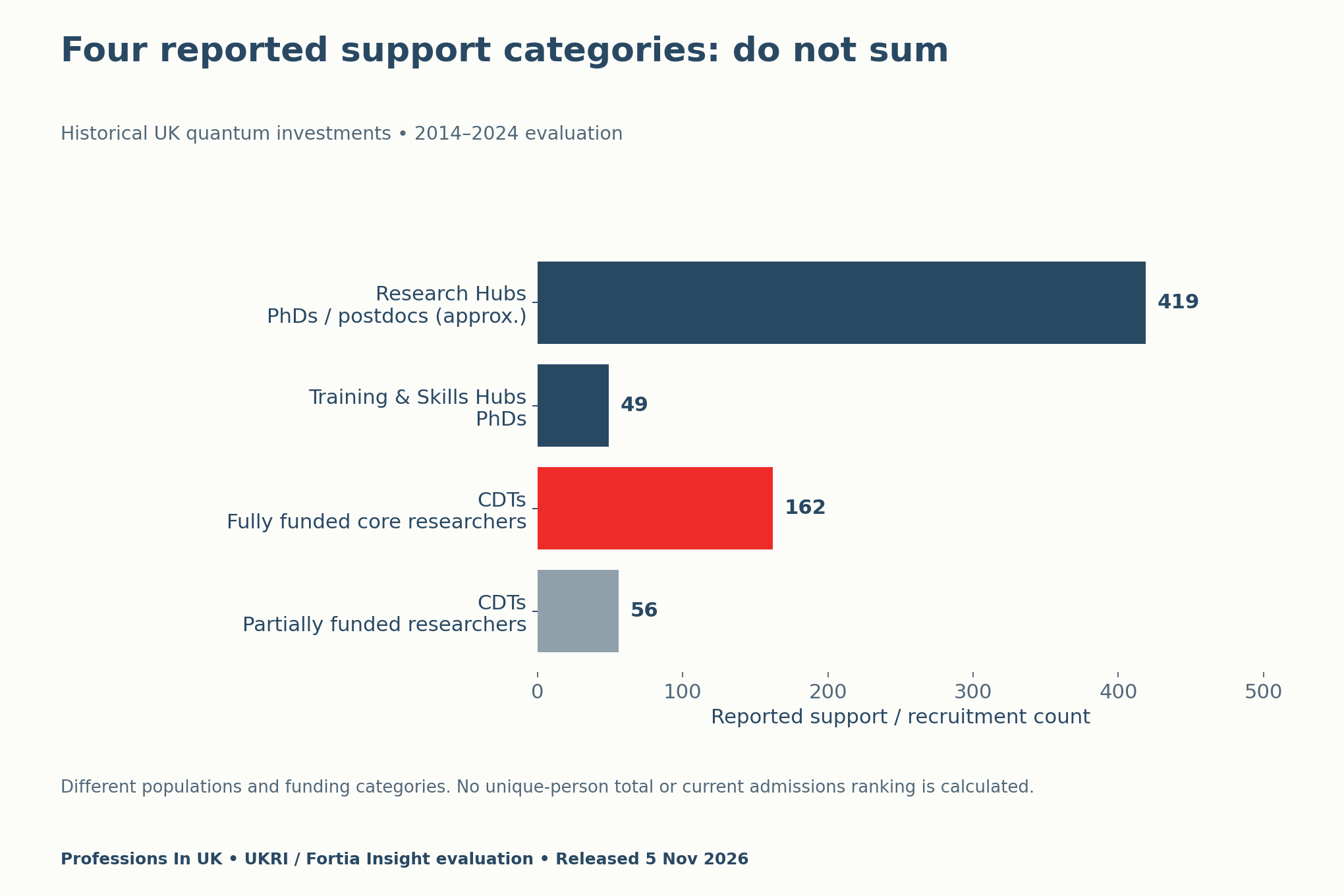
| Programme category | Reported count | What the label retains |
|---|---|---|
| Research Hubs: PhDs/postdocs | 419 | approximate supported count |
| Training & Skills Hubs: PhDs | 49 | supported count |
| CDTs: fully funded core researchers | 162 | recruited count |
| CDTs: partially funded other researchers | 56 | partially funded count |
A supported researcher is not necessarily a completed PhD. Similarly, partial funding is not the same as a fully funded core place. The report does not resolve every possible overlap for a combined total. Consequently, our comparison leaves the categories separate and avoids a grand total.
Read the training counts before using them as outcomes
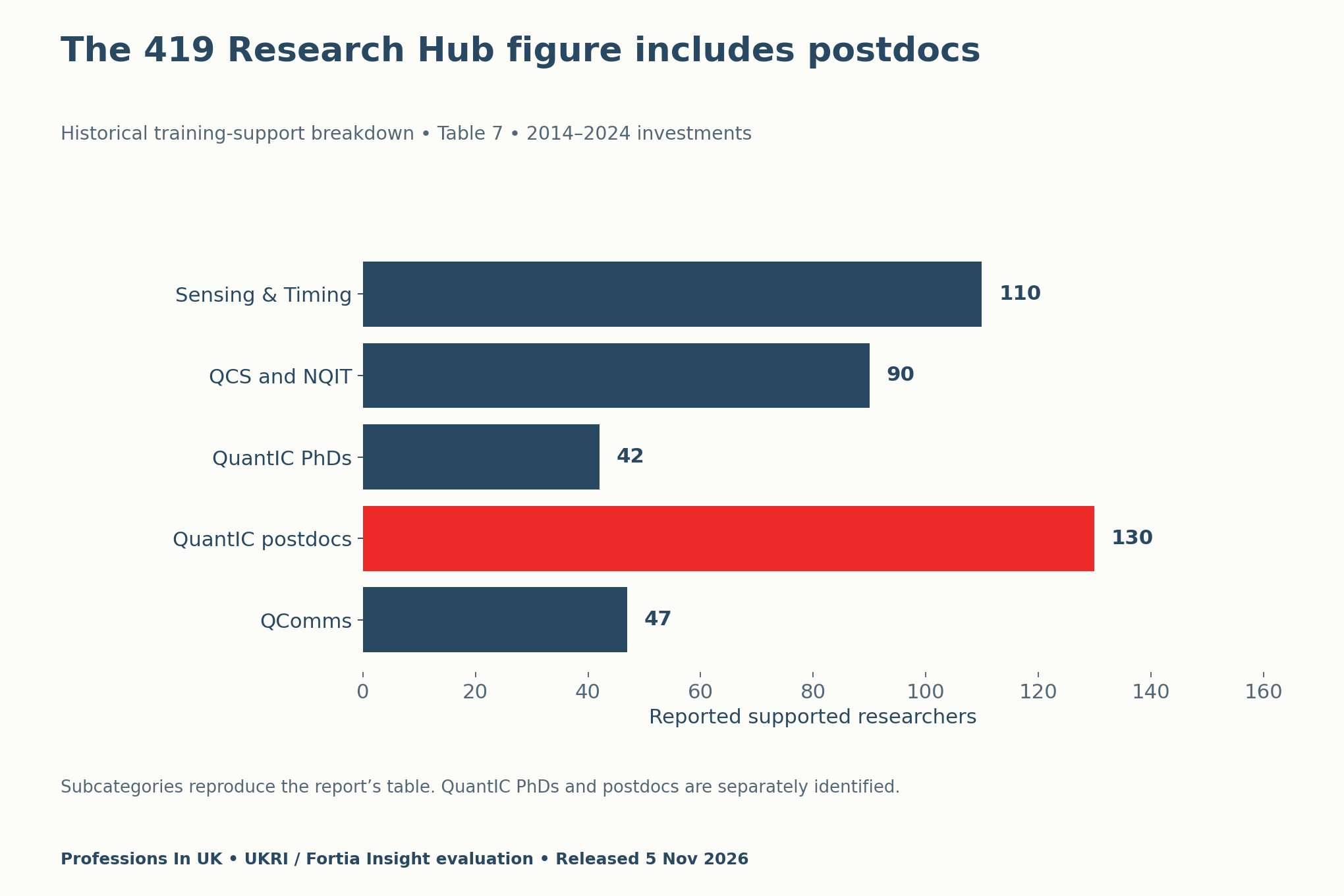
The Research Hub breakdown makes the unit problem concrete. QuantIC contributes separate PhD and postdoc entries. Calling the full 419 “new PhD graduates” would lose that distinction. We reproduce the table’s categories without estimating completion rates, funding per student or present-day capacity.
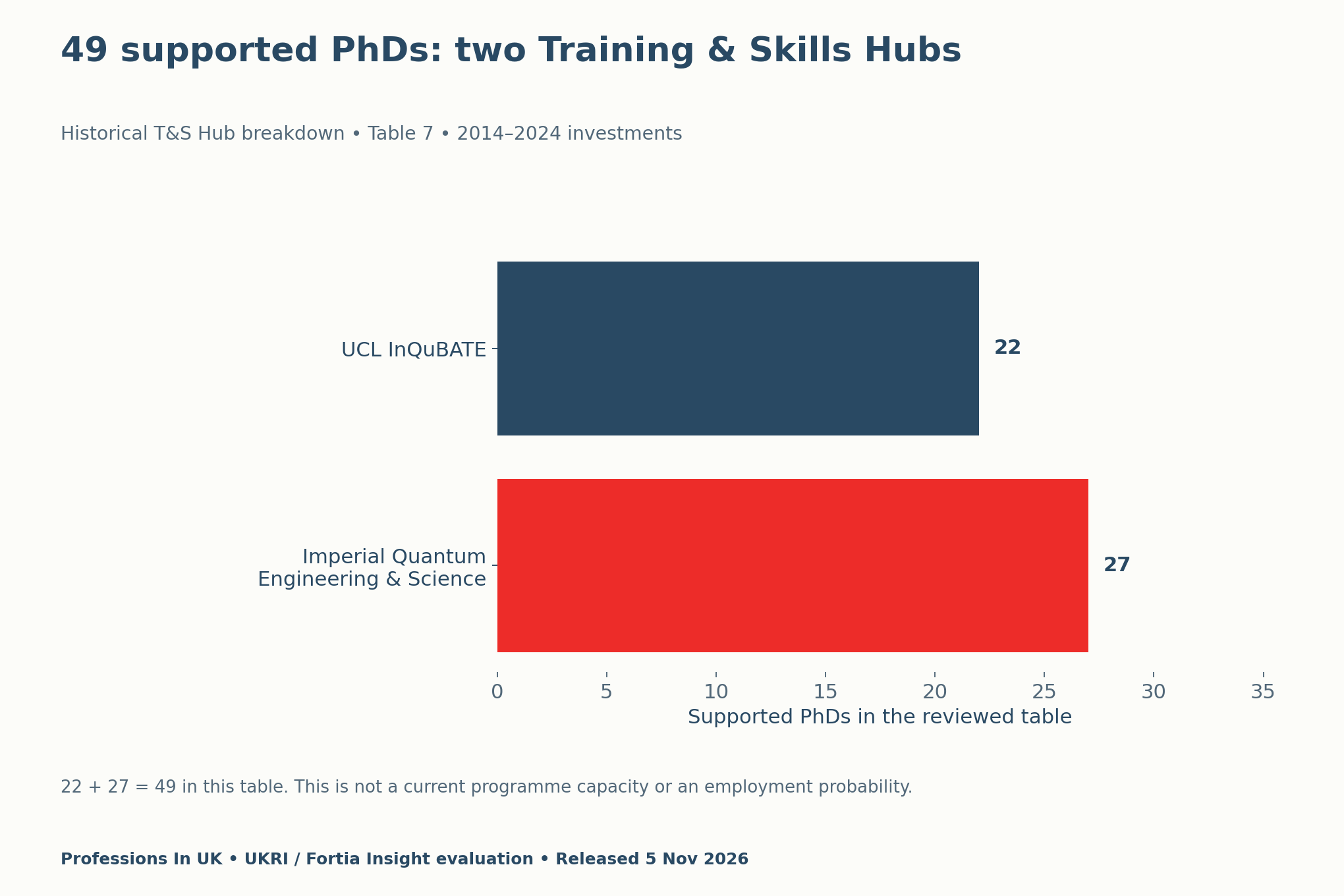
These two counts describe the reviewed investments. A larger historical count does not establish stronger supervision for a particular project. Nor does it show that either route has an open place now. Applicants need current programme information and an individual funding offer for those questions.
Compare three mechanisms of industry exposure
The evaluation identifies placements, co-funded projects and industry supervision as ways researchers encountered practical applications. Its qualitative findings help frame questions. They do not guarantee that every programme supplies every mechanism, or that a partner logo means a student will work with that organisation.
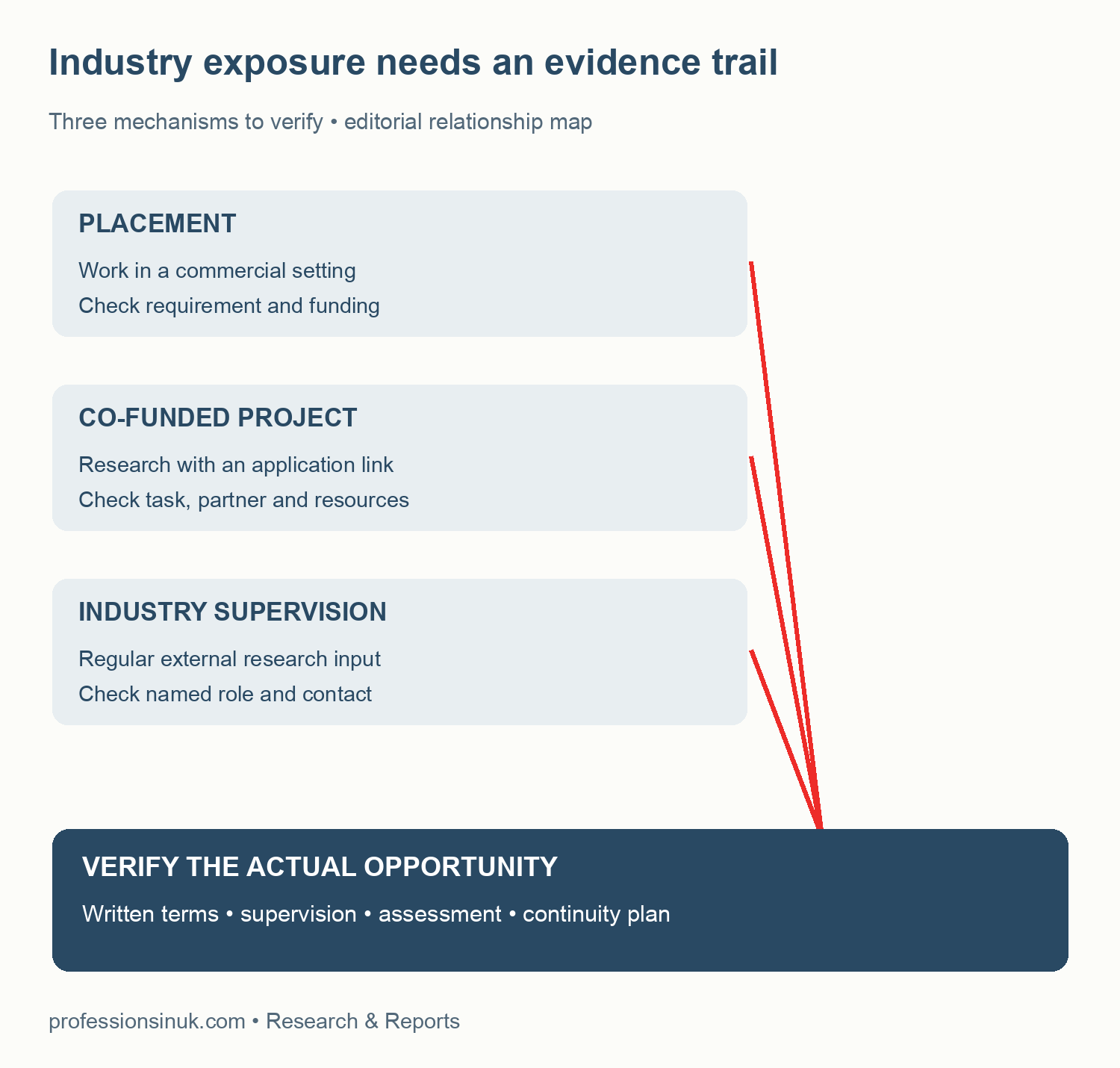
A placement can offer experience of a commercial environment. An industry-linked project can connect a research question to an application. An industrial supervisor can provide external input over time. However, those descriptions leave important questions unanswered: duration, funding, contact frequency, task ownership and what happens if a partner leaves.
Two official-page examples show why wording matters
The Quantum Technology Engineering CDT placement page states that students undertake a 12-week placement at the end of their first year. It also says placements are not usually directly associated with the PhD project. That is a useful distinction between commercial experience and project-specific research activity. Confirm the current cohort’s arrangements in writing.
Meanwhile, Bristol’s legacy QE-CDT application page says that programme has recruited its final cohort and points readers to QIST CDT. It lists funded internship or placement opportunities for the new route. Older fee material remains further down the page. Therefore, follow the current programme link instead of treating legacy text as current funding terms.
| Observed page wording | What it supports | What still needs checking |
|---|---|---|
| 12-week placement at end of first year | A specified placement structure on the QTE page | Current cohort terms, funding and placement task |
| Funded internship / placement opportunities | An opportunity described for QIST on Bristol’s page | Availability, selection, funding details and current programme terms |
| Old programme no longer accepting applications | A programme transition is explicitly flagged | Which current route and application page apply |
UK quantum PhD industry training: questions for supervisors
Start with scientific fit. Ask who will supervise the research, which facilities the project needs and how access works. Then separate the academic research plan from the industry activity. A good answer should identify the activity and who is responsible for arranging it.
Next, check whether the placement is required, optional, competitive or simply encouraged. Ask whether its time, travel and any relocation costs are funded. In addition, request the written terms for intellectual property, confidentiality and publication. This article does not interpret those terms as legal advice.
Finally, ask about assessment and continuity. What output, reflection or project review records the learning? Who supports the student if a partner withdraws? A dated unanswered question is more useful than an unsupported tick. Keep “not stated on the page” separate from “not offered”.
Our guide to turning learning into evidence explains the difference between an activity and an assessable output. For a broader career change, consider our retraining budget framework. Doctoral study has its own entry and funding requirements, so check the actual offer rather than borrowing assumptions from a short course.
Personalized UK Career Consulting
Receive tailored career guidance designed just for you. Get actionable steps and expert support to boost your career in 1-3 days. Take control of your career now.
Get StartedDownload the comparison pack
The historical counts file preserves categories and source pages. The ten-row programme matrix is blank for your own prospective comparison; it is not a completed ten-programme audit. The question sheet and two-page example register make the distinction between observed statements and unresolved terms explicit.
- Historical training counts and categories (CSV)
- Blank quantum programme comparison matrix (CSV)
- Industry-exposure questions worksheet (CSV)
- Two official-page wording examples (CSV)
Methodology and limits
We transcribed the support categories and Table 7 breakdowns from the independent evaluation. We checked that the Research Hub entries sum to 419 and that the two Training and Skills Hub entries sum to 49. Those checks reconcile each table; they do not establish a deduplicated total across programmes.
The evaluation is retrospective. Its selected-respondent progression findings are not university league tables or an individual’s employment probability. We also avoid its wider aggregate jobs and spinout figures here. The article has not conducted a current admissions audit, measured graduate earnings or established a universal technician pathway. Programme terms and partner arrangements can change.
Suggested citation: Professions In UK (8 November 2026), “UK Quantum PhD Industry Training: Check the Placement Evidence”, using UKRI’s independent evaluation of EPSRC quantum investments, 2014–2024. Cite the original evaluation when reusing historical figures and date any programme-page observations.


